


In a four-year mesocosm experiment conducted in southern Germany, grasslands containing legumes and non-legume forbs showed a weak negative association between legume-forb cover and dry matter yield, while metabolizable energy generally tended to increase with greater legume-forb cover. The forage-energy pattern was not universal: one of four plant “toppings” showed the opposite relationship, and the strength of the association depended on the topping and grass mixture. Harvest season was the dominant influence on both productivity and forage quality. Biomass was highest in spring and lowest in autumn, whereas autumn forage had the highest metabolizable energy. These findings describe associations in experimental grassland communities rather than a general benefit from adding broad-leaved plants to agricultural seed mixtures.
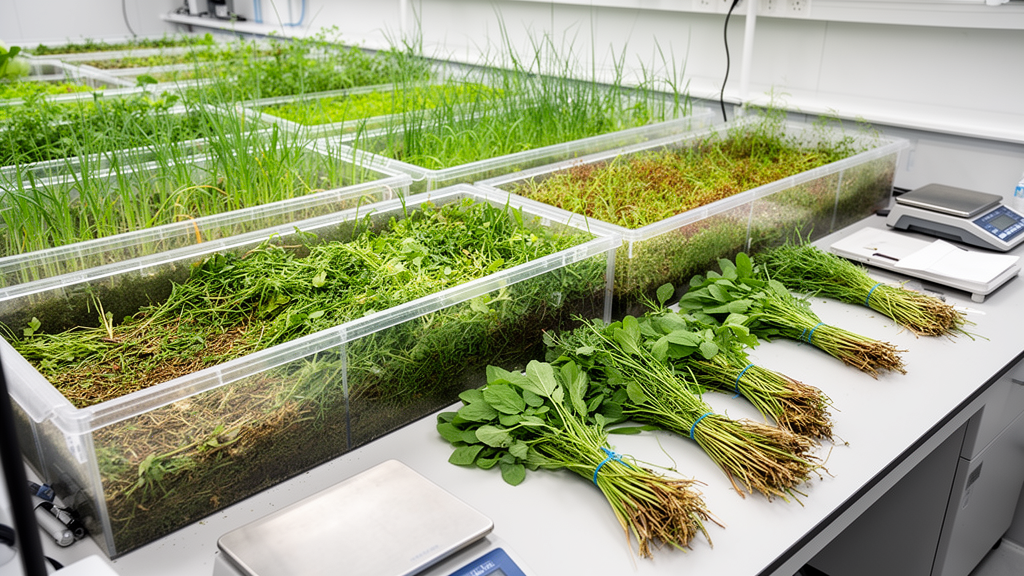
The experiment involved 64 containers filled with 64 litres of local soil and placed at a managed grassland site in Hohentengen in southern Germany. Eight treatments combined two commercial grass mixtures, called D1 and D2, with one of four 10-species toppings containing legumes and forbs. Each treatment had eight containers distributed across four randomized blocks. Three additional containers were left as bare-soil controls to check for plants emerging from the resident seed bank. None of the deliberately introduced species appeared in those controls, although minor amounts of unsown Rumex, Taraxacum and Cirsium were found in some containers and removed. One container failed to establish and was excluded, leaving 63 mesocosms in the final analyses.
Each topping shared a seven-species base that represented 80% of the mixture, with three additional species making up the remaining 20%. The four designs varied the proportions of legumes and forbs and included combinations of red clover, white clover, bird’s-foot trefoil, yellow lucerne and non-legume herbs. The grasses included agriculturally valuable forage species such as cocksfoot, tall oat-grass, perennial ryegrass, meadow fescue, timothy and red fescue. Seed was obtained from three producers in Germany and used local provenances. Grass seed was sown at 2.4 grams per square metre and topping seed at 1 gram per square metre. The containers were exposed to ambient weather on geotextiles, with the surrounding vegetation mown regularly.
To represent medium-intensity grassland management, the planted communities were cut three times each year, beginning in October 2020 and continuing through June 2023. The first cut generally occurred in late May or early June, the second in mid-August and the third in late September or early October. Each harvest was timed to the peak flowering stage of the dominant grasses, determined through weekly checks of marked tillers. Vegetation within a fixed 7-centimetre frame was cut, weighed and dried at 35–38 degrees Celsius before dry matter was determined. Standard NPK fertiliser was applied after harvests according to agricultural practice, with split applications in years two and three based on an estimated nitrogen requirement of 180 kilograms per hectare.
Plant establishment, community composition and functional diversity were monitored across three annual harvests. Surveys before cutting recorded cover of grasses, legumes, non-legume forbs and bare soil, as well as species-level abundance on the Braun-Blanquet scale. Functional richness, evenness and divergence were calculated from seed mass, canopy height and leaf area, representing dimensions associated with regeneration, light competition and resource acquisition. These ecological traits were not direct measures of nutritional quality. Forage was analysed for gas production, crude protein, crude lipid, crude ash and acid-detergent fibre, then converted to metabolizable energy, or ME, in megajoules per kilogram of dry matter. Dry matter yield was recorded separately for each mesocosm, but biomass from the eight replicates within a treatment was pooled before chemical analysis.
Nine of the 13 introduced legumes and forbs established over the four years. Red clover, cleavers, bird’s-foot trefoil and ribwort plantain were the most abundant, followed by smooth hawksbeard, field scabious, red campion, oxeye daisy and self-heal. Kidney vetch and meadow cranesbill did not emerge, while pimpinella and yellow lucerne produced very few individuals. The number of established species represented in all treatment combinations declined over time, but it did not differ among the four toppings. The experiment therefore showed partial establishment of the introduced broad-leaved plants, alongside continuing dominance by productive forage grasses and uneven persistence among the non-grass species.
Dry matter yield declined significantly as legume-forb cover increased, with the negative association most consistent in spring and autumn for both grass mixtures. The effect was weak relative to the much larger effect of harvest season. Spring yields exceeded those from summer and autumn, while summer responses varied more among toppings. Functional richness was positively associated with yield during spring harvests across the treatment combinations, but that relationship became variable in later years and depended on the topping and grass mixture. Functional evenness and divergence also had inconsistent effects on biomass, sometimes changing sign among treatments and harvest seasons. The model’s season effect for dry matter yield was therefore much stronger than the associations involving composition or functional-diversity indices.
For forage quality, ME ranged from 10.0 to 11.5 megajoules per kilogram of dry mass per year. Across toppings, ME tended to increase with legume-forb cover, but the relationship differed among the four designs: the positive pattern was observed for toppings B through D, while topping A showed a decrease in ME as cover increased. FEve tended to be associated with lower ME across toppings, although topping C showed the opposite pattern. FDiv had a positive relationship with ME only in selected combinations, including topping C with grass mixture D1 and topping A with mixture D2. A significant interaction among topping, grass mixture and harvest season confirmed that these responses were context-dependent. The study therefore found no general positive relationship between the measured functional-diversity indices and forage energy.
The seasonal contrasts were pronounced. ME was relatively similar across the eight treatments in spring and autumn, with overlapping confidence intervals and no significant pairwise differences. Summer cuts produced the clearest treatment differences: ME generally decreased relative to the other seasons, particularly for topping D within grass mixture D1, and significant differences occurred between toppings A and D within that grass mixture. A structural equation model estimated a positive direct association between legume-forb cover and ME, with a coefficient of 0.16, as well as positive associations between legume-forb cover and functional divergence and between legume-forb cover and functional evenness. These coefficients describe relationships among measured variables and do not establish that cover caused the energy differences or identify a biological mechanism.
Several limitations restrict how directly the results can be applied to farm fields. The containers were only 29 centimetres deep, capturing the shallow, most active rooting zone but not deeper soil horizons. Their homogeneous soil, edge microclimate and restricted water storage also differ from field conditions, and the authors considered the absolute dry matter yields to be upper-bound indicators. The controlled design provided replication and four years of observation, but the magnitude of yield and ME responses may differ in real swards. The treatment-level pooling of forage was especially important for interpreting the energy analysis: each pooled sample supplied one ME observation, so within-treatment variability could not be estimated, and individual mesocosm or species effects could not be demonstrated.
The study’s main implication is that species composition, relative abundance and harvest timing require attention when diverse forage mixtures are evaluated. The identity and abundance of established plants appeared more closely associated with ME than the functional-diversity indices alone, while season exerted the strongest control over dry matter yield. The authors proposed replicated field evaluation with individual ME samples to test whether the observed forage-energy association persists under field management, whether particular species account for it, and whether seed quality affects establishment. In the experimental setting, greater legume-forb cover was associated with a modest yield penalty and an overall tendency toward higher forage energy, but neither relationship was uniform across species mixtures, grass backgrounds or seasons.
Subject of Research: Effects of legume- and forb-rich seed mixtures on dry matter yield and metabolizable energy in mesocosm grasslands
Article Title: Effects of functionally diverse seed mixtures on dry matter yield and forage quality of a central European grassland
Article References: Möhrle, K., Kollmann, J., Hartmann, S., & Teixeira, L. H. (2026). Effects of functionally diverse seed mixtures on dry matter yield and forage quality of a central European grassland. Frontiers in Sustainable Food Systems, 10, Article 1925633. https://doi.org/10.3389/fsufs.2026.1925633
Image Credits: AI Generated
DOI: 10.3389/fsufs.2026.1925633
Keywords: grassland reseeding, forage quality, dry matter yield, metabolizable energy, legumes, non-legume forbs, functional diversity, harvest season, mesocosm experiment, Central Europe, Effects, functionally
Cite Scienmag News
Alan Morgan. (October 22, 2026). Mesocosm study links diverse seed mixtures to forage energy and yield trade-offs. Scienmag. https://scienmag.com/mesocosm-study-links-diverse-seed-mixtures-to-forage-energy-and-yield-trade-offs/
Alan Morgan. "Mesocosm study links diverse seed mixtures to forage energy and yield trade-offs." Scienmag, 22 October 2026, https://scienmag.com/mesocosm-study-links-diverse-seed-mixtures-to-forage-energy-and-yield-trade-offs/. Accessed 22 October 2026.
Alan Morgan. "Mesocosm study links diverse seed mixtures to forage energy and yield trade-offs." Scienmag. October 22, 2026. https://scienmag.com/mesocosm-study-links-diverse-seed-mixtures-to-forage-energy-and-yield-trade-offs/


