


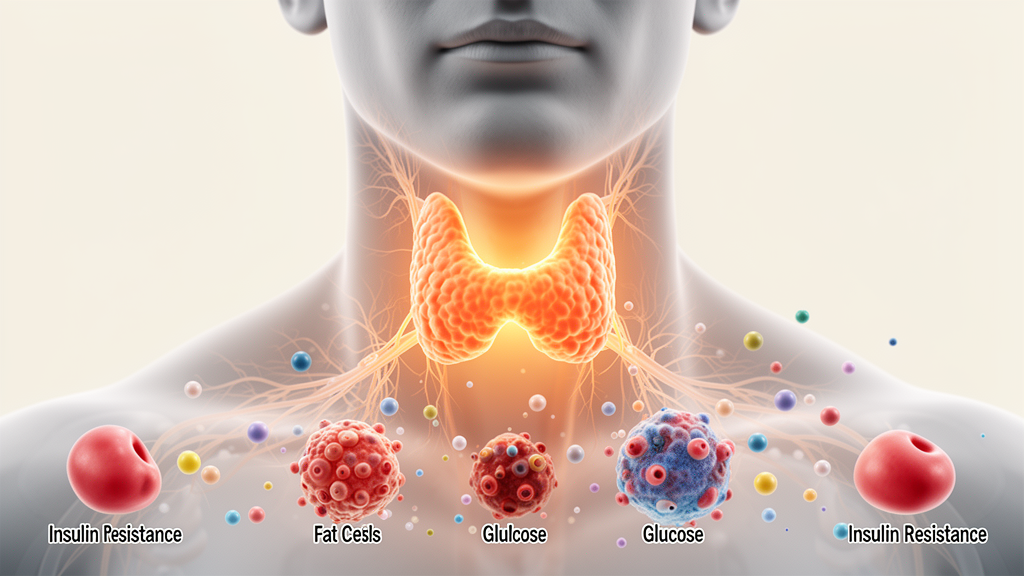
A 2026 mini review concludes that age-related thyroid dysfunction is linked with cardiovascular-kidney-metabolic syndrome through interacting disturbances in cardiac function, kidney filtration, glucose control and lipid metabolism. The synthesis combines human cohorts, meta-analyses, clinical trials and animal experiments, but much of the clinical evidence is observational and does not establish that thyroid dysfunction causes the wider syndrome. The review also highlights a complication in interpreting thyroid tests in later life: mildly elevated thyroid-stimulating hormone, or TSH, has been associated with better function and lower mortality in some very old populations, while more pronounced abnormalities can accompany greater cardiovascular and metabolic risk.
Thyroid hormones regulate metabolism throughout life through the hypothalamus-pituitary-thyroid axis. The circulating prohormone thyroxine, or T4, is converted in tissues by deiodinases into triiodothyronine, or T3, which acts on thyroid hormone receptors to influence metabolic and organ function. With aging, the pituitary-thyroid axis commonly changes and thyroid disorders become more prevalent. The review cites estimates that subclinical hypothyroidism affects about 6% of people aged 70 to 79 and 10% of those older than 80. Its prevalence rises with age, whereas overt hyperthyroidism becomes less common in some populations, although iodine-deficient regions show a different pattern and reported hyperthyroidism prevalence can reach 15% among people older than 70.
Not every age-related rise in TSH appears harmful. A retrospective Copenhagen study cited by the authors associated TSH values of 5 to 10 mIU/L with reduced all-cause mortality among people older than 65. An analysis of the Health ABC Study linked mildly elevated TSH, defined as 4.5 to 10.0 mIU/L, with slightly better mobility and a lower risk of functional decline in 2,290 high-functioning adults aged 70 to 79. Centenarians and nonagenarians in observational studies also tended to have higher TSH than controls, and the upper limit of the TSH reference range reportedly rises by 0.3 mIU/L per decade after age 40. Proposed explanations include reduced TSH bioactivity, less tissue-specific availability of thyroid hormones, diminished pituitary feedback sensitivity and a blunted thyroid response to TSH. These associations do not show that deliberately raising TSH promotes longevity.
The cardiovascular consequences are clearer when thyroid function is substantially abnormal. Hyperthyroidism produces a high-output circulation, with cardiac output reported to rise by 50% to 300%, faster heart rate, stronger myocardial contraction and reduced peripheral vascular resistance. Approximately 10% to 15% of hyperthyroidism cases are accompanied by atrial fibrillation, and the review reports that about 25% of hyperthyroid patients older than 60 have the arrhythmia. Atrial fibrillation in this setting is associated with higher risks of embolism, stroke, heart failure and cardiovascular death. Long-standing severe hyperthyroidism can also impair left-ventricular function; in one cited analysis, roughly 6% of affected patients progressed to systolic heart failure. Among symptomatic heart-failure patients with a left-ventricular ejection fraction below 35%, hyperthyroidism was identified as an independent adverse prognostic factor associated with an 85% increase in mortality risk.
Hypothyroidism places different demands on the cardiovascular system. Reduced thyroid hormone lowers ventricular contractility while increasing peripheral vascular resistance, potentially leading to ventricular dilation and heart failure. In experimental rat models of propylthiouracil-induced hypothyroidism, researchers observed sustained ventricular dilation, contractile dysfunction, increased expression of cardiac-remodeling genes and fibrosis progression. Rapid correction with L-thyroxine improved cardiac function in the animals, although the source also notes an exacerbation of myocardial inflammation and cellular infiltration in one model. Human evidence is less straightforward: a randomized, double-blind trial found that long-term oral T3 supplementation did not significantly improve left-ventricular function in hypothyroid patients with heart failure. Prospective evidence and meta-analyses associate subclinical hypothyroidism, particularly when TSH is at least 10 mIU/L, with higher risks of heart failure and coronary heart disease, but the clinical meaning of milder elevations remains disputed.
Thyroid dysfunction also has a two-way relationship with diabetes. Thyroid hormones directly influence hepatic gluconeogenesis, insulin sensitivity and pancreatic beta-cell function, while chronic hyperglycemia can impair thyroid hormone action, disrupt negative feedback in the pituitary-thyroid axis and damage thyroid follicular cells involved in hormone synthesis and release. In a retrospective cohort, hyperthyroidism was associated with adjusted hazard ratios of 1.66 for type 1 diabetes and 1.71 for type 2 diabetes compared with controls; hypothyroidism carried relative risks of 1.77 for both. Those associations did not increase significantly among patients older than 65 in that analysis. A meta-analysis of 38 studies found thyroid dysfunction in 20.24% of people with type 2 diabetes, including 11.87% with subclinical hypothyroidism and 7.75% with overt hypothyroidism. The review identifies female sex, glycated hemoglobin of at least 7%, diabetes duration longer than five years, family history of thyroid dysfunction, central obesity, smoking, retinopathy and neuropathy as factors associated with increased risk in people with type 2 diabetes.
Abnormal thyroid function can also disturb lipid handling. Thyroid hormones promote triglyceride breakdown, fatty-acid oxidation and lipoprotein clearance, while regulating cholesterol synthesis, bile-acid conversion and biliary excretion. Both overt and subclinical hypothyroidism are associated with higher total cholesterol, LDL cholesterol and triglycerides, generally in proportion to the rise in TSH. Meta-analytic evidence cited in the review found that levothyroxine replacement lowered LDL cholesterol by about 41 mg/dL in overt hypothyroidism. The effect on body weight is more nuanced: much of the apparent weight reduction after treatment may reflect loss of water and lean tissue rather than fat, and severe obesity is seldom a direct consequence of hypothyroidism alone. Nevertheless, the review reports associations between elevated TSH, subclinical hypothyroidism and later metabolic syndrome or obesity in older adults, as well as an increased risk of thyroid dysfunction among people who already have obesity.
The review places thyroid abnormalities within the cardiovascular-kidney-metabolic framework, which links cardiovascular disease, chronic kidney disease, obesity, type 2 diabetes and metabolic risk factors rather than treating them as isolated conditions. Hypothyroidism reduces renal blood flow and glomerular filtration rate and promotes tubular retention of sodium and water, while hyperthyroidism changes vascular tone, cardiac output and blood-pressure regulation. A meta-analysis of 15 studies involving approximately 5.1 million participants linked hypothyroidism with increased chronic kidney disease risk in both cross-sectional and cohort analyses. At the same time, insulin resistance, elevated LDL cholesterol and triglycerides can promote endothelial inflammation and atherosclerosis, while kidney impairment can further disturb glucose and lipid metabolism. The authors describe this arrangement as a positive feedback loop centered on metabolic disorders and organic dysfunction, rather than a single linear pathway. The evidence supports this network as a plausible mechanism, but it does not show that screening or treating thyroid dysfunction alone prevents the syndrome.
Not all people with similar TSH and T4 concentrations have the same functional response to thyroid hormone. The review discusses indices that combine circulating hormone measurements to estimate central thyroid sensitivity, including the thyroid feedback quartile index and related measures. Higher values generally indicate reduced sensitivity. Associations reported in prior studies link reduced sensitivity with metabolic syndrome, cardiovascular disease, kidney disease and mortality. A per-standard-deviation increase in the thyroid feedback quartile index was associated with 13% higher diabetes risk and 16% higher metabolic-syndrome risk, while a per-standard-deviation increase in the parameterized index was associated with 18% higher all-cause mortality and 31% higher cardiovascular-disease mortality in the populations examined. In an analysis of 8,391 euthyroid participants, reduced sensitivity was associated with stage 2 cardiovascular-kidney-metabolic syndrome in men and was more pronounced above age 50, while the association was weaker in women. These are group-level associations rather than individual risk predictions.
Possible interventions remain largely at the research stage. The review notes established cardiovascular-kidney-metabolic options such as SGLT2 inhibitors, GLP-1 receptor agonists and nonsteroidal mineralocorticoid receptor antagonists, then turns to drugs aimed at thyroid hormone receptor beta. This receptor is concentrated in the liver, where it regulates glucose and lipid metabolism; agonists have been investigated for metabolic dysfunction-associated steatohepatitis, and resmetirom has received Food and Drug Administration approval for that condition. It has not been established that thyroid receptor beta agonism prevents or treats cardiovascular-kidney-metabolic syndrome. The review instead identifies receptor-targeted therapy as a potential avenue requiring direct testing. Its central conclusion is restrained: thyroid dysfunction is an upstream modifier within a complex network, and future research must determine which abnormalities, patients and treatment windows carry meaningful clinical benefit.
Subject of Research: A review of age-related thyroid dysfunction, metabolic regulation and cardiovascular-kidney-metabolic syndrome.
Article Title: Thyroid dysfunction in aging and cardiovascular-kidney-metabolic syndrome: metabolic regulation and clinical implications
Article References: Li, H., Wang, N., Ran, X., Fan, Z., Zhao, T., & Ma, X. (2026). Thyroid dysfunction in aging and cardiovascular-kidney-metabolic syndrome: metabolic regulation and clinical implications. Frontiers in Endocrinology, 17, Article 2000192. https://doi.org/10.3389/fendo.2026.2000192
Image Credits: AI Generated
DOI: 10.3389/fendo.2026.2000192
Keywords: thyroid dysfunction, aging, thyroid-stimulating hormone, cardiovascular-kidney-metabolic syndrome, metabolic syndrome, cardiovascular disease, chronic kidney disease, insulin resistance, dyslipidemia, thyroid hormone receptors, Thyroid, dysfunction
Cite Scienmag News
Beatrice Stafford. (October 22, 2026). Review maps thyroid links to aging and metabolic syndrome. Scienmag. https://scienmag.com/review-maps-thyroid-links-to-aging-and-metabolic-syndrome/
Beatrice Stafford. "Review maps thyroid links to aging and metabolic syndrome." Scienmag, 22 October 2026, https://scienmag.com/review-maps-thyroid-links-to-aging-and-metabolic-syndrome/. Accessed 22 October 2026.
Beatrice Stafford. "Review maps thyroid links to aging and metabolic syndrome." Scienmag. October 22, 2026. https://scienmag.com/review-maps-thyroid-links-to-aging-and-metabolic-syndrome/


