


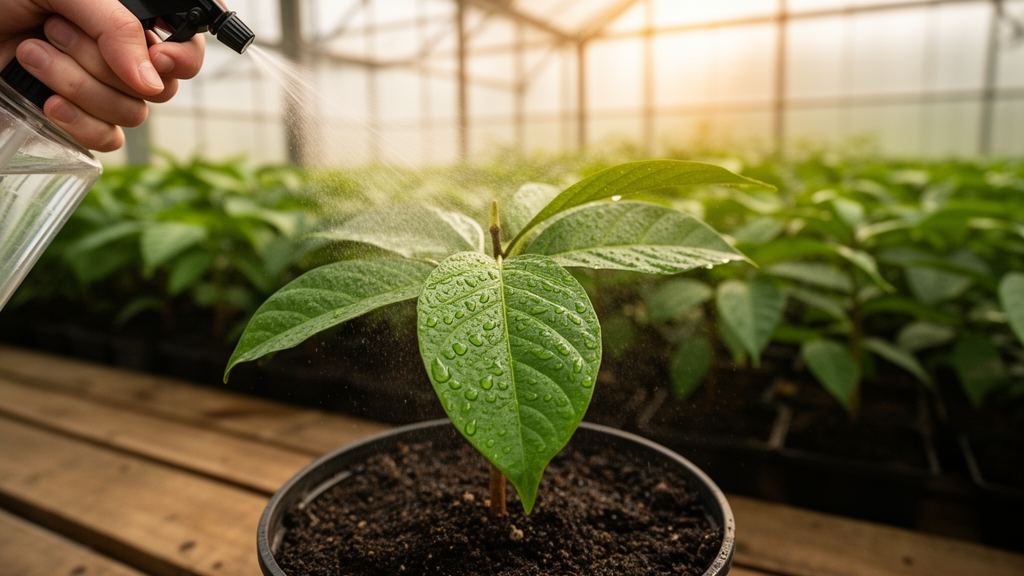
Chocolate begins its life as a fragile seedling, and the earliest weeks of a cacao plant’s time in the field can determine whether it ever delivers a commercial harvest. Now a team of Ecuadorian researchers reports that an unlikely ally may help young cacao trees through this vulnerable phase: seaweed. In a study published in Frontiers in Agronomy, scientists sprayed grafted cacao plantlets with extracts prepared from two locally abundant marine algae, the red seaweed Acanthophora spicifera and a green seaweed of the genus Ulva, and tracked how the treatments changed the seedlings’ growth and physiology over eight consecutive weeks. The results were strikingly specific. A dilute extract of Ulva prepared with 50 percent aqueous ethanol, applied at just 2.5 percent concentration, pushed the seedlings’ Chlorophyll Content Index to 43.1 ± 1.19, the highest value recorded in the experiment, while other extract combinations left the plants untouched or, under prolonged exposure, damaged them outright.
The research team, drawn from the ESPOL Polytechnic University, the Federal University of Santa Maria, the Universidad Agraria del Ecuador, and the Universidad de Especialidades Espíritu Santo, framed the work against the realities of Ecuadorian cocoa farming. Cacao is one of the country’s leading non-oil agricultural exports, prized internationally for the distinctive flavor and aroma of its beans. In 2024, roughly 612,453 hectares were planted with cacao in Ecuador, producing 403,699 metric tons of dry cocoa beans. Yet the crop’s economics are dominated by smallholders: approximately 87 percent of production units cultivate fewer than five hectares, often with limited access to credit, technical assistance, and agricultural inputs. That combination constrains essential agronomic practices and keeps yields well below the crop’s genetic potential, creating an opening for low-cost interventions that could improve establishment without demanding heavy investment.
Biostimulants occupy a peculiar niche in this picture. Unlike conventional fertilizers, they are not primarily nutrient sources. As defined in the plant science literature, a biostimulant is a formulated product of biological origin that improves productivity through the emergent properties of its complex constituents, modulating processes such as cell division, root and shoot elongation, photosynthesis, nutrient uptake, and stress responses. Seaweed-derived products are among the oldest and most widely used categories, with liquid seaweed extracts dating back to the 1950s. Their bioactive repertoire is broad: polysaccharides, phenolic compounds, amino acids, minerals, vitamins, pigments, and hormone-like molecules that can influence respiration, photosynthesis, nucleic acid metabolism, and ion uptake. The authors caution, however, that biostimulants should complement rather than replace balanced plant nutrition and sound agronomic management.
The two seaweeds chosen for the study were not arbitrary. Ulva species are rich in ulvan, a water-soluble sulfated polysaccharide composed mainly of rhamnose, glucuronic acid, iduronic acid, and xylose, which can act as a bioactive elicitor of physiological and biochemical responses in plants. Previous work has shown dramatic effects in other species: a crude ulvan extract applied to Arabidopsis thaliana increased root length by 174 percent and total plant dry weight by 62 percent under specific experimental conditions. Acanthophora spicifera, a tropical red seaweed that grows along the Ecuadorian coast, contains its own suite of sulfated polysaccharides, phenolics, and pigments, and its extracts have modulated photosynthesis, hormonal signaling, and defense-related genes in tomato and sweet pepper while reducing bacterial and fungal disease severity. Notably, the researchers point out that no previous study had tested either species as a biostimulant for cacao seedlings.
Experimentally, the design was exhaustive. The red seaweed was collected from the intertidal zone at San Pedro, Santa Elena, and the green seaweed from Puerto El Morro in Guayas. Biomass was cleaned, frozen, and then extracted at a 1:10 biomass-to-solvent ratio using three media: pure water, 25 percent aqueous ethanol, and 50 percent aqueous ethanol, followed by maceration in darkness at 4 degrees Celsius and centrifugation. Each extract was diluted to 2.5, 5, or 7.5 percent by volume and sprayed weekly onto grafted CCN-51 cacao plantlets, with filtered water serving as the control. In total, 450 plants were assigned to treatments in a completely randomized design, each plant acting as its own experimental unit across repeated measurements of plant height, leaf number, leaf length, and chlorophyll content taken at 15-day intervals.
The statistical machinery matched the complexity of the design. Because the same plants were measured repeatedly, the team used linear mixed-effects models with plant-level random intercepts for chlorophyll and height, and a generalized model with a negative binomial error distribution for leaf counts, which showed substantial overdispersion. The analysis revealed a significant interaction between treatment-dose combination and time for the Chlorophyll Content Index, meaning the effect of each formulation was not constant across the season. No differences existed among treatments at baseline, but by Day 45 the low-dose Ulva 50 percent ethanol extract stood clearly apart, with several other low-to-moderate Ulva treatments also producing relatively high chlorophyll values in later evaluations. Differences emerging only after the third week suggest the algal compounds progressively influence chlorophyll synthesis, nitrogen metabolism, and photosynthetic efficiency rather than acting immediately.
Leaf number told a more complicated story. It varied significantly among treatments at intermediate time points, but by Day 45 four treatment combinations had suffered complete defoliation, a treatment-specific phytotoxic response after prolonged exposure. The affected combinations included Ulva extracts at both 25 and 50 percent ethanol and an Acanthophora 25 percent ethanol extract at the highest dose. Meanwhile, plant height and leaf length showed no significant differences among treatments at any point, indicating that the seaweed extracts acted primarily at a physiological level, on photosynthetic pigment and foliar dynamics, before any structural growth changes became visible. A principal component analysis reinforced this pattern: the first principal component, explaining 46.4 percent of variance, was driven mainly by chlorophyll content, and the Ulva ethanol treatments at low doses clustered toward the favorable pole.
What explains the potency of the dilute Ulva extract? The authors point to betaines and cytokinin-like compounds previously identified in Ulva species, which have long been associated with enhanced leaf chlorophyll. Cytokinins regulate chlorophyll biosynthesis and chloroplast function, and a recent measurement of the green alga Ulva intestinalis, collected near the study site, found high cytokinin concentrations specifically in 50 percent ethanol extracts, matching the extraction medium that performed best here. The dark side of the results, the defoliation at higher or prolonged exposures, illustrates the narrow therapeutic window of biostimulants: excessive concentrations may inhibit pigment accumulation through osmotic or metabolic overload. The effect also underscores why extraction chemistry matters, since solvent polarity determines which bioactive constituents are recovered from the algal biomass.
The Ecuadorian context gives the findings practical weight. Locally harvested seaweed could become a sustainable, homegrown input for smallholder nurseries, and the study was supported by the country’s REDD+ Early Movers program as part of a mariculture project designed to create incentives for mangrove conservation, tying cacao agriculture to coastal ecosystem stewardship. The researchers are careful about scope: the responses were dose- and time-dependent, height and leaf size were unaffected, and the phytotoxic defoliation shows that concentration and application frequency must be optimized before any agronomic deployment. Still, as the first documented report of increased chlorophyll content in cacao seedlings treated with Ulva extracts, the study opens a precise, chemically informed path toward helping one of the world’s most beloved crops take root.
Subject of Research: Seaweed-derived biostimulants and the early growth and physiology of cacao plantlets
Article Title: Enhancing growth and physiological performance of Theobroma cacao plantlets with biostimulant extracts from Acanthophora spicifera and Ulva sp
Article References: Chavez-Navarrete, T., Briones-Avilés, B., Villao, L., Santos-Ordóñez, E., Portalanza, D., & Bonilla, J. (2026). Enhancing growth and physiological performance of Theobroma cacao plantlets with biostimulant extracts from Acanthophora spicifera and Ulva sp. Frontiers in Agronomy, 8, Article 1957460. https://doi.org/10.3389/fagro.2026.1957460
Image Credits: AI Generated
DOI: 10.3389/fagro.2026.1957460
Keywords: biostimulants, seaweed, cacao, Theobroma cacao, Ulva, Acanthophora spicifera, chlorophyll, Ecuador, plant physiology, sustainable agriculture, Enhancing, growth
Cite Scienmag News
Alan Morgan. (October 15, 2026). Seaweed Sprays Boost Chlorophyll in Young Cacao Plants, Ecuadorian Study Finds. Scienmag. https://scienmag.com/seaweed-sprays-boost-chlorophyll-in-young-cacao-plants-ecuadorian-study-finds/
Alan Morgan. "Seaweed Sprays Boost Chlorophyll in Young Cacao Plants, Ecuadorian Study Finds." Scienmag, 15 October 2026, https://scienmag.com/seaweed-sprays-boost-chlorophyll-in-young-cacao-plants-ecuadorian-study-finds/. Accessed 15 October 2026.
Alan Morgan. "Seaweed Sprays Boost Chlorophyll in Young Cacao Plants, Ecuadorian Study Finds." Scienmag. October 15, 2026. https://scienmag.com/seaweed-sprays-boost-chlorophyll-in-young-cacao-plants-ecuadorian-study-finds/


