


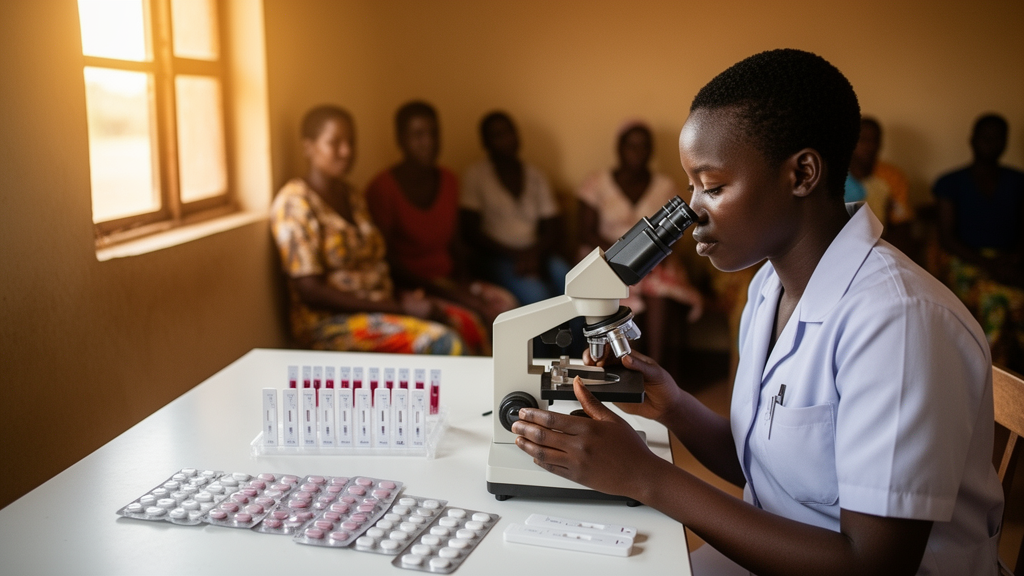
Every effective malaria treatment in use across Africa today rests on a single chemical foundation, and that foundation is starting to crack. Artemisinin-based combination therapies, which pair a fast-acting artemisinin derivative that clears most of the parasite biomass within hours with a slower partner drug that mops up the survivors, have held the line for two decades. Now a Perspective published in Frontiers in Malaria argues that the continent’s prevailing, wait-and-see policy for swapping out failing drugs is structurally mismatched to the way resistance behaves, and that Africa’s only realistic chance of avoiding a repeat of Southeast Asia’s collapse is to act preemptively, before treatment failure becomes statistically undeniable.
The warning rests on hard evidence. Partial resistance to artemisinin, encoded by mutations in the Plasmodium falciparum kelch13 gene, has emerged independently and repeatedly inside Africa rather than arriving through a single importable front. The kelch13 R561H mutation was confirmed in Rwanda in 2020; clinical and molecular evidence of resistant parasites followed in Uganda; and in Eritrea, resistant parasites were found already carrying the diagnosis-evading trait of HRP2 deletion. Validated and candidate kelch13 polymorphisms, among them P441L, C469Y, R561H, R622I, and A675V, are now distributed across the Great Rift Valley, and the World Health Organization records confirmed or suspected partial resistance in at least eight African countries.
The stakes could hardly be higher. The WHO estimates 282 million malaria cases and 610,000 deaths in 2024, with the African Region carrying roughly 94 percent of cases and 95 percent of deaths, about three-quarters of them in children under five. The WHO’s 2025 report names antimalarial drug resistance, alongside deletions of the histidine-rich protein 2 and 3 genes that blind many rapid diagnostic tests, as a direct and growing threat to case management. Africa has been here before: chloroquine and sulfadoxine-pyrimethamine were both lost across the continent within years of resistance taking hold, and in each case policy reacted only once failure was undeniable, too late to save the drug.
Southeast Asia has already run the experiment to its conclusion. In Pursat, Cambodia, the efficacy of dihydroartemisinin-piperaquine fell from 98 percent in 2005 to 63 percent by 2013 as the prevalence of kelch13 mutants rose from 40 to 77 percent. Between 2015 and 2018, multi-country efficacy of the same regimen had sunk to 50 percent, with treatment failure exceeding 85 percent at the worst sites. The reactive response became a treadmill: as one combination therapy failed, programs switched to another, only to watch resistance follow, until the region’s strategic answer was an outright push to eliminate falciparum malaria before it became untreatable.
Critically, that collapse began with the partner drug rather than the artemisinin. Partial resistance on its own rarely causes a combination therapy to fail: kelch13 mutations slow the clearance of young ring-stage parasites, leaving more of them for the partner drug to remove, but a fully effective partner can still cure the infection. Failure arrives when resistance to the partner joins in. Once artemisinin can no longer reliably suppress the parasite burden, survivors meet the partner drug almost as a monotherapy, which accelerates selection for partner-drug resistance. The molecular basis is well characterized: amplification of the plasmepsin-2 and plasmepsin-3 genes and mutations in the chloroquine resistance transporter underlie piperaquine failure, while changes in mdr1 and related loci shift susceptibility to lumefantrine and amodiaquine. In northern Uganda, parasites with reduced susceptibility to both dihydroartemisinin and lumefantrine have already been documented, and validated kelch13 mutations have climbed to substantial frequencies at several Ugandan sites.
Africa is not a milder version of the Greater Mekong; in several respects it is a harder place to fight resistance. Transmission across much of sub-Saharan Africa is far more intense, meaning more infections, more drug exposure, and faster spread of any resistant lineage that gains a foothold. Partial immunity acquired through repeated infection helps many African patients clear parasites even when a drug is failing, which masks treatment failure and delays its detection precisely where the trigger threshold matters most. A larger, more diverse parasite population offers more genetic raw material for resistance to arise and recombine. And Africa is not one epidemiological place: transmission ranges from holoendemic to near-elimination, so resistance can establish in one zone while a national average stays below the alarm level, which means any preemptive strategy must be stratified sub-nationally.
The conventional trigger for changing first-line therapy is a treatment failure rate above 10 percent. As a brake on premature, costly policy churn, the threshold is sensible. But as a strategy for a continent at the start of a resistance trajectory, the author argues, it carries a structural defect: by the time failure is common enough to be measured reliably, resistance is already widespread, and changing a national regimen takes years to plan, finance, procure, and deliver. The deeper problem is an asymmetry of errors. Switching too early wastes money; switching too late costs lives during the lag and can cost the drug itself. Drug efficacy is best understood as a shared, exhaustible resource, and when the two kinds of error carry such unequal consequences, waiting for certainty is not caution but risk. The author frames the calculus as ethical as well as epidemiological: the cost of a lost first-line drug falls hardest on young children in high-transmission, low-income settings, and deferring action until failure is statistically unambiguous means discovering the loss through their deaths.
The financing environment sharpens the point. The abrupt contraction of United States assistance in 2025, including the dismantling of the President’s Malaria Initiative and its implementing agency, has disrupted commodity supply, surveillance, and the technical partnerships on which resistance monitoring depends; one modeling study attributes roughly half of the malaria mortality reduction of the past two decades to US development assistance and warns of large avoidable mortality if the cuts stand. With total malaria investment flat near US$4 billion against a WHO target of more than US$9 billion, the surveillance and procurement capacity that reactive policy depends on is precisely what is most exposed. The preemptive agenda itself, however, is built largely from tools that already exist. Deploying several different first-line combination therapies across a population at once spreads drug pressure and slows selection against any one partner drug; a Rwanda-specific modeling study that evaluated 26 policy options found this single change could lower projected treatment failures by approximately half, with the largest gains when adopted before resistance became common. The WHO already recommends six artemisinin-based combinations for uncomplicated malaria.
Further elements of the agenda include preparing triple artemisinin-based combination therapies as a deployable contingency, since adding a second partner drug forces a parasite to overcome both compounds at once; artemether-lumefantrine-amodiaquine and artesunate-mefloquine-piperaquine have proved efficacious and well tolerated even in multidrug-resistant settings, and modeling indicates early adoption delays resistance emergence rather than merely reacting to it. On the pipeline front, the non-artemisinin combination ganaplacide-lumefantrine met its primary endpoint in the Phase 3 KALUMA trial in 2025, the first such advance in more than two decades and one that held up against partial-resistance mutants, though approval and deployment lie years ahead. Prevention is part of the same strategy: two WHO-recommended vaccines, R21/Matrix-M with roughly 75 percent efficacy against clinical malaria in seasonal use and RTS,S linked to a 13 percent decrease in all-cause child mortality, have reached children in more than 17 African countries, and every infection prevented is one less course of drugs and one less chance for resistance to spread. Underpinning it all, the author insists, molecular surveillance tracking kelch13, partner-drug markers, and pfhrp2 and pfhrp3 deletions must be funded as routine national infrastructure rather than grant-dependent research, because it is the sensor without which preemptive policy is blind and reactive policy is merely slow. The biology in Africa has not yet reached the Southeast Asian endpoint of routine treatment failure. That, the Perspective concludes, is the entire point and the entire opportunity: the window to act ahead of failure is open, narrow, and closing.
Subject of Research: Preemptive treatment policy to counter emerging artemisinin partial resistance in African falciparum malaria
Article Title: Holding the line against artemisinin partial resistance in Africa: the case for preemptive treatment policy
Article References: Holding the line against artemisinin partial resistance in Africa: the case for preemptive treatment policy. (n.d.). https://doi.org/10.3389/fmala.2026.1916099
Image Credits: AI Generated
DOI: 10.3389/fmala.2026.1916099
Keywords: artemisinin partial resistance, Plasmodium falciparum, kelch13, artemisinin-based combination therapy, malaria drug resistance, multiple first-line therapies, triple artemisinin-based combination therapy, molecular surveillance, pfhrp2 deletions, malaria vaccines, Africa, treatment policy
Cite Scienmag News
Juliet Wilcox. (October 15, 2026). Africa’s Window to Stop Artemisinin-Resistant Malaria Is Closing Fast. Scienmag. https://scienmag.com/africas-window-to-stop-artemisinin-resistant-malaria-is-closing-fast/
Juliet Wilcox. "Africa’s Window to Stop Artemisinin-Resistant Malaria Is Closing Fast." Scienmag, 15 October 2026, https://scienmag.com/africas-window-to-stop-artemisinin-resistant-malaria-is-closing-fast/. Accessed 15 October 2026.
Juliet Wilcox. "Africa’s Window to Stop Artemisinin-Resistant Malaria Is Closing Fast." Scienmag. October 15, 2026. https://scienmag.com/africas-window-to-stop-artemisinin-resistant-malaria-is-closing-fast/


