


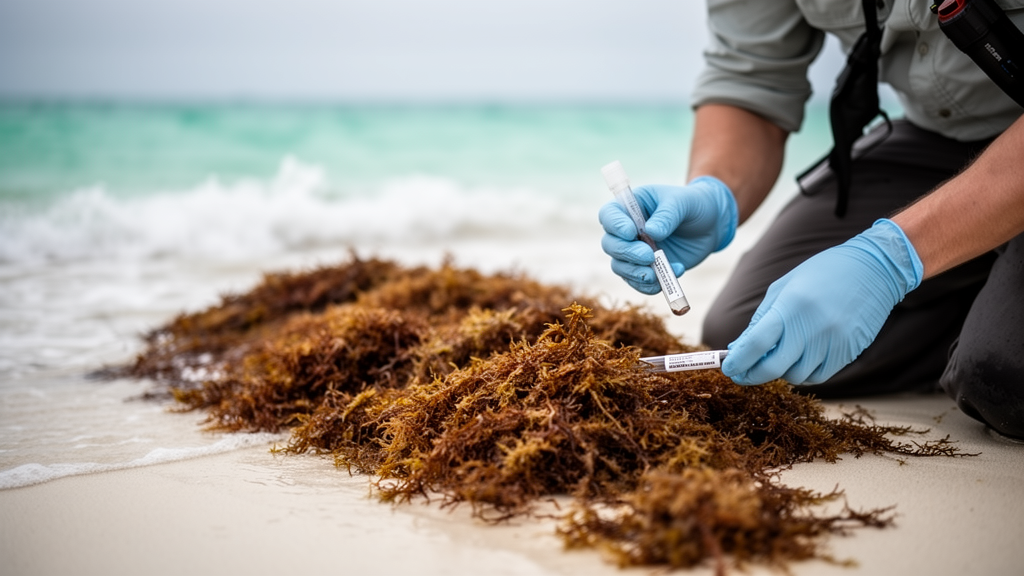
The golden-brown mats of sargassum that have increasingly blanketed beaches bordering the tropical Atlantic Ocean are more than just a nuisance for sunbathers and a headache for coastal municipalities. According to a new study published in Environmental Monitoring and Assessment, stranded sargassum can serve as a reservoir and even an incubator for enterococci, the fecal indicator bacteria that health officials rely on to judge whether beach water and sand are safe for recreation. The research, led by Afeefa A. Abdool-Ghany and Helena M. Solo-Gabriele of the University of Miami, provides some of the strongest controlled experimental evidence yet that the mounting seaweed inundations along Florida and Caribbean shorelines may be actively degrading sand and water quality, independent of any sewage input.
Enterococci have long been the workhorse of recreational water quality monitoring. The traditional paradigm assumes that when these bacteria exceed regulatory thresholds at a beach, the culprit is a waterborne source of fecal contamination, such as an ocean outfall or a sewage-laden river discharge. In Florida, for example, the guideline is a geometric mean of 35 colony-forming units per 100 milliliters of water, with a single-sample maximum of 70 CFU per 100 milliliters. When levels climb above such thresholds, advisories are issued to discourage swimming. But over the past two decades, scientists have come to appreciate that the beach itself, particularly the sand just above the high tide line, can harbor and even amplify these bacteria, turning the shoreline into a non-point source of contamination that confounds the simple sewage narrative.
Previous field studies had already hinted at a connection between wrack, the line of decaying organic material deposited at the top of the beach, and elevated bacterial levels. A year-long investigation at Key Biscayne Beach in Florida conducted by some of the same researchers found that decomposing sargassum harbored and likely promoted the regrowth of enterococci, and that during the COVID-19 beach shutdown, when human activity was minimal, high bacterial levels were confined precisely to the zone where sargassum had stranded. Other work showed that brown seaweeds and seagrasses can sustain fecal indicator bacteria in seawater and sediment, and the World Health Organization has even established a guideline level of 60 CFU per gram for enterococci in beach sand. What was missing, however, was a long-term, controlled experiment that isolated the effect of sargassum under natural rainfall and sunlight, and that is precisely the gap the new study set out to fill.
The team collected freshly stranded sargassum, predominantly Sargassum fluitans, from Lauderdale-by-the-Sea Beach in South Florida in March 2024, along with sand from the supratidal zone. Within an hour and a half, the material was transported to the laboratory and used to assemble twelve outdoor mesocosms on the flat roof of a five-story engineering building at the University of Miami, a location chosen to expose the systems to natural rainfall and sunlight while avoiding street-level contamination. Six mesocosms served as controls, each containing two kilograms of beach sand to a depth of three centimeters over a felt-lined tray. The other six received an additional half-kilogram layer of sargassum overlying the sand. Each tray drained into a reservoir designed to capture the leachate produced when rain percolated through the layers, allowing the researchers to track how bacteria moved through the system.
Because bird droppings are a well-known source of enterococci at beaches, the researchers deployed three bird deterrent systems, including reflective rods, fence spikes, and ultrasonic repellers, and observed no birds or fecal evidence throughout the experiment. Sanitized rain gauges flanking the mesocosms documented rainfall depth and provided rainwater samples for bacterial analysis. Over the seventy-day run, rain fell on ten days, totaling 19.36 centimeters, and generated measurable leachate on nine of those days. Samples of sargassum, sand, leachate, and rainwater were collected twice weekly and after rainfall events, then processed using the standardized membrane filtration method employed by the US Environmental Protection Agency, with colony counts back-calculated to CFU per dry gram or per 100 milliliters using paired moisture measurements.
The results were striking. Enterococci in the sargassum started at roughly 10 to the 2.3 CFU per gram and surged more than three orders of magnitude to about 10 to the 5.3 CFU per gram, an enormous proliferation under entirely natural conditions. Even after an eighteen-day stretch without rainfall near the end of the study, levels remained elevated at about 10 to the 4.8 CFU per gram, demonstrating that once established, the bacterial population persists in the wrack. Across the whole experiment, sargassum consistently carried the highest enterococci loads, with a geometric mean of 4.1 times 10 to the 4 CFU per gram, far exceeding the sand beneath it and the sand in the sargassum-free controls.
The influence of the seaweed extended well beyond its own biomass. Sand underlying the sargassum layer had a geometric mean enterococci concentration of 1.1 times 10 to the 3 CFU per gram, roughly two orders of magnitude higher than the 40 CFU per gram measured in the control sand, a difference that was highly statistically significant. Leachate told the same story: water draining through the sargassum mesocosms averaged 1.3 times 10 to the 4 CFU per 100 milliliters, about one order of magnitude above the 8.7 times 10 to the 2 CFU per 100 milliliters from the control mesocosms. Rainfall itself was essentially clean, with a geometric mean of just 3.5 CFU per 100 milliliters, indicating that the rain was not delivering bacteria but rather supplying the moisture that triggered bacterial regrowth in the wrack and sand below.
Time-series analysis revealed a compelling mechanistic pattern: each spike in moisture content within the sargassum was followed by a rise in enterococci concentrations up to a plateau, and the sand concentrations generally tracked the sargassum with a lag of about one order of magnitude. Pearson correlations within the sargassum mesocosms were moderate and significant between sargassum and sand, sand and leachate, and sargassum and leachate, while the control mesocosms showed only weak, non-significant relationships. The authors caution, however, that a sensitivity analysis showed the correlations lost statistical significance when a single maximum value was excluded, so the associations should be interpreted with some care. Still, the overall weight of evidence supports the hypothesis that sargassum acts as both a source and an amplifier of enterococci.
Why does sargassum prove such a hospitable habitat for these bacteria? The study points to several converging mechanisms. First, the wrack layer physically shields underlying organisms from the ultraviolet radiation that is known to inactivate enterococci in seawater. Second, as the seaweed decays it releases nitrogen and phosphorus that feed biofilms, the surface-attached microbial communities in which enterococci are known to reside and where they gain protection from predation. Third, the sargassum blanket buffers the wild swings in temperature and moisture that bare sand experiences, keeping conditions within the broad growth range of enterococci, which spans roughly 10 to 45 degrees Celsius. The wetting and drying cycles driven by intermittent rain may even favor enterococci specifically, since their exceptional tolerance of desiccation allows them to outlast competitors and then rebound rapidly when moisture returns.
For beach managers, the practical implications are direct. In some parts of Florida, the standard response to excessive strandings has been to integrate the sargassum into the sand by cutting and mixing it into the beach surface, but the new findings suggest this practice should be discouraged, because burying the seaweed distributes its bacterial load into the very matrix that beachgoers contact. Instead, the authors recommend that when strandings are excessive, the sargassum should be removed and handled offsite rather than incorporated into the beach. The team also outlines a research agenda: future mesocosms should simulate tidal washing, leachate should be retained to determine whether enterococci can grow in the water itself, culture methods should identify which enterococcal species dominate, and nutrient releases should be quantified. A predictive model integrating sunlight, temperature, moisture, and nutrients could ultimately confirm the mechanisms and help managers time their interventions. As the great Atlantic sargassum belt continues to deliver record inundations to Caribbean and Florida coastlines, understanding the humble wrack line as a microbial incubator may prove essential to keeping beaches open and safe.
Subject of Research: Enterococci proliferation in stranded sargassum and its impact on beach sand and water quality
Article Title: Proliferation of enterococci in sargassum can contribute towards sand and water quality impairment
Article References: Abdool-Ghany, A. A., Huang, K., Roca, M., Saba, E., Li, J., & Solo-Gabriele, H. M. (2026). Proliferation of enterococci in sargassum can contribute towards sand and water quality impairment. Environmental Monitoring and Assessment, 198(9), Article 1025. https://doi.org/10.1007/s10661-026-15872-3
Image Credits: AI Generated
DOI: 10.1007/s10661-026-15872-3
Keywords: sargassum, enterococci, fecal indicator bacteria, beach water quality, beach sand, mesocosm, wrack line, rainfall leachate, Sargassum fluitans, Florida beaches, recreational water safety, microbial regrowth
Cite Scienmag News
Violet Maxwell. (October 18, 2026). Sargassum on Beaches Acts as an Incubator for Fecal Indicator Bacteria. Scienmag. https://scienmag.com/sargassum-on-beaches-acts-as-an-incubator-for-fecal-indicator-bacteria/
Violet Maxwell. "Sargassum on Beaches Acts as an Incubator for Fecal Indicator Bacteria." Scienmag, 18 October 2026, https://scienmag.com/sargassum-on-beaches-acts-as-an-incubator-for-fecal-indicator-bacteria/. Accessed 18 October 2026.
Violet Maxwell. "Sargassum on Beaches Acts as an Incubator for Fecal Indicator Bacteria." Scienmag. October 18, 2026. https://scienmag.com/sargassum-on-beaches-acts-as-an-incubator-for-fecal-indicator-bacteria/


