


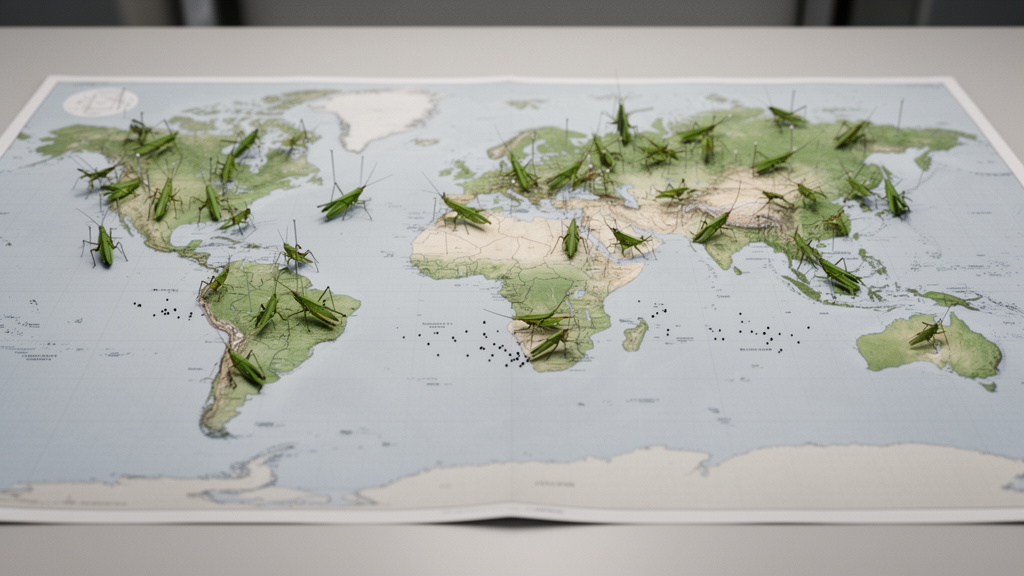
Researchers have published a comprehensive global analysis mapping the status of taxonomic knowledge for Orthoptera, the insect order that includes grasshoppers, crickets, and katydids. Published in Frontiers of Biogeography, the study provides a detailed spatial and temporal assessment of how well scientists understand the classification of this sixth-most species-rich insect order. By integrating data from major biodiversity repositories, the team created a framework that distinguishes between the discovery of new species and the revision of existing ones, offering a nuanced view of where taxonomic efforts are most concentrated and where significant gaps remain in our understanding of global biodiversity.
The study compiled all valid orthopteran species names and their synonyms from the Catalogue of Life, allocating them geographically using data from the Global Biodiversity Information Facility and the Orthoptera Species File. This approach allowed the researchers to create specific measures of taxonomic effort, based on the date of species descriptions and the number of associated synonyms. The analysis reveals that the description of currently valid species has increased exponentially since the nineteenth century, although a temporary decline was observed following World War II. Meanwhile, the number of synonyms outpaced the number of valid species until the 1980s, indicating a period of intense taxonomic revision before the rate of new synonymy detection began to slow.
A key finding of the research is the distinct spatial separation between alpha taxonomy, the description of new species, and beta taxonomy, the revision of the taxonomic status and relationships of already described taxa. Tropical regions and the Southern Hemisphere hold the majority of recently described species names with fewer associated synonyms. This pattern indicates a predominance of alpha taxonomy in these areas, highlighting the need for greater taxonomic efforts to refine classifications. In contrast, temperate regions, particularly in Europe and south-western Asia, contain the majority of older names and synonyms, suggesting that these areas have been more thoroughly studied and are currently dominated by beta taxonomy.
The temporal trends in taxonomic activity also show significant shifts in how scientists work. The number of active taxonomists increased over time, with declines following the World Wars, followed by a significant rise from the 1950s onwards that has continued through the twenty-first century. Currently, more than 100 taxonomists are actively working on Orthoptera. Per-taxonomist description rates have transitioned from highly variable figures before the twentieth century to consistent rates of five to ten species annually, often achieved through collaborative efforts. This shift reflects a maturation of the field, where individual heroics are replaced by sustained, cooperative scientific output.
The methodology employed in the study involves calculating two indices: the Alpha Temporal index and the Beta Proportion index. The Alpha Temporal index measures the temporal distribution of species-naming efforts, assuming that cells with recent species names indicate ongoing taxonomic efforts. Conversely, the Beta Proportion index measures the portion of synonymised species names in a given location, under the assumption that more studied sites will have more synonyms per species due to thorough taxonomic revisions. By combining these indices into a bivariate map, the researchers identified four main types of taxonomic trends around the world, ranging from regions in the process of inventory to those with well-established, consolidated taxonomies.
Regions characterized by recent species and few synonyms are predominant across the globe, especially in the Tropics. These areas are currently undergoing extensive activity in alpha taxonomy, driven by the high biodiversity yet to be documented. However, this task is often hampered by a historical shortage of taxonomists in megadiverse regions and the location of reference natural history collections in temperate countries. This creates a logistic obstacle for researchers from tropical regions who need access to type material deposited in Old World collections to advance their taxonomic revisions, a phenomenon often referred to as the taxonomic impediment.
In contrast, temperate regions such as Europe and North America are dominated by older valid species names and a higher proportion of synonyms. These areas are likely taxonomically saturated to some extent, with a significant proportion of their actual species richness already known and described. The current focus in these regions is on refining existing knowledge by describing species from remote areas or conducting broader analyses on systematics and evolutionary relationships using state-of-the-art techniques such as phylogenomics and museomics. The high presence of reference biological collections in these areas facilitates such detailed work, allowing for the fine-scale exploration of territories that may still uncover previously unknown taxonomic gaps.
The study also highlights the impact of sociopolitical factors on taxonomic progress. A small number of areas hold a combination of older names and few synonyms, indicating past inventory effort but little revisionary work. In many cases, this status is linked to socio-political impediments that hinder biodiversity monitoring and discourage international collaboration due to security risks and logistical issues. These areas are considered the most critical, as they require strong attention from the taxonomic community to address the lack of trained taxonomists and discontinued investment. Partnerships with local scholars and institutions are suggested as a way to facilitate these efforts in regions lacking capacity.
The authors propose that their framework makes the links between taxonomy and macroecology accessible for biodiversity studies in the era of Big Data. By mapping the status of taxonomic knowledge, the study helps identify understudied and undersampled areas requiring further attention. In the short term, tropical zones with recent names and few synonyms should prioritize alpha taxonomy to address their large species debt. In the long term, these same regions will need to advance towards beta taxonomy to refine existing knowledge. This work underscores the essential role of taxonomists in cataloguing species before they potentially become extinct in the Anthropocene, emphasizing the need for sustained training and collaboration networks within the scientific community.
Subject of Research: Global spatial and temporal patterns of taxonomic knowledge in Orthoptera
Article Title: Mapping the status of global taxonomic knowledge of Orthoptera ( Arthropoda , Insecta )
Article References: Castro-Souza, R. A., Stropp, J., Iniesta, L. F. M., Ladle, R. J., Szinwelski, N., Tessarolo, G., Diniz-Filho, J. A., Sobral-Souza, T., & Hortal, J. (2025). Mapping the status of global taxonomic knowledge of Orthoptera (Arthropoda, Insecta). Frontiers of Biogeography, 18, Article e145455. https://doi.org/10.21425/fob.18.145455
Image Credits: AI Generated
Keywords: Orthoptera, Taxonomy, Biogeography, Biodiversity, Alpha taxonomy, Beta taxonomy, Species description, Insecta, Global biodiversity, Taxonomic revision, Mapping, status
Cite Scienmag News
Violet Maxwell. (October 18, 2026). Global Map Reveals Uneven Taxonomic Knowledge of Orthoptera. Scienmag. https://scienmag.com/global-map-reveals-uneven-taxonomic-knowledge-of-orthoptera/
Violet Maxwell. "Global Map Reveals Uneven Taxonomic Knowledge of Orthoptera." Scienmag, 18 October 2026, https://scienmag.com/global-map-reveals-uneven-taxonomic-knowledge-of-orthoptera/. Accessed 18 October 2026.
Violet Maxwell. "Global Map Reveals Uneven Taxonomic Knowledge of Orthoptera." Scienmag. October 18, 2026. https://scienmag.com/global-map-reveals-uneven-taxonomic-knowledge-of-orthoptera/


