


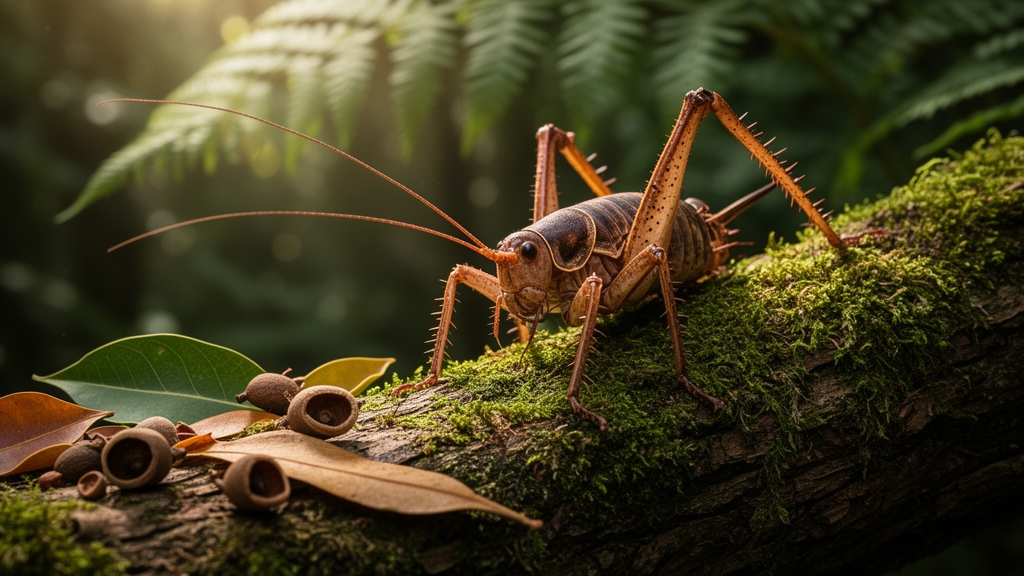
In the dense, temperate rainforests of New Zealand’s South Island, a quiet ecological drama unfolds beneath the leaf litter. Three species of flightless ground weta, belonging to the genus Hemiandrus, coexist in the same forest habitat, yet they have evolved distinct strategies for survival. A new study published in the Journal of Orthoptera Research provides the first comprehensive comparison of these sympatric species, shedding light on their diets, relative abundances, and growth patterns. By analyzing specimens collected over two spring-summer-autumn seasons, researchers have uncovered significant differences in how these nocturnal insects interact with their environment and with each other. This work offers crucial baseline data for understanding the ecology of New Zealand’s endemic orthopterans, which are often overlooked due to their hidden, burrowing lifestyles.
The study focused on three specific species: Hemiandrus electra, Hemiandrus nox, and an undescribed species referred to as Hemiandrus ‘disparalis’. These insects are members of the family Anostostomatidae, a group known for its diversity in New Zealand. While all three species are nocturnal and use soil burrows for shelter during the day, their dietary preferences vary markedly. The researchers examined the crop contents of 66 adult specimens, carefully extracting and analyzing food fragments under a stereomicroscope. The results revealed that H. electra and H. ‘disparalis’ are predominantly herbivorous, with less than 20% of their diet consisting of invertebrate fragments. In stark contrast, H. nox is primarily carnivorous, with approximately 80% of its crop contents identified as animal remains, including insect exoskeletons, antennae, and mandibles.
This dietary divergence suggests a form of resource partitioning, a common ecological strategy that allows multiple species to coexist by reducing direct competition for food. The plant fragments found in the crops of the herbivorous species indicated a polyphagous diet, with evidence of both dicot and monocot plant tissues. For H. nox, the presence of plant matter, though minor, may be incidental, resulting from the consumption of prey that had recently fed on vegetation. The study also noted that there were no significant differences in diet between males and females of any of the three species, a finding that contrasts with some previous studies on other weta species. This suggests that both sexes have similar nutritional requirements or that the coarse level of dietary analysis used in this study did not capture subtle sex-specific variations.
Relative abundance and sex ratios provided further insights into the population dynamics of these weta. A total of 966 specimens were identified from malaise traps set in the St Arnaud forest. H. electra was the most abundant species, accounting for 701 individuals, followed by H. ‘disparalis’ with 157 and H. nox with 109. This pattern aligns with general ecological principles, where species at higher trophic levels, such as the carnivorous H. nox, tend to be less abundant than their herbivorous counterparts. However, the researchers caution that trap interception may reflect behavioral differences, such as climbing activity, rather than true population sizes. The sex ratios were particularly intriguing. While H. ‘disparalis’ and H. nox showed a strong male bias in the traps, with males outnumbering females by more than two to one, H. electra exhibited a nearly even sex ratio of 355 males to 346 females.
The even sex ratio in H. electra is surprising because this species is known for maternal care, a behavior where females remain in their burrows to guard eggs and nymphs. One might expect that females would be less active and therefore less likely to be caught in traps, leading to a male-biased sample. The fact that H. electra females were caught in equal numbers to males suggests that their activity levels, at least during the sampling period, were comparable to those of males. This finding challenges previous assumptions about the behavioral consequences of maternal care in weta and highlights the need for further research into the daily activity patterns of these insects. The other two species, lacking maternal care, showed the expected male bias, possibly because males are more active in searching for mates and food after the mating season.
Another key aspect of the study was the analysis of growth and development in H. electra, the most abundant species. Using hind leg dimensions as a proxy for body size, researchers applied Gaussian mixture models to classify female specimens into five distinct size clusters. These clusters likely correspond to different developmental stages, or instars, with cluster 5 representing adults and cluster 1 representing the smallest nymphs. The distribution of these size classes across the sampling months revealed no clear seasonality in growth. Almost all size classes were present in each month, indicating that H. electra does not synchronize its development with specific seasons. This continuous growth pattern is unusual for many insects, which often have distinct reproductive cycles tied to seasonal changes in temperature and resource availability.
The absence of seasonality in H. electra suggests that the temperate rainforest environment provides a relatively stable set of conditions that support continuous development. While the smallest nymphs were absent in November, December, and April, the presence of all other size classes throughout the year indicates a multivoltine life cycle, where multiple generations can overlap. This finding has implications for understanding the population dynamics of weta in New Zealand’s forests, as it suggests that these insects are not constrained by seasonal bottlenecks in their life cycle. The study also highlights the importance of long-term monitoring programs, such as the Vespula wasp management program from which the weta specimens were collected, in providing valuable data on the ecology of non-target species.
The ecological significance of these findings extends beyond basic biology. Some weta species are considered pests in agricultural settings, particularly in vineyards and orchards. Understanding the natural diet and behavior of wild populations can inform integrated pest management strategies. For instance, knowing that H. electra and H. ‘disparalis’ are primarily herbivorous and feed on a variety of plant species can help identify which crops or plants are most vulnerable to weta damage. Conversely, the carnivorous nature of H. nox suggests that it may play a role in controlling populations of smaller invertebrates in the forest ecosystem. These insights can contribute to more nuanced approaches to managing weta populations in both natural and modified habitats.
Despite the valuable insights provided by this study, several questions remain unanswered. The exact mechanisms driving the dietary differences among the three species are not fully understood. While resource partitioning is a plausible explanation, other factors, such as phylogenetic constraints or historical ecological pressures, may also play a role. Additionally, the study did not investigate the diet of different instars, which could reveal further variations in feeding behavior. Future research should focus on long-term monitoring of weta populations, incorporating more detailed dietary analyses and behavioral observations. By studying these insects in their natural habitats, rather than extrapolating from related taxa, researchers can gain a more accurate understanding of their ecology and evolution. This study serves as a foundation for such future work, highlighting the rich diversity and complexity of New Zealand’s orthopteran fauna.
Subject of Research: Comparison of growth, relative abundance, and diet of three sympatric Hemiandrus ground wētā (Orthoptera, Anostostomatidae) in a New Zealand Forest
Article Title: Comparison of growth, relative abundance, and diet of three sympatric Hemiandrus ground wētā ( Orthoptera , Anostostomatidae ) in a New Zealand Forest
Article References: Chikwature, N., Morgan-Richards, M., Vereijssen, J., & Trewick, S. A. (2025). Comparison of growth, relative abundance, and diet of three sympatric Hemiandrus ground wētā (Orthoptera, Anostostomatidae) in a New Zealand Forest. Journal of Orthoptera Research, 34(1), 1-10. https://doi.org/10.3897/jor.34.123860
Image Credits: AI Generated
Keywords: Comparison, growth, relative, abundance, diet, three, sympatric, Hemiandrus, ground, Orthoptera, Anostostomatidae, Zealand
Cite Scienmag News
Gavin Prescott. (October 18, 2026). New Zealand Weta Study Reveals Distinct Diets and Growth Patterns. Scienmag. https://scienmag.com/new-zealand-weta-study-reveals-distinct-diets-and-growth-patterns/
Gavin Prescott. "New Zealand Weta Study Reveals Distinct Diets and Growth Patterns." Scienmag, 18 October 2026, https://scienmag.com/new-zealand-weta-study-reveals-distinct-diets-and-growth-patterns/. Accessed 18 October 2026.
Gavin Prescott. "New Zealand Weta Study Reveals Distinct Diets and Growth Patterns." Scienmag. October 18, 2026. https://scienmag.com/new-zealand-weta-study-reveals-distinct-diets-and-growth-patterns/


