


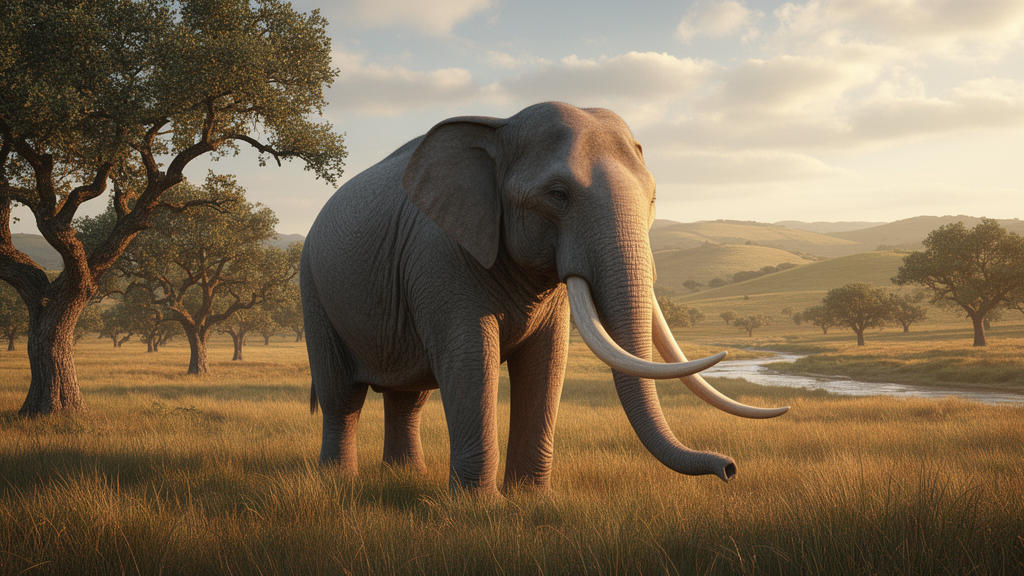
For nearly a million years, the straight-tusked elephant, scientifically known as Palaeoloxodon antiquus, roamed the landscapes of Europe, acting as a colossal force that sculpted the continent’s flora and fauna. As one of the largest herbivores to ever inhabit the region, this extinct megafauna played an integral role in shaping the ecological dynamics of the Pleistocene era. Its presence influenced vegetation structures, nutrient cycling, and the distribution of other species, creating a complex web of interactions that defined the European ecosystem. However, the species vanished approximately 50,000 to 34,000 years ago, a disappearance driven by a combination of climatic shifts and human activity. The loss of such a keystone species triggered significant ecological consequences, leading to the downgrading of trophic systems and the co-extinction of species that depended on the elephant’s ecological functions. Despite its extinction, questions remain about whether the environmental conditions that once supported this massive creature still exist today, and if so, where in modern Europe it might have thrived.
Researchers from the University of Bayreuth and other institutions have recently investigated this question by reconstructing the realised environmental niche of the straight-tusked elephant. By combining a novel compilation of fossil occurrences with palaeoclimate reconstructions, the team aimed to determine if the species could have persisted in the Mediterranean Basin until the present day. The study, published in Frontiers of Biogeography, utilises a Species Distribution Model framework to quantify the past potential distribution of the elephant since its extinction and its current potential distribution given modern climate conditions. This approach allows scientists to overcome the inherent uncertainties in palaeontological data, such as the difficulty in accurately dating fossils and correlating them with precise palaeoclimate reconstructions. By grouping fossil finds into Marine Isotope Stages, which represent distinct glacial or interglacial periods, the researchers were able to create a robust dataset for estimating the species’ realised niche.
The methodology involved compiling 288 reported occurrences of the straight-tusked elephant in Eurasia, of which 119 could be confidently attributed to a specific Marine Isotope Stage and contained precise geographical information. The majority of these occurrences, 105 in total, originated from interglacial sediments, while only 14 came from glacial sediments. The oldest fossils were attributed to Marine Isotope Stage 19, and the youngest to Stage 3. The researchers used climate data from the Last Glacial Maximum and the Last Interglacial period as proxies for cold and warm stages, respectively. They employed a binomial generalised linear model to predict the likelihood of the elephant’s occurrence based on annual mean temperature and annual precipitation. This modelling approach allowed them to assess the suitability of modern European climates for the species, providing insights into where it might have lived had it not gone extinct.
The results of the study indicate that the current climate across Central and Western Europe, excluding the Alps, as well as in the Mediterranean region, is highly suitable for the straight-tusked elephant. The model predicts a high probability of presence along the West Coast of Europe, reaching into the interior up to the Alps and in Great Britain. The northernmost potential distribution spans all of Denmark and includes the southern area of Sweden. In the southeast, the potential distribution extends slightly beyond the Black Sea, while the southernmost range covers all of Türkiye, with higher likelihoods of presence along the coasts. The Mediterranean region, comprising Greece, Italy, the Balkans, and the Iberian Peninsula, is also identified as highly suitable. Conversely, the likelihood of occurrence is much lower in mountainous regions such as the Alps, the Caucasus Mountains, the Carpathians, and the Pyrenees. These findings suggest that, without human-induced extinctions, European fauna would still comprise this extinct megafauna, acting as an ecosystem engineer on a continental scale.
During the Last Glacial Maximum, climatic conditions fragmented the suitable habitat for the straight-tusked elephant, forcing populations to retreat to the Mediterranean Basin. Between 34,000 and 18,000 years ago, the potential distribution of the species in Europe was at its lowest. However, 14,000 years ago, climatic conditions offered suitable habitat at comparable scales to those of 46,000 years ago. This indicates that for over 30,000 years, climatic change had distinctly reduced the suitable habitat for straight-tusked elephants in Europe. The study highlights the Mediterranean coastlines, including the African and Turkish coasts, as the most suitable habitat during this period. These findings support the notion that while glacial periods forced the species into refugia, they did not impede its survival in Europe, suggesting a remarkable resilience to climatic fluctuations.
The implications of these findings extend beyond mere curiosity about extinct species. Understanding the realised niche of the straight-tusked elephant can inform nature conservation efforts by identifying regions where ecosystems have historically adapted to the control regimes of extinct megafauna. Current conservation strategies in Europe primarily focus on shielding biodiversity from human activities through protected areas. However, these measures may fail to re-establish the lost control regimes that large megafauna exerted in the past. Restoring these ecological processes would require a paradigm shift in how biodiversity conservation and ecosystem management are approached. Rewilding, which emphasises the restoration of self-sustaining and complex ecosystems by re-instating natural processes and re-introducing missing species, offers a promising approach. However, the effectiveness of current rewilding initiatives in replicating the ecological roles of extinct megafauna is debated.
Current rewilding efforts have introduced large herbivores such as bison, cattle, and wild horses in an attempt to re-establish lost control regimes. Yet, the functional space of these rewilded assemblages often only partially overlaps with that of extinct communities. The largest herbivores are frequently found to be functionally irreplaceable, making it challenging to fully substitute the ecological roles of extinct megafauna like the straight-tusked elephant. Furthermore, the profound changes in landscape structure, species interactions, and migration dynamics that have reshaped modern ecosystems limit the ability of rewilding to fully restore the intricate ecological roles of extinct species. Large-scale migration dynamics that once connected European ecosystems are no longer feasible in today’s fragmented landscapes, inhibiting essential spatial processes such as seed dispersal and nutrient redistribution.
The study also acknowledges several limitations and potential biases. Seasonal extremes of climatic variables, rather than annual means, may play a significant role in determining the geographical distributions of elephants. The species distribution model employed here makes simplified assumptions about the relationship between environmental variables and the occurrence of the straight-tusked elephant. While increasing model complexity could refine niche estimates, such approaches depend on assumptions that uncertainties in palaeoecological data are negligible, a premise that is difficult to justify. Additionally, the model only considers environmental, but not biotic, predictors. Other neighbouring proboscideans may have limited the natural distribution of the straight-tusked elephant, and discrepancies between empirical findings and model predictions suggest limitations in fully capturing the realised niche of the species.
In conclusion, the findings suggest that under current climatic conditions, European ecosystems could include extinct megafauna such as the straight-tusked elephant. Ecosystems shaped by the control regimes of such megafauna may still possess the resilience and capacity for self-sustainability today. However, protecting nature from human interference alone does not restore the lost control regimes. Rewilding, though promising, must be approached with caution due to the incomplete understanding of the ecological processes that have shaped modern ecosystems and the inherent limitations of re-introducing large herbivores as surrogates for extinct megafauna. The study underscores the need for continued refinement of models and further exploration of the fossil record to improve our understanding of past ecological dynamics and their relevance to modern conservation efforts.
Subject of Research: Reconstruction of the potential modern range of the extinct straight-tusked elephant in Europe
Article Title: Europe’s lost landscape sculptors: Today’s potential range of the extinct elephant Palaeoloxodon antiquus
Article References: Gaiser, F., Müller, C., Phan, P., Mathes, G., & Steinbauer, M. J. (2025). Europe’s lost landscape sculptors: Today’s potential range of the extinct elephant Palaeoloxodon antiquus. Frontiers of Biogeography, 18, Article e135081. https://doi.org/10.21425/fob.18.135081
Image Credits: AI Generated
Keywords: Palaeoloxodon antiquus, Megafauna extinction, Species distribution modelling, European biogeography, Pleistocene climate, Ecosystem engineering, Rewilding, Marine Isotope Stages, Conservation biology, Fossil record, Europe, lost
Cite Scienmag News
Margaret Porter. (October 18, 2026). Europe’s Lost Elephant Could Have Survived Modern Climate. Scienmag. https://scienmag.com/europes-lost-elephant-could-have-survived-modern-climate/
Margaret Porter. "Europe’s Lost Elephant Could Have Survived Modern Climate." Scienmag, 18 October 2026, https://scienmag.com/europes-lost-elephant-could-have-survived-modern-climate/. Accessed 18 October 2026.
Margaret Porter. "Europe’s Lost Elephant Could Have Survived Modern Climate." Scienmag. October 18, 2026. https://scienmag.com/europes-lost-elephant-could-have-survived-modern-climate/


