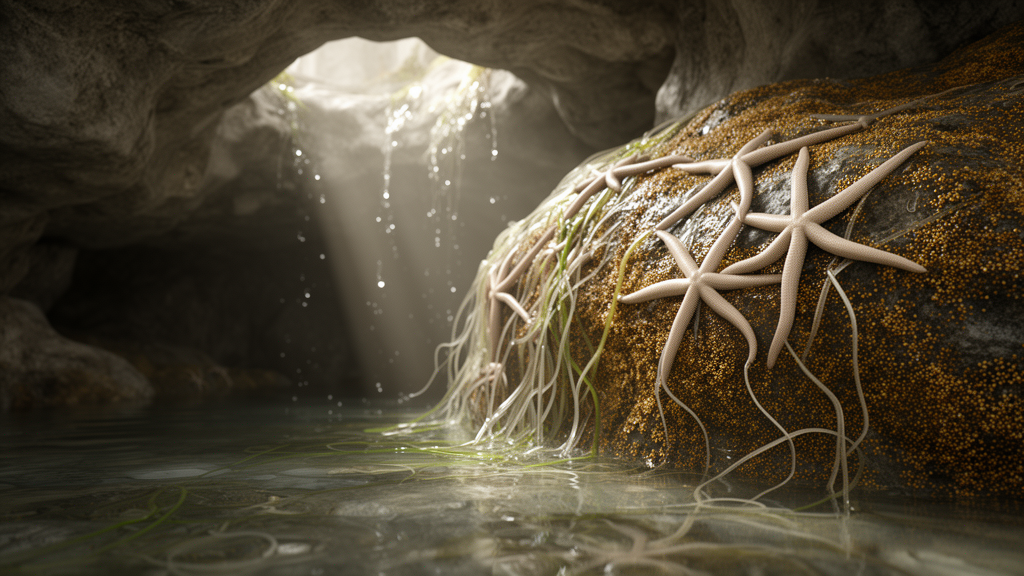
Deep within Bernier Cave on San Salvador Island in the Bahamas, a unique ecological partnership sustains one of the world’s rarest marine invertebrates. The cave brittle star, Amphicutis stygobita, relies entirely on a specific type of detritus for survival, a food source that is itself a complex microbial community. Recent research published in Subterranean Biology reveals that this detritus is dominated by a large diatom named Campylodiscus neofastuosus. This discovery highlights a rare instance where efficient photosynthetic activity by diatoms creates a complex biofilm that feeds an endemic cave species, offering new insights into how life thrives in light-limited subterranean environments.
Bernier Cave is the type locality for A. stygobita, which was described in 2011 as the world’s first known cave brittle star. The species is endemic to Bernier Cave and the nearby Lighthouse Cave, though it is significantly more abundant in the former. Finding these animals is challenging because their small disks, measuring only 3 to 4 millimeters in diameter, are filled with brown detritus that camouflages them against the cave walls. Laboratory experiments have shown that A. stygobita does not accept standard brittle star food but readily consumes the diatom-rich detritus collected from the cave. This specialized diet appears to be the primary reason the population remains stable in this unique habitat.
The cave environment plays a crucial role in supporting this food web. Bernier Cave features a large ceiling entrance that allows both substantial amounts of light and organic detritus to reach the aquatic ecosystem. The water in the cave is brackish, with salinities ranging from 14 to 28 parts per thousand. Tidal fluctuations are relatively slight compared to the surrounding ocean, resulting in slow water movement that allows sizeable accumulations of detritus to settle. A distinctive brown tide line visible on the cave walls is composed largely of C. neofastuosus and other microbes, indicating the prolific growth of this diatom in the entrance room where light is most available.
Campylodiscus neofastuosus, formerly known as Surirella fastuosa, is a large diatom that thrives in brackish water. In the detritus of Bernier Cave, it forms the backbone of the microbial community. While smaller diatom species such as Amphora, Achnanthes, and Orthoseira are more numerous in terms of individual count, C. neofastuosus dominates the biomass due to its large size. The detritus also contains a diverse array of other organisms, including filamentous Chlorophyta, nematodes, ostracods, harpacticoid copepods, ciliates, dinoflagellates, foraminifera, and various bacteria. White bacterial mats, primarily consisting of filamentous sulfur bacteria like Beggiatoa, are also present and are closely associated with the diatom-rich detritus.
One of the most fascinating aspects of C. neofastuosus is its morphological adaptation to the low-light conditions of the cave. The diatom possesses a distinctive cell wall, or frustule, that is concave and slightly heteropolar, resembling a plano-concave lens. This shape is ideal for projecting and focusing light. The frustule acts as an optical device, concentrating the limited available light onto the lens-shaped central area of the cell. Additionally, the diatom has a canal raphe that enhances its motility, allowing it to position itself at the optimal angle for light capture. This structural adaptation is critical for maximizing photosynthetic efficiency in an environment where light is scarce.
The chloroplasts of C. neofastuosus also exhibit remarkable plasticity in response to light levels. In total darkness, the chloroplasts fill almost the entire cell, appearing dark brown due to high concentrations of fucoxanthin. Fucoxanthin is a pigment that efficiently harvests light and transfers excitation energy to chlorophyll a. Under low light conditions, the chloroplasts become lobed and follow the costae, or ribs, of the cell wall, concentrating pigment in the lens-shaped interior. In brighter light, the chloroplasts become more compact and rounded around the nucleus, likely to protect DNA from ultraviolet radiation. This dynamic shape-shifting allows the diatom to optimize its light capture strategy based on environmental conditions.
Beyond its role in photosynthesis, C. neofastuosus produces extracellular polymeric substances, or EPS, which are essential for the formation of the detritus biofilm. These EPS are rich in polysaccharides, monosaccharides, and proteins, and they contain diatom oils including Omega-3 fatty acids. The EPS acts as a sticky glue, binding together various particles and microorganisms to form a fabric-like consistency. This structure is similar to marine snow found in deep-sea environments, which transports nutrients from surface blooms to the abyss. In the cave, this biofilm provides a manageable food source for the brittle star, allowing it to pull the detritus into its mouth with ease.
The nutritional value of the detritus is further enhanced by the symbiotic relationships within the biofilm. The EPS layer, known as the phycosphere, attracts heterotrophic bacteria that supply the diatoms with essential nutrients and cofactors, such as vitamin B12, which diatoms cannot produce themselves. This exchange creates a rich, energy-dense food web that supports not only the brittle star but also a diverse population of detritivores, including nematodes, ostracods, and copepods. The presence of C. neofastuosus makes the detritus in Bernier Cave distinct from that found in other caves, providing a high-quality food source that sustains the endemic population of A. stygobita.
This research underscores the importance of understanding the complex interactions between microorganisms and their environments in subterranean ecosystems. The ability of C. neofastuosus to adapt its morphology and chloroplast structure to low light conditions, combined with its production of nutrient-rich EPS, creates a unique niche that supports rare species. As cave ecosystems continue to face threats from climate change and human activity, preserving these delicate microbial communities is crucial for the survival of endemic species like the cave brittle star. The findings from Bernier Cave offer valuable insights into the resilience of life in extreme environments and the intricate mechanisms that allow organisms to thrive in the absence of abundant light.
Subject of Research: Diatom biofilm ecology and cave brittle star nutrition
Article Title: A biofilm micro-community dominated by the diatom Campylodiscus neofastuosus ( Surirellales ) binds detritus used as food source for rare brittle stars endemic to two Bahamian caves
Article References: Steinitz-Kannan, M., Carpenter, J. H., & Nienaber, M. A. (2025). A biofilm micro-community dominated by the diatom Campylodiscus neofastuosus (Surirellales) binds detritus used as food source for rare brittle stars endemic to two Bahamian caves. Subterranean Biology, 51, 197-212. https://doi.org/10.3897/subtbiol.51.141192
Image Credits: AI Generated
DOI: 10.3897/subtbiol.51.141192
Keywords: diatoms, cave ecology, brittle stars, biofilm, photosynthesis, Bahamas, microbiology, subterranean biology, Campylodiscus neofastuosus, Amphicutis stygobita, micro-community, dominated
Cite Scienmag News
Morgan Morrow. (October 18, 2026). Diatom Biofilm Feeds Rare Cave Brittle Stars. Scienmag. https://scienmag.com/diatom-biofilm-feeds-rare-cave-brittle-stars/
Morgan Morrow. "Diatom Biofilm Feeds Rare Cave Brittle Stars." Scienmag, 18 October 2026, https://scienmag.com/diatom-biofilm-feeds-rare-cave-brittle-stars/. Accessed 18 October 2026.
Morgan Morrow. "Diatom Biofilm Feeds Rare Cave Brittle Stars." Scienmag. October 18, 2026. https://scienmag.com/diatom-biofilm-feeds-rare-cave-brittle-stars/