


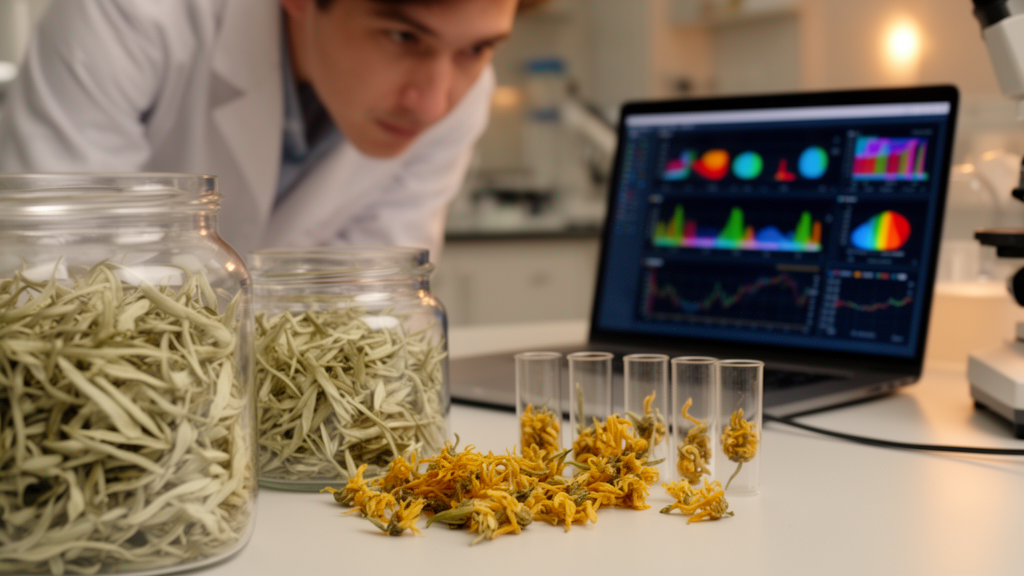
Osmanthus white tea, a delicate fusion of traditional Chinese white tea and the fragrant blossoms of Osmanthus fragrans, has long been prized for its subtle floral notes and health-promoting properties. However, the precise mechanisms governing how scenting parameters influence the final quality of this beverage have remained poorly understood. A new study published in Food Chemistry: X by Yan Huang and colleagues from Wuyi University provides a comprehensive analysis of these dynamics, revealing that specific processing conditions can significantly alter the physicochemical profile, antioxidant capacity, and volatile metabolite composition of the tea. By employing advanced machine learning techniques, the researchers have identified key molecular markers that can predict the scenting intensity, offering a new pathway for optimizing industrial production and ensuring consistent quality in this emerging tea category.
The scenting process, a pivotal step in flower tea production, involves co-processing tea leaves with fresh flowers under controlled environmental conditions to allow the leaves to absorb volatile aromatic compounds. While jasmine tea has traditionally dominated the flower tea market, osmanthus tea has gained considerable attention in recent years due to its distinct sweet-floral aroma and potential health benefits. Previous studies have focused primarily on green and black tea bases, leaving a significant gap in the understanding of how osmanthus scenting interacts with the unique chemical matrix of white tea. White tea, known for its minimal processing, retains high levels of catechins and flavonoids but typically exhibits a subdued aroma, making it an ideal candidate for scenting enhancement. The current study addresses this gap by systematically investigating the effects of scenting frequency, flower-to-tea ratio, and scenting duration on the overall quality of osmanthus white tea.
Using Shoumei white tea as the base material and Dan Gui osmanthus flowers as the floral source, the researchers prepared nine treatment combinations following an orthogonal experimental design. Each sample was subjected to varying numbers of scenting cycles, flower-to-tea ratios, and scenting durations, with an unscented control group included for comparison. The quality of each sample was evaluated through a comprehensive suite of analyses, including sensory evaluation, color difference analysis, physicochemical composition, antioxidant activity, and volatile metabolite profiling. This multi-faceted approach allowed the researchers to capture the complex interplay between processing parameters and tea quality, providing a holistic view of the scenting process.
The results demonstrated that the scenting process significantly modulated the CIELab color parameters of the tea infusions, with increases in a* and b* values indicating a shift toward enhanced red-green and yellow chromaticity. Sensory evaluation revealed that sample No. 8, which underwent three scenting cycles with a 10:5 flower-to-tea ratio and a 10-hour scenting duration, achieved the highest overall score, characterized by a bright yellow liquor, intense and persistent floral aroma, and rich flavor. Physicochemical analysis showed that scenting increased water extract, soluble sugars, and free amino acids, while reducing moisture content and catechin levels. These changes collectively contributed to a more harmonious flavor profile, with enhanced sweetness and umami notes and reduced bitterness and astringency.
Antioxidant activity assays indicated that most scented samples exhibited higher DPPH radical scavenging rates compared to the control, with samples subjected to a 10-hour scenting duration showing the highest activity. Hydroxyl radical scavenging capacity, expressed as IC50 values, was also enhanced in scented samples, although excessive scenting cycles appeared to reduce this capacity. Electronic nose and electronic tongue analyses further confirmed the distinct aroma and taste profiles of the scented teas, with sample No. 7 exhibiting the most balanced taste profile and sample No. 8 showing the richest aroma. These instrumental analyses provided objective validation of the sensory evaluation results, highlighting the consistency between human perception and technical measurements.
Headspace solid-phase microextraction coupled with gas chromatography-mass spectrometry (HS-SPME-GC-MS) identified 137 volatile compounds in the osmanthus white tea samples, with the number of detected aroma species increasing with the number of scenting cycles. The identified compounds were classified into five major chemical categories: terpenes, esters, aldehydes, alcohols, and ketones. Terpenes, including trans-beta-ocimene, constituted the dominant aroma framework, while esters contributed fruity-sweet modulations. Multivariate statistical analysis, including principal component analysis (PCA) and orthogonal partial least squares discriminant analysis (OPLS-DA), revealed clear separation among the different scenting treatments, with 53 compounds exhibiting variable importance in projection (VIP) scores greater than 1. These key discriminatory compounds included 2-methylpentan-3-one, (3E,5E)-3,5-octadien-2-one, and beta-ionone, which are known for their significant contributions to the osmanthus scent identity.
To further elucidate the relationship between volatile compound profiles and scenting intensity, the researchers employed machine learning classification models. Random Forest (RF), Support Vector Machine (SVM), and Extreme Gradient Boosting (XGBoost) classifiers were trained on the 53 VIP compounds to predict the number of scenting cycles. The SVM model achieved the highest macro-averaged area under the curve (AUC) of 0.922 and an accuracy of 76.7%, indicating robust discrimination among the different scenting categories. SHapley Additive exPlanations (SHAP) analysis was used to interpret the feature contributions, identifying n-butyl acrylate, linalyl formate, and (3Z)-hexenyl tiglate as the top discriminatory markers for scenting intensity. These compounds exhibited distinct accumulation or depletion patterns with increasing scenting cycles, providing a molecular basis for the observed quality differences.
Mantel test correlation analysis established a statistically significant link between the key volatile compounds and electronic nose sensor responses, with the strongest correlation observed between (5R,8R,8aS)-5-heptyl-8-methyloctahydroindolizine and the terpene-sensitive W1W sensor. This finding supports the feasibility of using electronic nose technology as a rapid, non-destructive screening tool for osmanthus white tea quality assessment. The convergent identification of marker compounds through OPLS-DA VIP analysis, Mantel test correlation, and SHAP-based machine learning provides strong cross-validation evidence for the reliability of the identified scenting intensity indicators. These results have important practical implications for the industrial-scale production and quality control of high-quality osmanthus white tea.
Despite the promising findings, the study acknowledges several limitations, including the limited sample size for machine learning classification and the semi-quantitative nature of the GC-MS data. Future research with larger datasets, positive controls, and isothermal-exposure controls will be necessary to confirm the robustness and applicability of these findings. Nevertheless, the current study offers valuable insights into the complex interactions between scenting parameters and tea quality, providing a theoretical and practical foundation for optimizing the production of osmanthus white tea. As consumer interest in functional and aromatic teas continues to grow, these findings may pave the way for the development of new tea products with enhanced sensory and health-promoting properties.
Subject of Research: Scenting parameters affect physicochemical quality, antioxidant capacity, and volatile metabolites of osmanthus white tea: an SVM-SHAP analysis
Article Title: Scenting parameters affect physicochemical quality, antioxidant capacity, and volatile metabolites of osmanthus white tea: an SVM-SHAP analysis
Article References: Huang, Y., Hao, S., Cheng, X., Shi, Y., Ma, C., Wu, W., & Wu, Z. (2026). Scenting parameters affect physicochemical quality, antioxidant capacity, and volatile metabolites of osmanthus white tea: an SVM-SHAP analysis. Food Chemistry: X, Article 104629. https://doi.org/10.1016/j.fochx.2026.104629
Image Credits: AI Generated
DOI: 10.1016/j.fochx.2026.104629
Keywords: Scenting, parameters, affect, physicochemical, quality, antioxidant, capacity, volatile, metabolites, osmanthus, white, SVM-SHAP
Cite Scienmag News
Teresa Odom. (October 18, 2026). Machine Learning Decodes Osmanthus White Tea Scenting. Scienmag. https://scienmag.com/machine-learning-decodes-osmanthus-white-tea-scenting/
Teresa Odom. "Machine Learning Decodes Osmanthus White Tea Scenting." Scienmag, 18 October 2026, https://scienmag.com/machine-learning-decodes-osmanthus-white-tea-scenting/. Accessed 18 October 2026.
Teresa Odom. "Machine Learning Decodes Osmanthus White Tea Scenting." Scienmag. October 18, 2026. https://scienmag.com/machine-learning-decodes-osmanthus-white-tea-scenting/


