


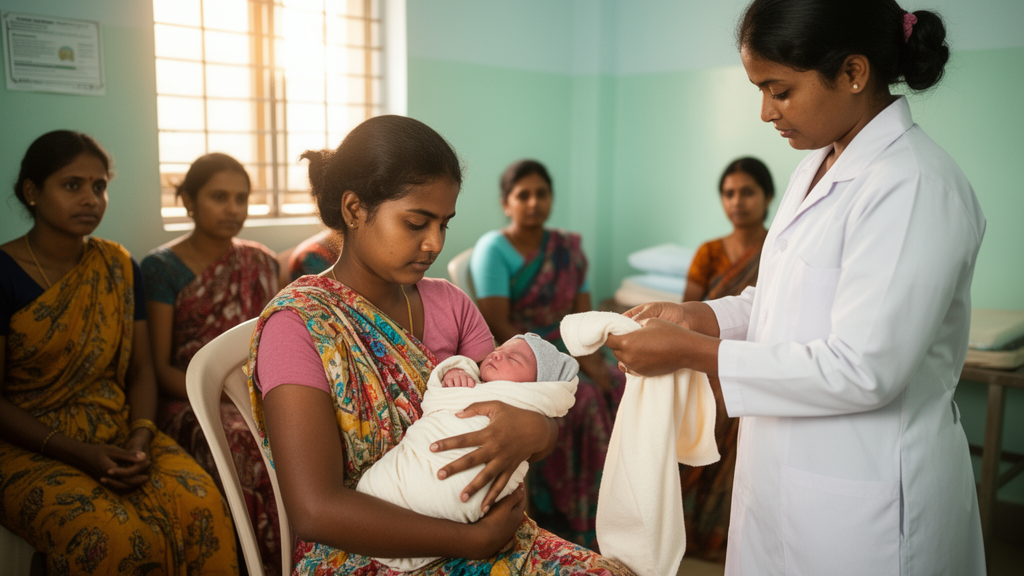
A structured parenting education program delivered in ordinary primary healthcare clinics has produced measurable gains in how confident new parents feel and how responsively they interact with their newborns, according to a mixed-methods study spanning six field sites in Pakistan and Afghanistan. The research, published in BMC Pediatrics, offers some of the clearest evidence yet that the waiting rooms and consultation spaces of routine antenatal and postnatal care can double as powerful engines for early childhood development in two countries where formal parenting support has historically been scarce.
The intervention, known as the Early Childhood Development Parenting Readiness Education Program, or ECD PREP, was embedded directly into the flow of primary healthcare services. Rather than asking parents to attend separate classes at distant venues, the program integrated responsive caregiving education into the same visits where mothers already receive antenatal care, delivery services, and postnatal care. This design choice matters technically: it exploits existing contact points between families and the health system, which is precisely where scalability becomes possible in resource-constrained settings.
Responsive caregiving during the earliest years of life is considered foundational by developmental scientists. The concept covers a parent’s ability to read an infant’s cues, whether a cry signals hunger, discomfort, or overstimulation, and to answer those signals promptly and appropriately. Decades of research link this pattern of interaction to stronger physical growth, cognitive attainment, and socio-emotional adjustment, and it strengthens the parent-child relationship at a stage when the brain is developing at its fastest rate. Healthcare settings, the study’s authors argue, can serve as a hub for promoting and scaling up responsive caregiving among parents who might otherwise never encounter such guidance.
To test whether clinic-based education could actually shift these behaviors, the research team recruited 423 participants, 324 from Pakistan and 99 from Afghanistan, across six field sites, four in Pakistan and two in Afghanistan. The sites were assigned using a controlled allocation: two Pakistani fields and one Afghan field delivered the intervention, while an equal number served as control sites offering standard care. Participants were enrolled through convenience sampling, and the study formed the sequential mixed-method arm of a broader implementation research effort led by teams at Aga Khan University in Karachi and Aga Khan Health Services in Kabul, with funding from the Aga Khan Foundation’s Foundations for Health and Empowerment initiative in partnership with Global Affairs Canada.
The quantitative battery was deliberately multi-dimensional. Parenting confidence was measured with the Karitane Parenting Confidence Scale, a validated instrument that captures a parent’s self-assessed competence in soothing, feeding, and understanding their infant. Overall wellbeing was assessed with the World Health Organization Quality of Life scale, and newborn responsive interaction was scored with the ECD PREP newborn responsive interaction scale, which evaluates observable dimensions of parent-infant exchange. A basic demographics questionnaire rounded out the instruments. Quantitative data were analyzed in SPSS, while qualitative interviews with parents and healthcare professionals were analyzed manually to extract themes about the program’s perceived value.
The numbers tell a striking story. Parents who received the clinic-based education scored significantly higher on parenting confidence than controls, 34.57 plus or minus 6.44 versus 32.52 plus or minus 6.3, a mean difference of 2.05 with a p-value below 0.001. The gap on newborn responsive interaction was even larger in practical terms: 17.89 plus or minus 2.32 in the intervention group against 15.37 plus or minus 4.33 among controls, a mean difference of 2.52, again with p below 0.001. Notably, the standard deviation among intervention parents was roughly half that of the control group on the interaction scale, suggesting that the program did not merely lift the average but also narrowed the spread, raising the floor for parents who might otherwise have struggled most with reading infant cues.
The qualitative interviews added texture that the statistics alone cannot convey. Parents described the intervention as beneficial in two specific ways: it taught them what responsive parenting actually looks like in daily practice, and it helped them develop strong attachment with their newborns. Healthcare professionals, for their part, agreed that the program enhanced their own skills and knowledge in responsive caregiving, an important secondary finding because it indicates the education flows in both directions. When clinic staff feel more capable of coaching families, the intervention becomes self-reinforcing rather than dependent on a single training event.
These results carry weight beyond the study sites. Pakistan and Afghanistan together account for a substantial share of the world’s children growing up in conditions where early stimulation and responsive care are rarely discussed in formal terms, and where the health system is often the only institution in regular contact with new mothers during the first weeks of life. By demonstrating that a continuous, structured parenting education stream can be run inside existing primary healthcare infrastructure, the study provides a template that other low- and middle-income countries could adapt without building new programs from scratch. The finding that confidence and interaction both improved also aligns with a broader technical principle in behavior change: self-efficacy and practice tend to rise together when education is repeated across multiple routine contacts rather than delivered once.
The authors are careful about the study’s design boundaries. Convenience sampling means the participants were not randomly drawn from the general population, and the allocation of sites rather than individuals introduces the possibility of site-level differences influencing outcomes. The published version is also an early-release, peer-reviewed accepted manuscript that remains subject to further editorial refinement. Still, the consistency of the quantitative differences across two countries, combined with converging qualitative themes from both parents and healthcare professionals, strengthens the case that the observed effects reflect the intervention itself rather than local idiosyncrasies.
The study’s central conclusion is direct: a continuous structured parenting education intervention in healthcare settings can improve parental practices in ways that contribute to optimal child development. The authors therefore emphasize the need to integrate parenting education programs at all levels of healthcare settings, from community outreach to facility-based services. For the 423 families who took part, the program changed how they responded to their newborns in the earliest days of life. For health systems across the region, the message is that the same clinics already delivering vaccines and postnatal checkups can, with modest additions, become the front line of the science of responsive caregiving, turning every routine visit into an opportunity to build the parent-child bond that underpins a lifetime of development.
Subject of Research: Pediatrics
Article Title: Newborn parenting education in primary healthcare settings of Pakistan and Afghanistan: impact on confidence and interactions
Article References: Bhamani, S., Nadeem, S., Shams, M., Tikmani, S. S., Aslam, K., Choudhry, S., Jiwa, B., Maab, A., & Delawar, G. (2026). Newborn parenting education in primary healthcare settings of Pakistan and Afghanistan: impact on confidence and interactions. BMC Pediatrics. https://doi.org/10.1186/s12887-026-07587-8
Image Credits: AI Generated
DOI: 10.1186/s12887-026-07587-8
Keywords: responsive caregiving, parenting education, primary healthcare, early childhood development, Pakistan, Afghanistan, newborn care, parent-child interaction, Newborn, parenting, education, primary
Cite Scienmag News
Harold Sullivan. (October 18, 2026). Parenting Classes in Clinics Boost Newborn Care Confidence in Pakistan and Afghanistan. Scienmag. https://scienmag.com/parenting-classes-in-clinics-boost-newborn-care-confidence-in-pakistan-and-afghanistan/
Harold Sullivan. "Parenting Classes in Clinics Boost Newborn Care Confidence in Pakistan and Afghanistan." Scienmag, 18 October 2026, https://scienmag.com/parenting-classes-in-clinics-boost-newborn-care-confidence-in-pakistan-and-afghanistan/. Accessed 18 October 2026.
Harold Sullivan. "Parenting Classes in Clinics Boost Newborn Care Confidence in Pakistan and Afghanistan." Scienmag. October 18, 2026. https://scienmag.com/parenting-classes-in-clinics-boost-newborn-care-confidence-in-pakistan-and-afghanistan/


