


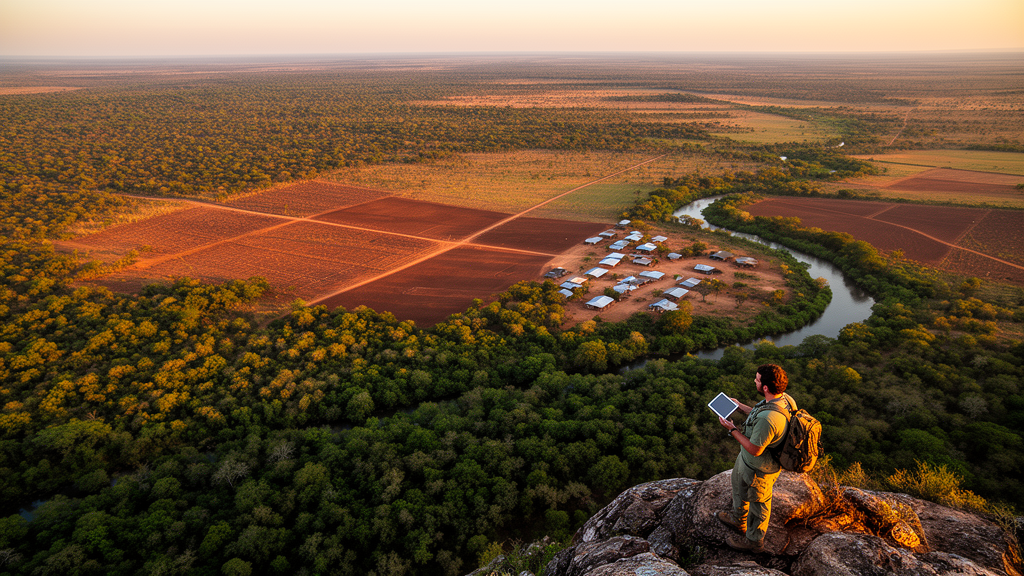
A new study published in Discover Forests provides a detailed quantitative analysis of the forces driving habitat loss in Zambia’s Greater Kafue Ecosystem, one of southern Africa’s most significant protected-area landscapes. Researchers from Copperbelt University utilized a Random Forest machine learning model to identify the specific socio-economic, climatic, and topographic factors that predict where natural habitat is most likely to be converted to anthropogenic uses. The study, led by Gift Mulenga, Darius Phiri, Matamyo Simwanda, and Vincent R. Nyirenda, offers a spatially explicit framework for conservation planning that moves beyond simple change detection to understand the underlying pressures affecting the ecosystem.
The Greater Kafue Ecosystem comprises Kafue National Park and nine surrounding Game Management Areas, covering approximately 66,000 square kilometers. Between 1984 and 2024, the proportion of natural habitat in the region declined from approximately 98.31% to 83.96%, a transformation that has been spatially heterogeneous across the landscape. Some Game Management Areas have retained over 96% of their natural cover, while others have fallen below 40%, indicating that local factors interact with regional pressures to produce distinct outcomes. This variability highlights the need for targeted interventions rather than uniform conservation policies across the entire ecosystem.
To address this complexity, the researchers employed a Random Forest classifier, an ensemble learning algorithm known for its ability to handle high-dimensional data and capture non-linear relationships. The model was trained on a binary response variable derived from Landsat satellite classifications for 1984 and 2024, which distinguished between natural cover types such as forest and grassland, and anthropogenic types such as cropland and built-up areas. Fourteen predictor variables were evaluated, including population density, distance to settlements, mean annual rainfall, elevation, and the proportion of cultivated land within a one-kilometer neighborhood.
The model demonstrated strong predictive performance on an independent, spatially blocked test set, achieving an accuracy of 0.77 and an Area Under the Curve (AUC-ROC) of 0.83. The F1-score of 0.81 and Cohen’s Kappa of 0.53 further confirmed the model’s reliability, with ten-fold spatial cross-validation showing stable results. A higher false-positive rate compared to the false-negative rate indicated a precautionary bias, which is particularly suitable for conservation screening where identifying potential risk areas is prioritized over missing them.
Among the fourteen predictors, the percentage of cultivated land emerged as the dominant factor, accounting for 33.6% of the total variable importance. This was followed by mean annual rainfall at 12.0% and distance to settlements at 11.89%. The analysis revealed that socio-economic factors collectively contributed approximately 47.3% of the predictive power, significantly outweighing climatic, topographic, and conservation status variables. This finding aligns with broader evidence that smallholder agricultural expansion is the primary pathway of habitat conversion in sub-Saharan African woodlands.
The study identified specific cut-points where the predicted probability of habitat loss changes sharply. For cultivated land, a threshold of approximately 10% cover within a local area marked a significant increase in susceptibility, with loss probability rising from 11.3% below this level to 79.9% above it. Similarly, areas within 4 kilometers of settlements showed a high-risk influence zone, with a 75.1% probability of loss compared to 25.7% beyond that distance. These statistical cut-points serve as operational early-warning indicators for conservation managers, although they are not validated ecological thresholds.
Spatial susceptibility mapping revealed pronounced contrasts across the ecosystem. The Game Management Areas of Bilili, Namwala, and Mumbwa were identified as the principal high-susceptibility zones, with Bilili showing the highest risk at 94.5% of its area classified as high or very high susceptibility. In contrast, Kafue National Park remained predominantly low risk, with 95.4% of its area classified as very low susceptibility. This spatial differentiation supports a strategy of targeted monitoring and preventive action in the most vulnerable Game Management Areas, while recognizing that the national park remains relatively stable.
The researchers also conducted a sensitivity analysis to address potential endogeneity in the cultivated-land predictor, which is temporally close to the 2024 outcome. When the model was refitted without this variable, performance declined but remained well above chance, indicating that the predictive skill is not solely dependent on this single factor. However, the dominance of socio-economic predictors was conditional on the inclusion of cultivated land, with climatic and proximity variables becoming more prominent in its absence. This nuance is crucial for interpreting the results and designing robust conservation strategies.
The study acknowledges several limitations, including the cross-sectional nature of the analysis, which prevents the establishment of temporal causation. Most socio-economic predictors represent conditions around 2020–2021, while the response integrates conversion over four decades. Additionally, the model’s reliance on a companion Landsat classification means that thematic and change-detection errors propagate into the results. Despite these constraints, the study provides a valuable methodological template for applying machine learning to conservation challenges in other African multi-use landscapes.
By integrating the Human-Environment Interaction and Driver-Pressure-State-Impact-Response frameworks with interpretable machine learning, the study offers a comprehensive view of habitat loss drivers in the Greater Kafue Ecosystem. The findings underscore the critical role of agricultural expansion and accessibility in shaping conservation outcomes and provide actionable metrics for prioritizing interventions. As the ecosystem continues to face pressures from population growth and land-use change, this spatially explicit approach can help guide effective and targeted conservation efforts to protect its rich biodiversity.
Subject of Research: Drivers of habitat loss in Zambia's Greater Kafue Ecosystem
Article Title: Drivers of forest loss and habitat degradation in Zambia’s Greater Kafue Ecosystem
Article References: Mulenga, G., Phiri, D., Simwanda, M., & Nyirenda, V. R. (2026). Drivers of forest loss and habitat degradation in Zambia’s Greater Kafue Ecosystem. Discover Forests, 2(1), Article 81. https://doi.org/10.1007/s44415-026-00143-3
Image Credits: AI Generated
DOI: 10.1007/s44415-026-00143-3
Keywords: habitat loss, Random Forest, Zambia, Greater Kafue Ecosystem, agricultural expansion, conservation planning, remote sensing, Miombo woodlands, spatial analysis, biodiversity, Drivers, forest
Cite Scienmag News
Teresa Odom. (October 18, 2026). Machine Learning Maps Habitat Loss Drivers in Zambia. Scienmag. https://scienmag.com/machine-learning-maps-habitat-loss-drivers-in-zambia/
Teresa Odom. "Machine Learning Maps Habitat Loss Drivers in Zambia." Scienmag, 18 October 2026, https://scienmag.com/machine-learning-maps-habitat-loss-drivers-in-zambia/. Accessed 18 October 2026.
Teresa Odom. "Machine Learning Maps Habitat Loss Drivers in Zambia." Scienmag. October 18, 2026. https://scienmag.com/machine-learning-maps-habitat-loss-drivers-in-zambia/


