


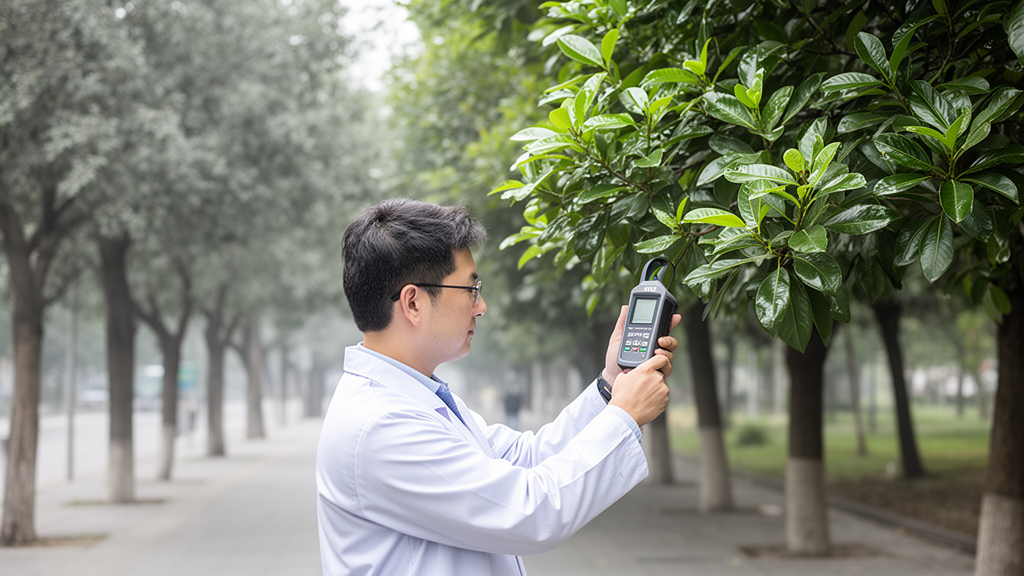
Urban vegetation serves as a critical line of defense against air pollution, with leaves acting as natural filters that capture particulate matter from the atmosphere. However, quantifying the exact mass of dust accumulated on these leaves has traditionally required destructive sampling methods, such as washing and filtration, which are labor-intensive and impractical for large-scale monitoring. A new study published in Environmental Monitoring and Assessment offers a nondestructive alternative by leveraging ultraviolet, visible, and near-infrared spectroscopy to assess foliar particulate retention. The research, conducted by Ziyi Huang, Yulong Guo, and Zhengwei Huang from Nanjing Forestry University, demonstrates that spectral models can be transferred between different plant species with significant accuracy, provided that specific calibration corrections are applied. This approach holds the potential to revolutionize how cities monitor the health and pollution-capturing capacity of their green infrastructure.
The study focused on two common urban shrub species: Ligustrum japonicum ‘Howardii’ and Photinia × fraseri ‘Red Robin’. Researchers sampled 180 leaves of the former and 45 leaves of the latter from three distinct urban environments in Nanjing, China: park zones, street zones, and industrial zones. These locations were chosen to represent a gradient of pollution exposure, with industrial areas typically exhibiting higher particulate loads. By measuring reflectance spectra before particle removal and using the mass per unit leaf area recovered through washing as the quantitative reference, the team established a robust baseline for comparing nondestructive spectral predictions against physical measurements. This dual-species design allowed the researchers to test the generalizability of their models, a critical step for any technology intended for widespread urban application.
The core of the investigation involved evaluating two separate tasks: classifying the functional zone of the leaf’s origin and predicting the absolute mass of particulate matter. Models were initially fitted on the source species, Ligustrum japonicum, and then tested on the target species, Photinia × fraseri. This cross-species transfer is a significant challenge in remote sensing and spectroscopy because different plant species have unique leaf structures, pigment compositions, and surface textures that affect how light is reflected. The researchers compared various preprocessing methods and wavelength schemes to determine which spectral regions were most informative for distinguishing pollution levels. The goal was to identify a spectral signature that could reliably indicate dust load regardless of the specific plant species, thereby creating a universal tool for urban ecologists.
For the classification task, which aimed to identify whether a leaf came from a park, street, or industrial zone, the results were promising. Among the tested schemes, the joint exclusion of selected endpoint and water-related spectral intervals yielded a target classification accuracy of 91.1%. This high accuracy suggests that the spectral differences between pollution zones are robust enough to be detected even when transferring models from one species to another. Water-related intervals were excluded because water absorption features can dominate the near-infrared spectrum and potentially obscure the subtle signals related to particulate deposition. By focusing on the remaining spectral bands, the model could effectively distinguish the environmental context of the leaf, providing a rapid way to categorize urban green spaces based on their exposure to pollution.
However, the prediction of absolute particulate mass proved more complex. The full-spectrum model, which utilized the entire range of measured wavelengths, performed best among the tested alternatives for the source species. Yet, when applied directly to the 45 target leaves of Photinia × fraseri, the model showed limited absolute agreement, with an R-squared value of only 0.265 and a positive bias. This discrepancy highlights the inherent difficulty of cross-species transfer; while the relative patterns of pollution might be preserved, the absolute magnitude of the spectral response to dust varies between species. The positive bias indicates that the model tended to overestimate the dust load on the target species, likely due to differences in leaf surface reflectance properties that were not fully captured by the source species calibration.
To address this limitation, the researchers implemented a linear output correction strategy. This method involved using a small subset of 15 target reference leaves, with five leaves from each of the three functional zones, to adjust the model’s predictions. The corrected model was then tested on the remaining 30 leaves in each of 50 repeated splits to ensure statistical robustness. The results of this calibration correction were striking: the corrected test R-squared averaged 0.797 with a standard deviation of 0.042. This significant improvement demonstrates that a small number of reference measurements can effectively bridge the gap between source and target species, making the nondestructive method viable for practical use. The success of this linear correction suggests that the relationship between spectral reflectance and particulate mass, while shifted, remains linear across the two species studied.
The implications of these findings extend beyond the specific species and location studied. Urban planners and environmental managers often rely on a diverse mix of plant species to create green spaces. The ability to use a single, calibrated spectral model across multiple species could streamline monitoring efforts, reducing the need for species-specific calibration datasets. This is particularly important in cities where vegetation is heterogeneous and changing seasonally. The study’s focus on Nanjing, a major metropolitan area in China, provides a relevant case study for other rapidly urbanizing regions facing significant air quality challenges. The integration of machine learning with spectroscopy offers a scalable solution for assessing the ecosystem services provided by urban trees and shrubs.
Despite the promising results, the authors acknowledge several limitations that must be considered before broader application. The study was conducted in a specific geographic location and with only two species, which limits the generalizability of the findings to other climates and plant types. Furthermore, the unmeasured deposit and leaf properties, such as the specific composition of the particulate matter and the detailed microstructure of the leaf surface, limit the mechanistic interpretation of the spectral signals. The model captures the statistical relationship between reflectance and mass but does not fully explain the physical and chemical interactions that govern light scattering and absorption in the presence of dust. Future research should aim to incorporate more detailed leaf trait data to improve the mechanistic understanding of these spectral responses.
Reference uncertainty and leaf dependence also remain areas requiring further validation. The accuracy of the nondestructive method relies on the quality of the reference measurements obtained through washing and filtration. Any errors in these reference values will propagate into the spectral models. Additionally, the dependence on specific leaf conditions, such as health status and age, could affect the spectral baseline. The target-based scheme selection used in this study, where the optimal preprocessing and wavelength intervals were chosen based on the target species performance, is a practical approach but may not be optimal for all scenarios. Further validation across a wider range of species, locations, and pollution levels is necessary to establish the robustness of this method for global urban monitoring.
In conclusion, this study presents a significant step forward in the nondestructive assessment of foliar particulate retention in urban vegetation. By demonstrating that spectral models can be successfully transferred between species with the aid of linear output correction, the researchers have provided a practical tool for monitoring urban air quality and the performance of green infrastructure. The high classification accuracy and improved mass prediction after calibration highlight the potential of UV–Vis–NIR spectroscopy as a rapid, non-invasive method for environmental assessment. As cities continue to prioritize green solutions to pollution, such technologies will play an increasingly important role in managing and optimizing urban ecosystems. The work underscores the value of interdisciplinary approaches that combine plant physiology, spectroscopy, and machine learning to address complex environmental challenges.
Subject of Research: Nondestructive spectral assessment of particulate matter on urban leaves
Article Title: Nondestructive UV–Vis–NIR assessment of foliar particulate retention in urban vegetation: cross-species transfer and calibration correction
Article References: Huang, Z., Guo, Y., & Huang, Z. (2026). Nondestructive UV–Vis–NIR assessment of foliar particulate retention in urban vegetation: cross-species transfer and calibration correction. Environmental Monitoring and Assessment, 198(11), Article 1220. https://doi.org/10.1007/s10661-026-16062-x
Image Credits: AI Generated
DOI: 10.1007/s10661-026-16062-x
Keywords: UV-Vis-NIR spectroscopy, urban vegetation, particulate matter, cross-species transfer, calibration correction, environmental monitoring, leaf reflectance, air quality, machine learning, nondestructive testing, Nondestructive, assessment
Cite Scienmag News
Russell Cooper. (October 18, 2026). Spectral Models Predict Urban Leaf Dust Load Across Species. Scienmag. https://scienmag.com/spectral-models-predict-urban-leaf-dust-load-across-species/
Russell Cooper. "Spectral Models Predict Urban Leaf Dust Load Across Species." Scienmag, 18 October 2026, https://scienmag.com/spectral-models-predict-urban-leaf-dust-load-across-species/. Accessed 18 October 2026.
Russell Cooper. "Spectral Models Predict Urban Leaf Dust Load Across Species." Scienmag. October 18, 2026. https://scienmag.com/spectral-models-predict-urban-leaf-dust-load-across-species/


