


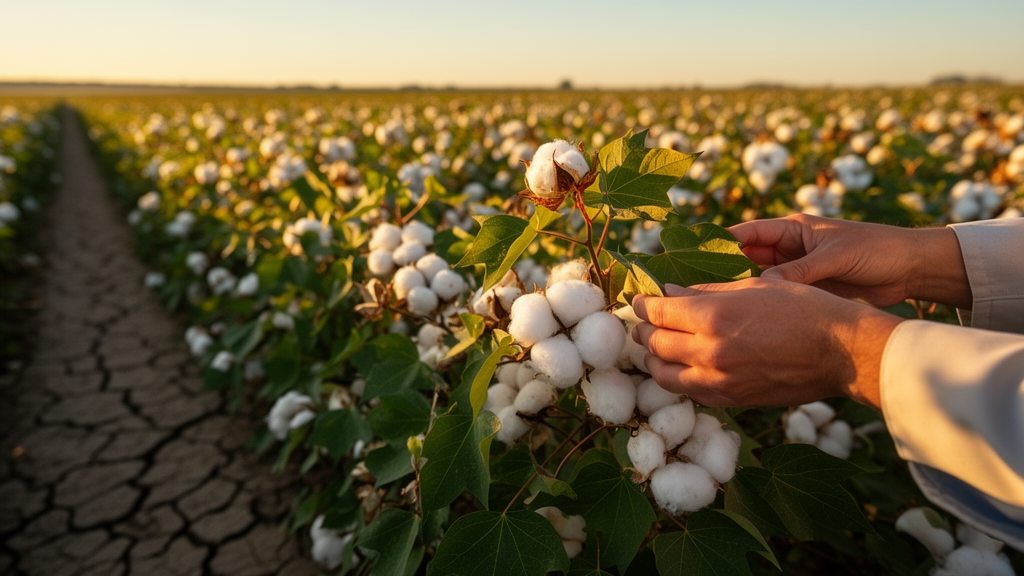
Cotton is one of the most economically important fiber crops on the planet, but the plants that produce it are increasingly under siege. Drought, high temperatures, and soil salinity — all intensifying as climate change reshapes growing regions — can slash yields and degrade fiber quality. Now, a research team led by scientists at MNS University of Agriculture in Multan, Pakistan, has taken a deep dive into a little-studied family of plant proteins that may hold keys to helping cotton survive these assaults. Their findings, published in BMC Plant Biology, offer a genome-wide map of germin-like proteins (GLPs) in upland cotton and reveal specific genes that spring into action when the plant faces environmental stress.
Germin-like proteins belong to the ancient Cupin superfamily, a group of genes conserved across the plant kingdom and known for remarkable functional versatility. GLPs have been implicated in plant defense, development, and responses to both biotic threats like pathogens and abiotic challenges such as water scarcity and salt accumulation. Many GLPs exhibit oxalate oxidase activity, generating hydrogen peroxide — a signaling molecule that can trigger protective responses — while others participate in cell wall strengthening, seed development, and stress perception. Despite their importance in other crops, the GLP family had never been systematically characterized in cotton, leaving a significant gap in understanding how this vital crop copes with hostile conditions.
The research team, which included collaborators from Shenzhen University in China, South-Central Minzu University in Wuhan, the University of Sargodha in Pakistan, and Harran University in Türkiye, set out to fill that gap. Using bioinformatic tools, they scoured the cotton genome and identified 32 GLP members — a family size that provides ample raw material for evolutionary innovation and functional specialization. The researchers then subjected these genes to a battery of computational analyses designed to uncover their evolutionary history, structural features, and expression behavior under stress.
To trace the lineage and conservation of GLP genes, the team retrieved GLP sequences not only from cotton but also from monocots, eudicots, model organisms, and primitive plant species. By constructing phylogenetic trees that compared these sequences across the plant tree of life, they could infer which cotton GLPs are most closely related to well-characterized genes in other species and which may have evolved unique functions. This evolutionary framework was reinforced by analyses of conserved protein motifs, functional domains, and gene structures — the exon-intron architectures that often reveal how genes have been duplicated, rearranged, or modified over millions of years.
One of the most revealing parts of the investigation focused on gene duplication. Plants frequently duplicate genes, and the extra copies can then diverge in function — a process called subfunctionalization or neofunctionalization that allows organisms to acquire new capabilities without losing essential ones. The researchers used both circular and linear collinearity analyses to detect intra- and inter-chromosomal duplication events within the cotton genome. These analyses confirmed that segmental and tandem duplications have shaped the GLP family in cotton, providing the genetic raw material that enables different family members to respond to distinct environmental cues.
With the structural and evolutionary groundwork laid, the team turned to expression data. They mined digital gene expression datasets to identify which GhGLP genes respond to three major abiotic stresses: drought, high temperature, and salinity. The results were striking. Several genes — including GhGLP2, GhGLP3, GhGLP12, GhGLP19, and GhGLP25 — showed significantly higher transcript abundance under stress conditions compared to normal growing conditions. This upregulation suggests that these particular GLP genes are recruited by the plant’s stress-response machinery when environmental conditions turn hostile.
Digital expression data, however, can sometimes be noisy or confounded by experimental variables. To ensure their findings were robust, the researchers validated the expression patterns using quantitative real-time polymerase chain reaction (qRT-PCR), a laboratory technique that measures the actual abundance of specific messenger RNA molecules with high precision. The qRT-PCR results confirmed the digital expression predictions, providing strong evidence that the identified GhGLP genes are genuinely activated under drought, heat, and salt stress rather than being artifacts of computational analysis.
The implications of this work extend well beyond basic plant biology. Cotton farmers worldwide face mounting pressure from climate-driven stresses that can devastate yields. Breeding programs that incorporate stress-responsive genes — such as the highly upregulated GhGLP2, GhGLP3, GhGLP12, GhGLP19, and GhGLP25 identified in this study — could potentially develop cotton varieties that maintain productivity under marginal growing conditions. Marker-assisted selection, genomic editing, and transgenic approaches could all leverage these findings to engineer or select for enhanced stress tolerance.
The study also contributes to a broader scientific conversation about how gene families evolve and diversify in crop plants. By comparing cotton GLPs with those from monocots, eudicots, and primitive species, the researchers have built a phylogenetic framework that can inform similar investigations in other crops. The combination of genome-wide identification, evolutionary analysis, structural characterization, and expression validation represents a template for studying other gene families that may play roles in stress adaptation.
As climate change continues to challenge agricultural systems globally, understanding the molecular underpinnings of stress tolerance becomes ever more urgent. This research illuminates one piece of that puzzle — the germin-like protein family in cotton — and provides a foundation for future work aimed at translating genomic insights into practical breeding strategies. The team’s identification of specific stress-responsive GhGLP genes offers concrete targets for scientists and breeders working to safeguard one of the world’s most important fiber crops against an increasingly unpredictable environment.
Subject of Research: Genome-wide characterization of the germin-like protein gene family in upland cotton and its expression response to abiotic stresses
Article Title: Genome-wide characterization and expression divergence of germin-like protein (GLP) family in upland cotton (Gossypium hirsutum L.) in response to abiotic stress conditions
Article References: Gul, F., Akram, U., Abdullah, M., Khan, Z., Tabasum, S., Sher, M. A., Hong, L., Khan, M. A., Farooq, S., Alramadan, Y., & Ahmad, F. (2026). Genome-wide characterization and expression divergence of germin-like protein (GLP) family in upland cotton (Gossypium hirsutum L.) in response to abiotic stress conditions. BMC Plant Biology. https://doi.org/10.1186/s12870-026-09966-w
Image Credits: AI Generated
DOI: 10.1186/s12870-026-09966-w
Keywords: cotton, germin-like proteins, Gossypium hirsutum, abiotic stress, drought, salinity, heat stress, gene family, phylogenetics, gene expression, qRT-PCR, plant stress response
Cite Scienmag News
Juliet Wilcox. (October 18, 2026). Hidden Stress Genes in Cotton Could Shield Crops From Drought, Heat and Salt. Scienmag. https://scienmag.com/hidden-stress-genes-in-cotton-could-shield-crops-from-drought-heat-and-salt/
Juliet Wilcox. "Hidden Stress Genes in Cotton Could Shield Crops From Drought, Heat and Salt." Scienmag, 18 October 2026, https://scienmag.com/hidden-stress-genes-in-cotton-could-shield-crops-from-drought-heat-and-salt/. Accessed 18 October 2026.
Juliet Wilcox. "Hidden Stress Genes in Cotton Could Shield Crops From Drought, Heat and Salt." Scienmag. October 18, 2026. https://scienmag.com/hidden-stress-genes-in-cotton-could-shield-crops-from-drought-heat-and-salt/


