


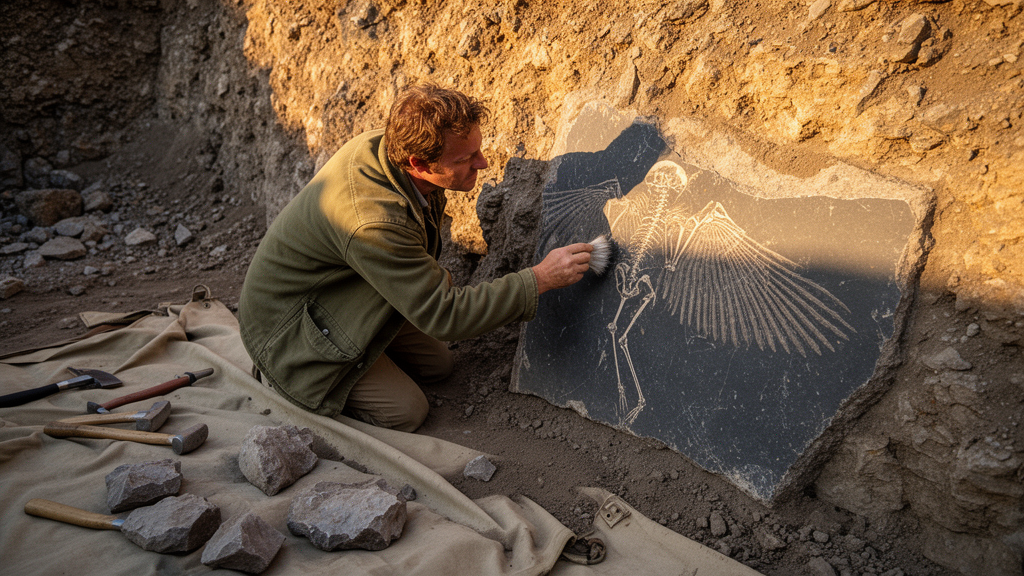
A newly described specimen of Archaeopteryx has emerged from the limestone quarries of Bavaria, adding a crucial piece to the puzzle of early bird evolution. This fossil, designated as SMNK-PAL 10,000, was discovered in the lower Tithonian Mörnsheim Formation near Mühlheim, Germany. It represents the third avialan specimen found in this specific geological formation and the twelfth known specimen attributed to the genus Archaeopteryx. The discovery underscores the continued significance of the Franconian Alb region, a site renowned for its exceptionally preserved fossils from the Late Jurassic period. Researchers have carefully analyzed the skeleton, which includes the right forelimb and shoulder, as well as fragments of the left forelimb and both hind limbs, providing new insights into the morphology of these ancient creatures.
The specimen was unearthed on May 31, 2019, by a researcher in the ‘Fossilien-Besuchersteinbruch’ or visitors’ fossil quarry. The layer from which it was extracted is located 2.5 meters below a marker layer known as ‘Dicke Emma’ and 1.5 meters below the ‘Vierte Rosa’. Due to the brittle and clayey nature of the rock, the fossil broke into nine pieces upon discovery. Despite this fragmentation, the careful removal and reorganization of the pieces allowed for the preparation of the preserved forelimb bones. The presence of additional fragments nearby suggests that the original specimen may have been more complete than what was recovered, hinting at the potential for further discoveries in the area.
Despite significant alteration by late diagenesis, the fossil can be referred to Archaeopteryx sp. based on the morphology of its furcula, coracoid, humerus, and radius. A key element in this identification is a manual ungual, or claw, which nests within the morphospace of Archaeopteryx rather than that of Anchiornis, a related genus. Phylogenetic analyses further support the assignment of the new specimen to Archaeopteryx. However, due to the fossil’s state of preservation and the still-unresolved taxonomy of the genus at the species level, an identification beyond the genus remains impossible. This highlights the ongoing challenges in classifying these ancient birds, where subtle morphological differences can be difficult to distinguish from taphonomic artifacts.
The geological context of the Mörnsheim Formation is distinct from the more famous Altmühltal Formation, which has yielded the majority of Archaeopteryx specimens. The Mörnsheim Formation is slightly younger, representing the topmost horizon of the Hybonotum zone. It is characterized by a higher number of silicified limestone beds, particularly in its lower part. Fossils from this formation are often at least partially disarticulated and fragmentary, suggesting a different taphonomic context compared to the underlying Altmühltal Formation. The assemblage includes a diversity of invertebrates and vertebrates, such as chondrichthyans, actinopterygians, turtles, rhynchocephalians, and pterosaurs, providing a broader picture of the Late Jurassic ecosystem in the region.
Technical analyses of the specimen included X-ray computed tomography (CT) scans, which revealed details not visible to the naked eye. The CT scans showed that certain features, such as longitudinal furrows on the radius and phalanges, are likely the result of compaction rather than original anatomical structures. This finding is significant because it suggests that some morphological characteristics previously used to distinguish between different taxa may be taphonomic artifacts. The study also employed geometric morphometrics to analyze the shape of the manual unguals, comparing them with those of known Archaeopteryx and Anchiornis specimens. The results indicated that the ungual of the new specimen has a stronger affinity with Archaeopteryx, further supporting its classification.
Phylogenetic analyses were conducted using a revised matrix that included 179 terminal taxa and 597 characters. The analyses were performed using both equally weighted and implied weighted characters to determine the phylogenetic position of the new specimen. The results placed SMNK-PAL 10,000 in a polytomy with Archaeopteryx, lacking any autapomorphic characters that distinguish it from the latter. This placement suggests that the new specimen does not represent a distinct species but rather adds to the known variation within the genus. The analyses also provided insights into the relationships among other paravian theropods, confirming the sister group relationship between Dromaeosauridae and Avialae in this particular analysis.
The discovery of this new specimen adds to the growing body of evidence that Archaeopteryx underwent evolutionary changes and may have split into different species over its existence. The genus is known to have existed over a range of at least 64 kilometers and for a timespan of at least 700,000 to one million years. Morphological variations within the genus, such as differences in dentition and limb proportions, suggest that these ancient birds were not a static group but were undergoing dynamic evolutionary processes. The new specimen, with its humerus and ulna lengths most similar to those of the Munich specimen, fits within this pattern of variation, contributing to our understanding of the diversity and evolution of early birds.
The study also highlights the importance of considering taphonomic effects when interpreting fossil morphology. The compaction and impaction of the bones in SMNK-PAL 10,000 resulted in features that could be mistaken for anatomical structures. This underscores the need for careful analysis and the use of advanced imaging techniques to distinguish between original features and artifacts. The findings have implications for the interpretation of other fossils from the Solnhofen Archipelago, suggesting that some diagnostic characters may need to be re-evaluated in light of taphonomic processes. This careful approach to fossil analysis is crucial for building an accurate picture of the evolution of birds and their relatives.
In conclusion, the new Archaeopteryx specimen from the Mörnsheim Formation provides valuable insights into the morphology and evolution of early birds. While its fragmentary nature limits the level of taxonomic identification, its assignment to Archaeopteryx is supported by multiple lines of evidence, including morphological comparisons and phylogenetic analyses. The study also emphasizes the importance of considering taphonomic effects in fossil interpretation, highlighting the need for further research to resolve the taxonomy of these iconic paravians. As more specimens are discovered and analyzed, our understanding of the origin and evolution of birds will continue to deepen, revealing the complex history of life on Earth.
Subject of Research: Description and phylogenetic analysis of a new Archaeopteryx specimen from the Late Jurassic Mörnsheim Formation
Article Title: A new Archaeopteryx from the lower Tithonian Mörnsheim Formation at Mühlheim (Late Jurassic)
Article References: Foth, C., van de Kamp, T., Tischlinger, H., Kantelis, T., Carney, R. M., Zuber, M., Hamann, E., Wallaard, J. J. W., Lenz, N., Rauhut, O. W. M., & Frey, E. (2025). A new Archaeopteryx from the lower Tithonian Mörnsheim Formation at Mühlheim (Late Jurassic). Fossil Record, 28(1), 17-43. https://doi.org/10.3897/fr.28.131671
Image Credits: AI Generated
DOI: 10.3897/fr.28.131671
Keywords: Archaeopteryx, Paleontology, Late Jurassic, Bird evolution, Fossil discovery, Bavaria, Mörnsheim Formation, Phylogenetics, Taphonomy, Theropoda, lower, Tithonian
Cite Scienmag News
Gavin Prescott. (October 18, 2026). New Archaeopteryx Fossil Reveals Complex Bird Origins. Scienmag. https://scienmag.com/new-archaeopteryx-fossil-reveals-complex-bird-origins/
Gavin Prescott. "New Archaeopteryx Fossil Reveals Complex Bird Origins." Scienmag, 18 October 2026, https://scienmag.com/new-archaeopteryx-fossil-reveals-complex-bird-origins/. Accessed 18 October 2026.
Gavin Prescott. "New Archaeopteryx Fossil Reveals Complex Bird Origins." Scienmag. October 18, 2026. https://scienmag.com/new-archaeopteryx-fossil-reveals-complex-bird-origins/


