


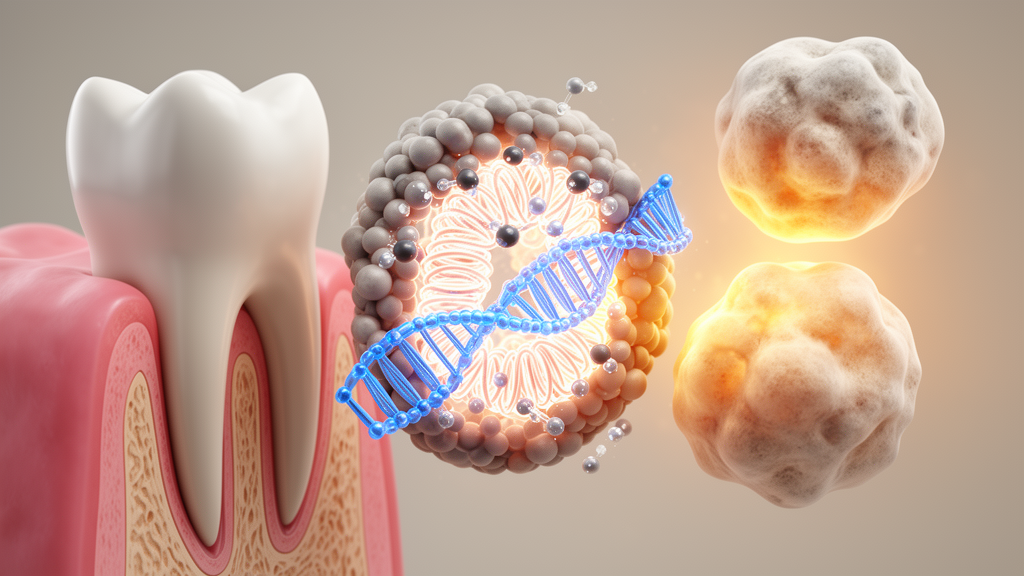
A delayed or failed eruption of the permanent teeth is a defining feature of cleidocranial dysplasia, an autosomal dominant disorder caused by mutations in the RUNX2 gene. Why these teeth become impacted has remained unclear, but a study published in Cell Death Discovery points to an unexpected driver: the senescence of dental follicle cells, which are known to coordinate the osteoclastogenesis and osteogenesis involved in eruption. The researchers report that RUNX2 regulates this senescence program through an epigenetic mechanism involving histone lactylation at the H3K18 position of chromatin.
The evidence begins with human tissue. In dental follicle samples from patients with cleidocranial dysplasia, the team found a significant reduction in cells positive for senescence-associated beta-galactosidase and for P16INK4a, a marker of cellular senescence, compared with samples from healthy controls. This observation built on the group’s earlier work showing that RUNX2 mutations inhibit senescence in dental follicle cells from these patients. Because cellular senescence is increasingly implicated as a dynamic regulator of morphogenesis and tissue remodeling, the authors asked whether the senescence of dental follicle cells is not a byproduct of eruption but a necessary part of it.
Animal experiments supported that idea. During normal tooth eruption in mice, senescent cells accumulated progressively in the dental follicle. In Runx2+/− mice, which model the human disorder and exhibit delayed tooth eruption, this accumulation was suppressed. To test whether the senescence was functionally required rather than merely correlated, the researchers inhibited dental follicle senescence in wild-type mice using nicotinamide mononucleotide. Those mice also showed delayed tooth eruption, indicating that dental follicle cell senescence is necessary for the process to proceed on schedule.
The mechanistic core of the study lies in how RUNX2 controls senescence at the level of chromatin. When the researchers knocked down RUNX2 or introduced disease-associated mutations, they observed an upregulation of HDAC3, a histone deacetylase enzyme. HDAC3, in turn, catalyzed histone delactylation, predominantly at the H3K18 position. The reduced H3K18 lactylation levels in this setting led to transcriptional repression of PLAU, a gene whose reduced expression accompanied the loss of senescence in the dental follicle cells. The authors therefore describe an HDAC3/H3K18la/PLAU axis through which RUNX2 knockdown or mutation suppresses dental follicle cell senescence.
Taken together, the findings position dental follicle cell senescence as an important driver of tooth eruption and identify histone lactylation as a novel epigenetic regulatory mechanism through which RUNX2 governs cellular senescence. The work connects an epigenetic mark on chromatin to a developmental process that goes wrong in a recognized genetic disorder. The study’s conclusions rest on patient tissue comparisons, mouse genetics, and cell-based manipulation of the RUNX2-HDAC3 pathway, and the published version is an early-release, peer-reviewed accepted manuscript that remains subject to further editorial edits before the final version of record appears.
Subject of Research: Epigenetic regulation of dental follicle cell senescence by RUNX2 during tooth eruption
Article Title: Histone lactylation mediates the regulation of dental follicle cells' senescence driven by RUNX2 during the process of tooth eruption
Article References: Ji, L., Zhao, W., Li, J., Liu, D., Zhang, C., Wang, X., Liu, Y., & Zheng, S. (2026). Histone lactylation mediates the regulation of dental follicle cells' senescence driven by RUNX2 during the process of tooth eruption. Cell Death Discovery. https://doi.org/10.1038/s41420-026-03347-w
Image Credits: AI Generated
DOI: 10.1038/s41420-026-03347-w
Keywords: RUNX2, cleidocranial dysplasia, dental follicle, cellular senescence, histone lactylation, H3K18, HDAC3, PLAU, tooth eruption, epigenetics, nicotinamide mononucleotide, Histone
Cite Scienmag News
Beatrice Stafford. (October 26, 2026). RUNX2 drives tooth eruption through histone lactylation and follicle cell senescence. Scienmag. https://scienmag.com/runx2-drives-tooth-eruption-through-histone-lactylation-and-follicle-cell-senescence/
Beatrice Stafford. "RUNX2 drives tooth eruption through histone lactylation and follicle cell senescence." Scienmag, 26 October 2026, https://scienmag.com/runx2-drives-tooth-eruption-through-histone-lactylation-and-follicle-cell-senescence/. Accessed 26 October 2026.
Beatrice Stafford. "RUNX2 drives tooth eruption through histone lactylation and follicle cell senescence." Scienmag. October 26, 2026. https://scienmag.com/runx2-drives-tooth-eruption-through-histone-lactylation-and-follicle-cell-senescence/


