


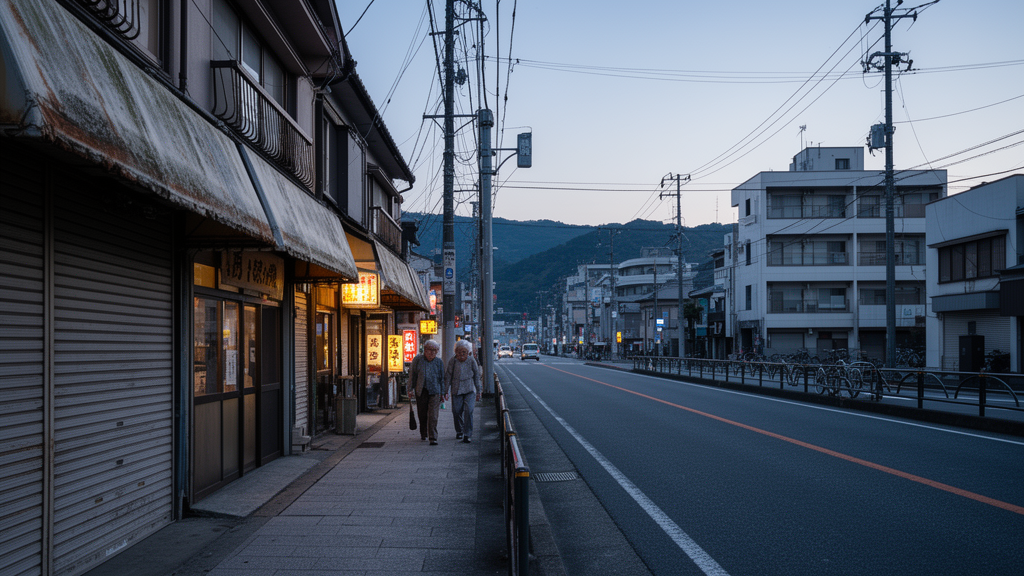
A four-decade statistical analysis of Japanese small and medium-sized cities has found that the country’s long-running policy for supporting shrinking municipalities shows no statistically significant average effect on population or employment. The study, published in the journal Cities, examined the long-term consequences of Japan’s Depopulated-Area-Designation (DAD) policy, a national framework that has operated for more than half a century to identify municipalities facing population loss and to support them through infrastructure, fiscal, industrial, and social measures.
The research was conducted by Associate Professor Haruka Kato of Osaka Metropolitan University’s Graduate School of Human Life and Ecology. Small and medium-sized cities are considered essential for balanced national development, yet many in Japan now face prolonged population loss, aging, and weakened labor markets. Whether a formal depopulation designation can stabilize such communities over time had not been determined.
The analysis covered data from 1980 to 2020 for 1,561 small and medium-sized cities with populations of approximately 200,000 or fewer. Of these, 771 municipalities had received the DAD designation, while 790 had not. This large comparison group allowed the study to compare designated municipalities against non-designated cities over the study period.
Methodologically, the study employed a staggered difference-in-differences approach. Because municipalities entered the designation scheme at different points in time, the staggered structure allowed the analysis to compare changes in designated cities against changes in non-designated cities, both before and after designation. The outcomes examined were total population, total employed persons, and employed residents working within their municipality of residence, three measures that together capture demographic trajectories and the structure of local labor markets.
The headline result was a null one: over the full post-designation period, the analysis estimated no statistically significant average effect of DAD designation on either population or employment. In other words, on average, designated municipalities did not perform better than comparable non-designated municipalities once the policy was in place. But the event-study analysis, which traces estimated effects year by year after designation, revealed a delayed pattern within that aggregate null.
For approximately 15 years after designation, no statistically significant effect on population was detected. At around 20 years after designation, however, designated municipalities began to show significant population decline, and the number of employed persons followed a similar downward trajectory. By contrast, employed residents working within their own municipality of residence did not show the same aggregate decline. This divergence indicates that the delayed losses appeared in overall population and total employment, while the number of residents living and working locally remained comparatively stable.
These findings suggest that designation alone cannot reverse, or even stabilize, the structural decline facing many of Japan’s small and medium-sized cities. The delayed emergence of significant decline around the 20-year mark indicates that the policy’s long-run stabilizing effect, at least as measured across these outcomes, is limited.
Dr. Kato framed the results as a warning against long-term dependence on designation-based policy. “DAD policy was created to support communities confronting depopulation, but our results show that long-term dependence on designation-based policy may not be enough,” said Dr. Kato. “Shrinking cities need smart decline strategies that place residents’ quality of life, sustainable services, and community resilience at the center.”
The study, “Impact of depopulated area designation policy on the population and employment in Japanese Small and Medium-sized cities,” was published in Cities on 11 July 2026. The author declares no known competing financial interests or personal relationships that could have appeared to influence the work reported in the paper.
Subject of Research: Long-term effects of Japan's Depopulated-Area-Designation policy on population and employment in small and medium-sized cities
Article Title: Dear DAD: You can’t designate your way out of depopulation
Article References: Dear DAD: You can’t designate your way out of depopulation. Original publication (Bibliographic details unavailable.)
Image Credits: AI Generated
DOI: Not provided
Keywords: Japan, depopulation, Depopulated-Area-Designation, small and medium-sized cities, difference-in-differences, population decline, employment, urban policy, smart decline, Osaka Metropolitan University, Dear, designate
Cite Scienmag News
Courtney Benton. (October 26, 2026). Japan’s depopulation designation fails to halt long-term city shrinkage. Scienmag. https://scienmag.com/japans-depopulation-designation-fails-to-halt-long-term-city-shrinkage/
Courtney Benton. "Japan’s depopulation designation fails to halt long-term city shrinkage." Scienmag, 26 October 2026, https://scienmag.com/japans-depopulation-designation-fails-to-halt-long-term-city-shrinkage/. Accessed 26 October 2026.
Courtney Benton. "Japan’s depopulation designation fails to halt long-term city shrinkage." Scienmag. October 26, 2026. https://scienmag.com/japans-depopulation-designation-fails-to-halt-long-term-city-shrinkage/


