


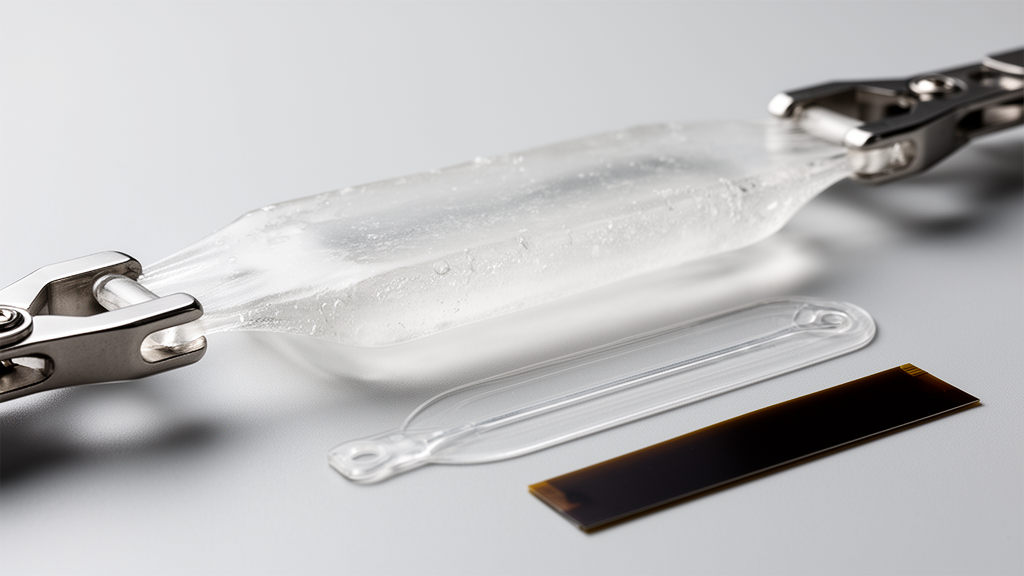
Researchers have built a family of gels made from silk fibroin and deep eutectic solvents whose mechanical properties can be tuned across enormous ranges, from nearly liquid-soft to stiff and load-bearing. The team, publishing in Advanced Composites and Hybrid Materials, reports that tensile strength in the materials spans almost two orders of magnitude, from 0.02 to 1.6 megapascals, while the modulus stretches across nearly three orders of magnitude, from 0.008 to 3.5 megapascals. The gels also conduct ions and were demonstrated in two proof-of-concept devices: an ultra-conformable wearable sensor for monitoring physiological signals and a load-bearing triboelectric nanogenerator, or TENG, for self-powered systems.
The central problem the researchers set out to address is a familiar one in soft materials: making a gel that is simultaneously stretchable and mechanically tunable usually requires sacrificing one property for the other. According to the authors, this limitation stems from a lack of hierarchical network design and of synergistic interactions at the interfaces between components. Their answer is a strategy they call deep eutectic solvent-mediated multiscale regulation, abbreviated DMR, which uses the solvent itself to reorganize a natural polymer across multiple length scales at once.
In this work, the team used a deep eutectic solvent to hierarchically deconstruct silk fibroin from Bombyx mori, the domestic silkworm, breaking the macroscopic protein down into structural units at the microscale, the nanoscale, and the molecular scale simultaneously. Rather than treating these fragments as waste, the researchers harnessed them as hierarchical reinforcements embedded within the polymer matrix. The resulting hybrid network is held together by multiple hydrogen bonds and electrostatic interactions between the silk-derived building blocks and the solvent system. Because the reinforcement operates at several scales rather than one, the mechanical behavior of the final eutectogel can be adjusted broadly, which is what produces the unusually wide span in strength and stiffness. The authors also report excellent ionic conductivity and multifunctionality in the materials, properties that matter for soft electronics, where a gel must often carry signals as well as survive repeated deformation.
To understand why the networks behave this way, the team combined molecular dynamics simulations with spectroscopic analyses. The simulations and spectra provide evidence, the authors write, supporting the proposed multiscale interfacial interaction mechanisms, that is, the idea that cooperative hydrogen bonding and electrostatic attraction across different structural scales are what stabilize the hybrid network and enable its tunability. The applications demonstrated remain at the proof-of-concept stage, and the authors are careful to frame them that way. The wearable sensor was designed to be ultra-conformable, meaning it can laminate closely to skin or other curved surfaces, and was used for physiological monitoring. The triboelectric nanogenerator was engineered to bear load while harvesting energy, pointing toward self-powered systems in which the structural material itself generates electricity.
The authors position the multiscale composite design approach as a promising route toward versatile biomass-based hybrid materials generally, with potential utility in flexible electronics and energy-harvesting devices. The breadth of mechanical tunability reported here, spanning from gels soft enough for conformable wearables to materials stiff enough to bear load in an energy harvester, gives the DMR strategy an unusually wide design space, and the demonstration of both sensing and energy-harvesting functions in a single material family shows how far that space reaches in this study.
Subject of Research: Deep eutectic solvent-mediated multiscale silk fibroin hybrid eutectogels with broadly tunable mechanics for flexible electronics and energy harvesting
Article Title: Deep eutectic solvent-mediated multiscale silk fibroin hybrid eutectogels with broadly tunable mechanics for flexible electronics and energy harvesting
Article References: Zhang, M., Shuai, Y., Wan, Q., Wang, J., Xu, Z., Yu, J., Wu, Q., Cai, J., Zheng, T., Zhu, J., & Yang, M. (2026). Deep eutectic solvent-mediated multiscale silk fibroin hybrid eutectogels with broadly tunable mechanics for flexible electronics and energy harvesting. Advanced Composites and Hybrid Materials. https://doi.org/10.1007/s42114-026-02138-2
Image Credits: AI Generated
DOI: 10.1007/s42114-026-02138-2
Keywords: Deep, eutectic, solvent-mediated, multiscale, silk, fibroin, hybrid, eutectogels, broadly, tunable, mechanics, flexible
Cite Scienmag News
Denise Maddox. (October 26, 2026). Silk Gels Tuned Across Scales Stretch From Soft Sensors to Energy Harvesters. Scienmag. https://scienmag.com/silk-gels-tuned-across-scales-stretch-from-soft-sensors-to-energy-harvesters/
Denise Maddox. "Silk Gels Tuned Across Scales Stretch From Soft Sensors to Energy Harvesters." Scienmag, 26 October 2026, https://scienmag.com/silk-gels-tuned-across-scales-stretch-from-soft-sensors-to-energy-harvesters/. Accessed 26 October 2026.
Denise Maddox. "Silk Gels Tuned Across Scales Stretch From Soft Sensors to Energy Harvesters." Scienmag. October 26, 2026. https://scienmag.com/silk-gels-tuned-across-scales-stretch-from-soft-sensors-to-energy-harvesters/


