


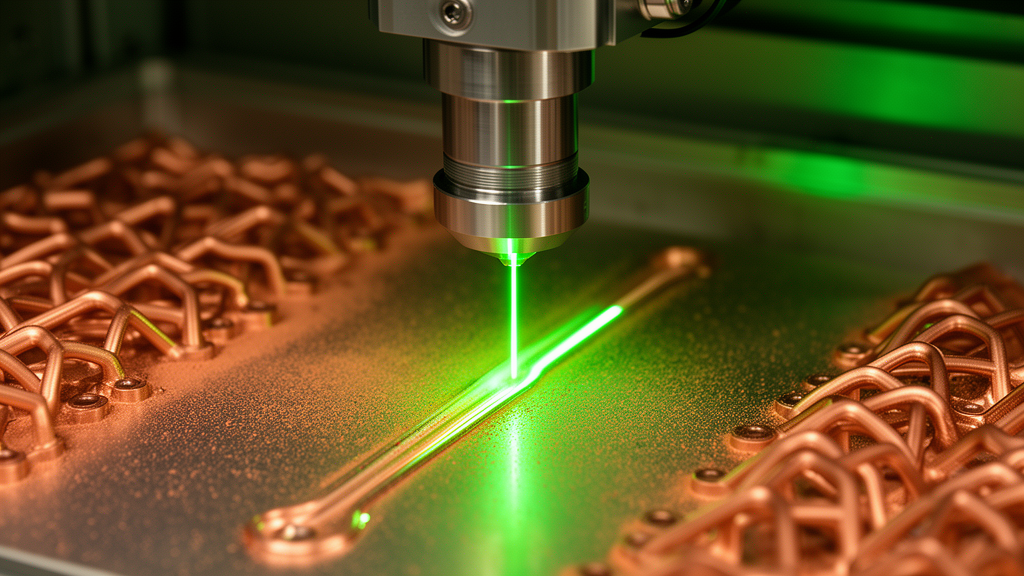
Copper-chromium-zirconium (CuCrZr) alloy has long frustrated engineers trying to print it with laser powder bed fusion (LPBF), the additive manufacturing technique that melts thin layers of metal powder with a scanned laser beam. The alloy reflects away most of the energy delivered by conventional near-infrared lasers, and its high thermal conductivity drains heat from the melt pool almost as fast as the beam can supply it. A new study published in the Journal of Materials Science on 24 October 2026 by Rong Hu, Longxin Li, Qingjuan Wang, Wuteng Sun, Tong Wang, Wen Wang and Kuaishe Wang systematically maps how laser power, scanning speed and the resulting linear energy density control defect formation and solidification microstructure in CuCrZr parts built with a green laser.
The team’s central variable was the linear energy density, or LED, defined as the laser power divided by the scanning speed — in effect, the energy deposited per unit length of the scan track. By varying laser power and scanning speed across their investigated parameter range, the researchers could tune this energy input and observe how the melt pool, the solidifying microstructure and the final build quality responded. The experiments covered the interplay between melting, remelting, molten metal flow and powder spreading, all of which determine whether a printed layer fuses cleanly or breaks up into defects.
The results show that surface quality and porosity respond in opposite directions to the process parameters. An appropriate increase in laser power promoted melting and remelting, facilitated the flow and spreading of molten metal, and thereby suppressed the balling phenomenon — the tendency of the melt pool to break into spherical droplets — while reducing surface roughness. Within the parameter window explored, porosity generally decreased as the scanning speed increased. The authors suggest that combining relatively high laser power with relatively high scanning speed may help ensure sufficient powder melting while limiting overheating, improving melt pool stability and overall build quality.
Relative density, the key measure of how completely the powder has consolidated into solid metal, traced a distinctive curve against linear energy density: it first rose and then fell, peaking at 99.28 percent at an LED of 0.467 J/mm. The explanation lies in two competing defect mechanisms. At low energy density, melt pools stay small and overlap between adjacent tracks and layers is insufficient, producing lack-of-fusion defects — unmelted or partially bonded regions that weaken the part. At excessive energy density, overheating drives vaporization and enhances vapor recoil pressure, promoting keyhole formation, a porosity mode in which a deep vapor cavity collapses and traps gas bubbles in the solidifying metal.
The energy input also left its signature in the solidified microstructure at two very different length scales. Increasing LED enhanced thermal accumulation in the melt pool and reduced the cooling rate, conditions that favor columnar grain growth at the microscale. The area fraction of columnar grains increased from 69.1 to 74.0 percent across the studied range, a shift that reflects how slower heat extraction gives elongated grains more opportunity to grow along the solidification direction.
At the nanoscale, the picture was one of progressive coarsening. Higher linear energy density coarsened the dislocation cell structures that form during rapid solidification, reduced the density of geometrically necessary dislocations, and promoted the growth of chromium precipitates. The study documented these nanoscale changes as direct consequences of the increased thermal accumulation associated with higher energy input.
Tensile testing tied the process window to measurable performance. The best combination of strength and ductility appeared at the same energy density that maximized density: an ultimate tensile strength of 349.2 MPa together with an elongation of 37.8 percent, achieved at an LED of 0.467 J/mm, corresponding to a laser power of 420 W and a scanning speed of 900 mm/s.
The study’s findings are specific to the parameter range investigated and to CuCrZr processed with green laser LPBF, and the authors frame the high-power, high-speed combination as a strategy that may improve build quality rather than a universally validated rule. Even so, the work delivers a clear quantitative map — from balling and lack-of-fusion at one extreme to keyhole porosity and coarsened microstructures at the other — for anyone attempting to print this notoriously difficult copper alloy.
Subject of Research: Effects of process parameters on defect formation and solidification microstructure evolution in CuCrZr alloy fabricated by green laser powder bed fusion
Article Title: Effects of process parameters on defect formation and solidification microstructure evolution in CuCrZr alloy fabricated by green laser powder bed fusion
Article References: Hu, R., Li, L., Wang, Q., Sun, W., Wang, T., Wang, W., & Wang, K. (2026). Effects of process parameters on defect formation and solidification microstructure evolution in CuCrZr alloy fabricated by green laser powder bed fusion. Journal of Materials Science. https://doi.org/10.1007/s10853-026-13972-6
Image Credits: AI Generated
DOI: 10.1007/s10853-026-13972-6
Keywords: Effects, process, parameters, defect, formation, solidification, microstructure, evolution, CuCrZr, alloy, fabricated, green
Cite Scienmag News
Denise Maddox. (October 26, 2026). Green Laser Tuning Yields Dense, Strong 3D-Printed CuCrZr Alloy. Scienmag. https://scienmag.com/green-laser-tuning-yields-dense-strong-3d-printed-cucrzr-alloy/
Denise Maddox. "Green Laser Tuning Yields Dense, Strong 3D-Printed CuCrZr Alloy." Scienmag, 26 October 2026, https://scienmag.com/green-laser-tuning-yields-dense-strong-3d-printed-cucrzr-alloy/. Accessed 26 October 2026.
Denise Maddox. "Green Laser Tuning Yields Dense, Strong 3D-Printed CuCrZr Alloy." Scienmag. October 26, 2026. https://scienmag.com/green-laser-tuning-yields-dense-strong-3d-printed-cucrzr-alloy/


