


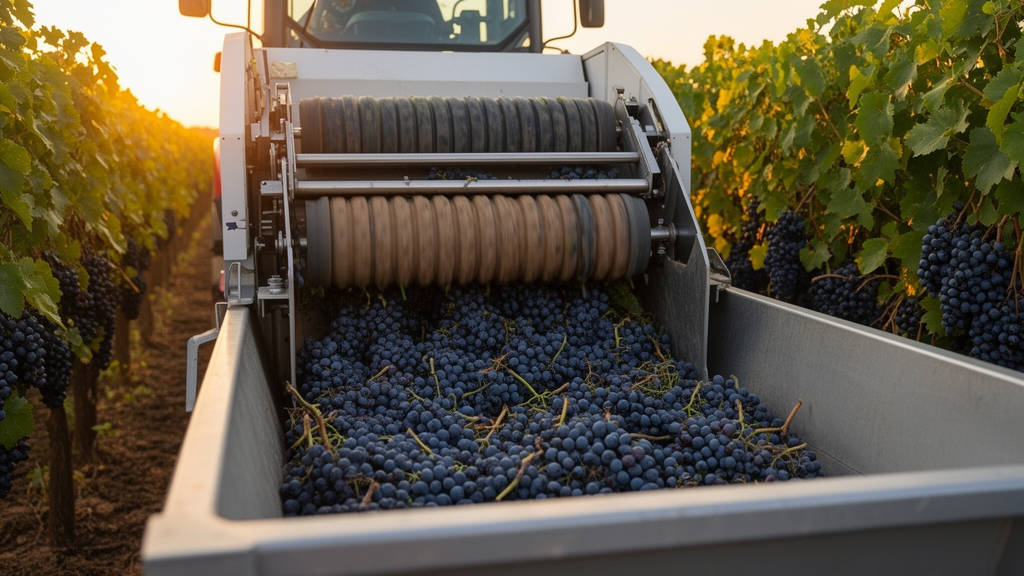
In the vineyards of Xinjiang, where wine grapes hang in dense clusters beneath a Y-shaped trellis, the harvest season has long depended on human hands. Workers move row by row, snipping bunches from the vine one at a time, a process that is both labor-intensive and racing against the clock as fruit ripens. Now, a team of agricultural engineers has developed and tested a mechanical harvesting device that can sever entire grape clusters with a reciprocating double-action blade while spring-loaded teeth gently guide the fruit into position beforehand. In bench trials with Riesling grapes, the optimized machine achieved a harvesting rate of 89.10 percent and a damage rate of just 6.60 percent, offering a glimpse of how mechanization might reach one of viticulture’s most delicate operations.
The challenge that motivated this work is deceptively simple to state but difficult to solve. Wine grapes, unlike table grapes, have thin skins that bruise and split easily under mechanical stress. Existing harvesting machinery relies primarily on vibration, combing, or cutting principles. Vibration-type harvesters shake the fruiting shoots to dislodge berries, and while they operate efficiently, they tend to crush berries and leave stems incompletely separated, producing generally high damage rates. Brush-type harvesters comb through clusters but often knock berries loose and tangle the fruit, making whole-cluster harvest nearly impossible. For winemaking, preserving intact clusters matters enormously: whole-cluster harvesting helps maintain berry integrity and reduces oxidation and microbial contamination, both of which directly influence wine quality.
The research team, working at the vineyard of Zhangyu Babao Baron Winery in Shihezi City, Xinjiang, designed a device that integrates three functions: combing, supporting, and cutting. The machine mounts on a power chassis in a half-width harvesting mode, with a working width of 600 millimeters and a forward speed capped at 1.9 kilometers per hour. Two electric actuators adjust the position and height of the cutting table, keeping the reciprocating cutter and combing components close to the fruiting branches throughout operation. A parallel four-bar mechanism and torsion spring maintain alignment as the machine advances through the vine rows, which in the standardized Y-shaped planting pattern are spaced 3.5 to 3.7 meters apart with fruiting positions concentrated at the fifth node of the branches.
The working sequence unfolds in three stages. First, the device moves toward the fruiting branch with the cutter blade parallel and close to the stems. Then, as the machine advances, motor-driven eccentric flanges and toggle rods cause spring tine rods to swing periodically, slapping and combing the fruiting branches so that hanging grape clusters settle into a natural drooping position. Meanwhile, the reciprocating double-action cutter severs the stems beneath the comb teeth. Cut clusters and debris fall onto a collection surface below, completing the whole-bunch harvest. The key insight is that the combing action pre-positions the fruit before the blade arrives, reducing the chance that clusters are cut mid-bunch or sliced across berry surfaces.
To understand and optimize this mechanism, the researchers built kinematic models of both the cutter and the combing components. For the reciprocating cutter, they derived equations describing how any point on the blade moves as a combination of the machine’s forward motion and the crank-driven reciprocating stroke. Using MATLAB, they generated parametric cutting diagrams that divide the blade’s swept area into three zones: a single-pass cutting area where each stalk is cut once, a re-cutting area swept twice by the blade which wastes power, and a missed-cutting area where stalks are pushed forward and cut in the next pass after significant bending, producing higher stubble that can damage grapes. The proportions of these zones depend on the ratio between cutting speed and forward speed, a relationship the team exploited to tune performance.
The combing mechanism presented its own analytical challenge. The eccentric flange rotates and contacts a toggle rod, which in turn pushes the spring tine through a defined swing cycle: upward until maximum deflection, then downward until the tine separates from the rod, after which the tine remains stationary until the next cycle begins. The researchers derived geometric equations linking the flange motor’s rotational speed, the eccentricity of the toothed rod mounting position, and the resulting swing amplitude and frequency of the spring tine. Because the measured length of wine grape clusters averaged 129 millimeters, they designed swing ranges of 110, 130, and 150 millimeters, with eccentricity settings of 18, 20, and 22 millimeters corresponding to oscillation frequencies of 12, 25, and 38 hertz.
Before building the full optimization framework, the team measured the shear mechanical properties of wine grape fruit stems. Using an INSTRON 8801 universal testing machine, they tested stems at moisture contents of 60, 70, and 80 percent, diameters of 3, 4, and 5 millimeters, and shear rates of 5, 15, and 25 millimeters per minute. The results showed that peak shear force decreased as shear rate increased, reaching a maximum of 134.8 newtons at 10 millimeters per minute when moisture content was 70 percent and diameter was 4 millimeters. Peak force also decreased with increasing moisture content and increased with stem diameter, reaching 117.1 newtons at 5 millimeters. These relatively low shear forces confirmed that a reciprocating cutter could sever the peduncles without excessive energy input.
With the theoretical foundation in place, the researchers conducted a four-factor, three-level Box-Behnken experimental design with 29 test combinations, each repeated three times, using harvesting rate and damage rate as response variables. The factors were forward speed (0.3 to 0.7 kilometers per hour), average cutting speed (6.5 to 7.5 millimeters per second), oscillation frequency of the spring tines (12 to 38 hertz), and eccentricity of the tine-pushing rod (18 to 22 millimeters). Analysis of variance revealed that all four single factors were highly significant for both responses, with forward speed ranking as the most influential factor for harvesting rate and damage rate alike. Second-order response models achieved coefficients of determination of 0.9623 for harvesting rate and 0.9488 for damage rate, indicating strong explanatory power.
The single-factor analysis revealed nuanced trade-offs. Harvesting rate rose and then fell as forward speed increased, peaking near 89.63 percent before dropping sharply to 74.63 percent at the highest speed, because a lower knife-to-machine speed ratio enlarged the missed-cut zone. Higher average cutting speed consistently improved harvesting rate, from 81.22 percent to 90.68 percent, by reducing the missed-cut area. Oscillation frequency increased harvesting rate up to approximately 37 hertz before plateauing, while eccentricity peaked at 87.79 percent harvesting rate at an intermediate setting. For damage rate, the trends were partly inverted: moderate forward speed minimized damage at 8.06 percent, while higher cutting speed and oscillation frequency both reduced damage, and greater eccentricity raised it from 7.53 percent to 9.41 percent by lifting clusters higher into the blade’s path.
Multi-objective optimization balancing maximum harvesting rate against minimum damage rate yielded a predicted optimum at a forward speed of 0.40 kilometers per hour, a horizontal cutter speed of 7.48 millimeters per second, an oscillation frequency of 33 hertz, and an eccentricity of 19 millimeters. The model predicted a harvesting rate of 92.08 percent and a damage rate of 6.22 percent. Validation trials under these conditions produced measured averages of 89.10 percent and 6.60 percent respectively, with relative errors of 3.24 percent and 6.11 percent from the theoretical values. The damage rate represents a notable improvement over the 9.3 percent fruit damage previously reported in comparable studies. The researchers acknowledge that the device has so far been validated only under Y-shaped trellising at a fixed angle, tested only with Riesling and Merlot varieties, and operated exclusively in laboratory settings without long-term field durability assessment. Future work will address compatibility with other training systems, expand the range of suitable grape varieties, and evaluate wear resistance under sustained orchard operation as the technology moves toward commercial deployment.
Subject of Research: Mechanical harvesting of whole wine grape clusters using a combined reciprocating cutter and spring-tine combing device
Article Title: Analysis of operating mechanism and optimization of parameters of harvesting device for low-loss cutting of whole clusters of wine grapes
Article References: Li, J., Zhang, C., Meng, H., Kan, Z., Peng, H., Zhou, D., Qiao, X., Ma, Y., & Li, P. (2026). Analysis of operating mechanism and optimization of parameters of harvesting device for low-loss cutting of whole clusters of wine grapes. Results in Engineering, 32, Article 113416. https://doi.org/10.1016/j.rineng.2026.113416
Image Credits: AI Generated
DOI: 10.1016/j.rineng.2026.113416
Keywords: wine grapes, mechanical harvesting, reciprocating cutter, spring tine, Xinjiang, Box-Behnken design, damage rate, harvesting rate, agricultural engineering, viticulture, whole-cluster harvest, kinematic modeling
Cite Scienmag News
Denise Maddox. (October 26, 2026). Engineers Build a Gentler Machine That Cuts Whole Wine Grape Clusters With Less Damage. Scienmag. https://scienmag.com/engineers-build-a-gentler-machine-that-cuts-whole-wine-grape-clusters-with-less-damage/
Denise Maddox. "Engineers Build a Gentler Machine That Cuts Whole Wine Grape Clusters With Less Damage." Scienmag, 26 October 2026, https://scienmag.com/engineers-build-a-gentler-machine-that-cuts-whole-wine-grape-clusters-with-less-damage/. Accessed 26 October 2026.
Denise Maddox. "Engineers Build a Gentler Machine That Cuts Whole Wine Grape Clusters With Less Damage." Scienmag. October 26, 2026. https://scienmag.com/engineers-build-a-gentler-machine-that-cuts-whole-wine-grape-clusters-with-less-damage/


