


In recent decades, humid heatwaves have escalated in both frequency and intensity, posing a mounting threat to public health worldwide. Unlike dry heat, humid heatwaves combine temperature and moisture levels, creating conditions that severely limit the human body’s ability to dissipate heat through sweating. Scientific understanding of these extreme events has underscored that wet bulb temperatures exceeding approximately 31.5°C represent a critical threshold, beyond which even healthy individuals may succumb due to the body’s failing cooling mechanisms. Nonetheless, the broader spatial patterns and mechanisms driving large-scale humid heatwaves, particularly their aggregation over vast regions such as the extensive 2023 Asian heatwave, remained elusive until now.
A groundbreaking study published in Nature Geoscience on March 24, 2026, addresses this knowledge gap by elucidating the intricate land-ocean dynamics that fuel widespread humid heatwaves. Using an innovative complex network analysis of global climate data spanning four decades—from 1982 through 2023—the research reveals robust linkages between coastal sea surface temperature changes and terrestrial humid heat extremes. The investigation places particular emphasis on tropical and subtropical regions, where oceanic moisture supply intensifies the atmospheric humidity during heatwave episodes.
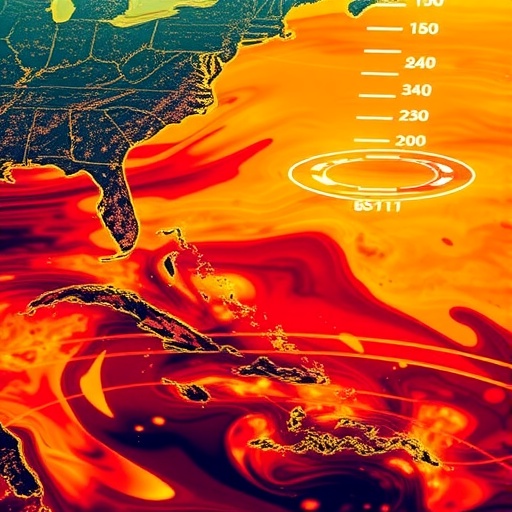
The principal researcher, Fenying Cai from the Potsdam Institute for Climate Impact Research (PIK), highlights the pivotal role of warming coastal waters in driving clustered hot and humid extremes. According to Cai, ocean-warming in tropical zones facilitates an enhanced moisture flux from the ocean surface into the atmosphere. This increased moisture is subsequently transported inland by prevailing wind patterns, amplifying terrestrial humidity and the overall heat stress during these events. The spatial extent of these anomalies frequently spans large regions, resulting in simultaneous, widespread impacts rather than isolated local heatwaves.
Beyond the tropics, the study identifies complex interactions involving combined land and ocean warming, interlinked with large-scale atmospheric wave patterns such as Rossby waves and monsoonal circulation shifts. These intricate atmospheric oscillations modulate heatwave intensity and humidity transport in mid-latitude areas, extending the reach of oceanic influences farther from the equator. In this context, ocean surface temperature rise acts not only as a moisture source but also as a large-scale climate driver dynamically coupling marine and terrestrial climates.
One of the study’s most compelling findings relates to the Indian Ocean’s warming trends, which have emerged as critical determinants of humid heat risks in South Asia and the Middle East. The Indian Ocean’s sea surface temperature anomalies correlate strongly with increased frequency and severity of humid heatwaves in densely populated regions, where adaptive capacity and infrastructure resilience are often limited. Similarly, the tropical North Atlantic Ocean surfaces influence humid heat risks in northern South America, underlying the pan-tropical nature of this marine-atmospheric coupling.
Researchers utilized an advanced network-based analytical framework that maps temporal and spatial climate variable interdependencies, enabling them to detect emergent large-scale patterns otherwise obscured in traditional analyses. This method captures the synchrony of humid heat extreme events and their propagation via atmospheric teleconnections linked to oceanic variability. Significantly, the study demonstrates that these ocean-driven processes are markedly more pronounced in aggregated large-scale events than in sporadic, localized heatwaves.
Understanding the mechanistic pathways between ocean warming and humid heatwaves is crucial for enhancing climate adaptation strategies. Coastal sea surface temperatures present a promising early-warning proxy, enabling better forecasting of impending humid heat extremes before they take hold on terrestrial environments. This predictive capability is vital for public health interventions, infrastructure preparedness, and resource management in vulnerable regions exposed to escalating heat stress.
Moreover, the study provides a robust scientific foundation for policy formulation aimed at mitigating the impacts of these climate hazards. By revealing the ocean’s role as both a supplier of atmospheric moisture and a broader climate modulator, the research underscores the necessity of integrated land-ocean monitoring systems and climate models that incorporate marine surface temperature variability with high spatial and temporal resolution.
The implications extend beyond immediate health concerns. Intensified humid heatwaves contribute to increased energy demand (particularly for cooling), agricultural productivity losses due to heat and moisture stress, and challenges to water resource sustainability. Consequently, this research invites a multidisciplinary approach linking oceanography, atmospheric science, public health, and socio-economic resilience planning.
The annual progression toward more frequent and severe humid heatwaves aligns with the increasing baseline temperatures driven by anthropogenic climate change. As greenhouse gas emissions continue to elevate global mean temperatures, the likelihood of surpassing critical wet bulb temperature thresholds grows. Thus, large-scale warming oceanic patterns not only exacerbate present climate extremes but also signal intensifying future risks under current emission trajectories.
In summary, this pivotal research delineates a complex, large-scale coupling of coastal oceanic warming and atmospheric humidity dynamics that drives the aggregation of extreme humid heatwaves. These findings represent a major advance in climate science, offering new pathways for early detection, risk assessment, and adaptive mitigation of one of the most perilous climate phenomena threatening human health and ecosystems in a warming world.
News Publication Date: 24 March 2026.
Web References:
10.1038/s41561-026-01952-z
Cite Scienmag News
Russell Cooper. (March 25, 2026). Rising Coastal Water Temperatures: Key Cause of Widespread Humid Heatwaves. Scienmag. https://scienmag.com/rising-coastal-water-temperatures-key-cause-of-widespread-humid-heatwaves/
Russell Cooper. "Rising Coastal Water Temperatures: Key Cause of Widespread Humid Heatwaves." Scienmag, 25 March 2026, https://scienmag.com/rising-coastal-water-temperatures-key-cause-of-widespread-humid-heatwaves/. Accessed 4 September 2026.
Russell Cooper. "Rising Coastal Water Temperatures: Key Cause of Widespread Humid Heatwaves." Scienmag. March 25, 2026. https://scienmag.com/rising-coastal-water-temperatures-key-cause-of-widespread-humid-heatwaves/


