


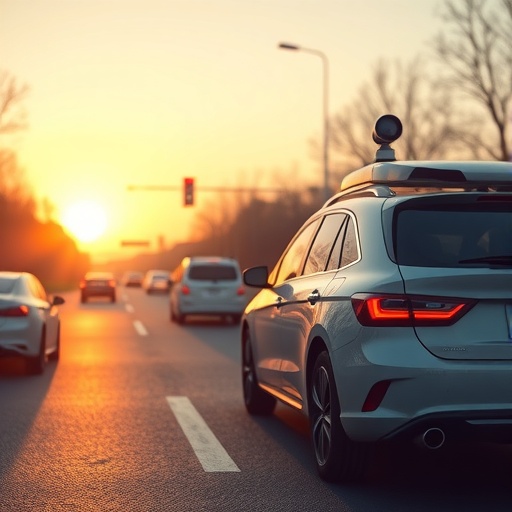
Autonomous vehicles (AVs), which are already becoming a familiar sight on the streets of major cities across the United States and around the globe, are set to revolutionize urban mobility and reshape city infrastructures in profound ways. Recent research conducted by scholars at Carnegie Mellon University and the University of Texas at Dallas delves into one of the most pressing challenges that AVs might address: the commuter parking problem in business districts. This study not only examines how AVs could alter travel behaviors during peak morning commutes but also explores their impact on parking dynamics and urban space allocation.
The impetus behind this research stems from a growing recognition that as cities expand and densify, parking demand in central business districts increasingly strains urban design and transportation systems. Traditional responses have involved dedicating vast land areas to parking facilities, often at high costs and with inefficient land use consequences. Despite these efforts, many commuters continue to face high parking fees, limited parking availability, and exacerbated traffic congestion during morning rush hours. AVs offer a novel approach by potentially decoupling parking needs from workplace proximity; they can transport commuters to their destinations and then autonomously seek more affordable parking in suburban or peripheral areas.
Employing Pittsburgh, Pennsylvania as a representative case study, the researchers developed a sophisticated continuous-time game-theoretic model that encapsulates multiple economic factors influencing commuter decisions. This modeling framework accounts for variables such as parking fees, the time lost in traffic congestion, and constraints related to curbside pickup and drop-off zones. By simulating individual commuter behaviors within these parameters, the study offers nuanced insights into how AVs might influence choices regarding departure times and parking locations, thereby affecting overall traffic flow and congestion patterns in the urban core.
One of the study’s key revelations is the paradoxical effect AV adoption might have on the total volume of vehicular movement. While AVs can alleviate street congestion near busy districts by parking vehicles outside the central area, the additional traveling distance to suburban parking spots inadvertently increases vehicle hours and miles traveled. This rise in peripheral circulation leads to a higher system-wide travel cost compared with scenarios dominated by human-driven cars that typically park closer to workplaces despite higher fees and scarcity.
This insight reveals a fundamental trade-off in urban planning as AVs become ubiquitous: although central parking demand may decline, peripheral traffic and energy consumption may simultaneously surge, complicating the city planners’ task. The resultant shift in land use within business districts could prompt transformative changes—for example, converting existing parking infrastructure for alternative uses such as commercial development, green spaces, or residential projects that align better with future urban needs and sustainability goals.
To mitigate these unintended consequences, the researchers discuss regulatory mechanisms that could steer commuter behavior towards more optimal system-wide outcomes. Tools such as dynamic pricing of parking fees and congestion tolling can influence when and where commuters choose to park, effectively managing demand peaks and encouraging more efficient travel patterns. Moreover, infrastructural adaptations, including redesigning parking lots to serve as AV drop-off zones or short-term waiting areas, may further harmonize traffic flows and reduce bottlenecks.
In their simulations focused on the Pittsburgh context, the research team estimates that implementing such regulatory and infrastructural changes could slash total system costs—reflecting congestion, delay, and operational expenses—by up to 28.5%. This substantial efficiency gain underscores the strategic importance of proactive urban planning in anticipation of AV technology’s mass deployment, rather than reactive, piecemeal responses that risk entrenching inefficiencies.
Delving deeper into behavioral economics, the study illuminates how commuter decisions are intricately sensitive to relatively minor cost or convenience adjustments when mediated through AV technology. Small shifts in parking price structures or curb pickup policies can cascade into dramatic changes in collective travel behavior, demonstrating the complex interplay between technology, infrastructure, and human choices. These findings position the study’s model as an early warning and decision-support system for urban planners aiming to navigate the transition period ushered in by AV adoption.
The interdisciplinary collaboration between transportation engineering, operations management, and urban studies in this research enriches its relevance and applicability. As Sean Qian, a coauthor and Civil Engineering Professor at Carnegie Mellon University, emphasizes, guidance derived from such studies will be invaluable for municipal decision-makers—from mobility departments to elected officials—who face mounting pressure to design adaptive policies that reconcile evolving transportation modalities with urban livability goals.
The study also raises broader questions about sustainability and environmental impact. Increased vehicle miles traveled resulting from distant AV parking might elevate greenhouse gas emissions unless paired with electrification or renewable energy strategies. Therefore, the integration of AV deployment with electric vehicle (EV) infrastructure, clean energy grids, and multimodal transit systems will be critical to fully realize the envisioned benefits of reduced congestion and optimized land use.
Furthermore, the research invites critical reflection on how urban design might evolve in the AV era. The potential repurposing of centrally located parking spaces could catalyze the creation of more pedestrian-friendly, mixed-use neighborhoods that promote local commerce and enhance social interaction. This may dovetail with wider trends in urban regeneration that prioritize walkability, green infrastructure, and human-scaled environments, contributing to resilient and vibrant cities.
As AV technology continues to advance, with increasing capabilities for autonomy, communication, and integration within smart city frameworks, the implications of this study expand. The model presented provides a foundation for exploring scenarios with a mix of autonomous and human-driven vehicles, varied levels of autonomy adoption, and different urban morphologies. Such explorations will be indispensable for governments aiming to future-proof their transportation policies amidst rapidly changing technological landscapes.
Ultimately, this pioneering research underscores the necessity of viewing autonomous vehicles not simply as a technological novelty but as a catalyst for systemic urban transformation. The careful orchestration of policy, infrastructure, and behavioral incentives will determine whether AVs are a solution to perennial commuter parking woes or a source of new challenges in urban mobility. As city planners stand at this crossroads, insights from studies like this illuminate paths to smarter, more sustainable futures.
News Publication Date: 16-Feb-2026
Web References:
https://pubsonline.informs.org/doi/10.1287/mnsc.2023.01213
http://dx.doi.org/10.1287/mnsc.2023.01213
Cite Scienmag News
Courtney Benton. (March 25, 2026). Research Explores Impact of Autonomous Vehicles on Morning Commutes. Scienmag. https://scienmag.com/research-explores-impact-of-autonomous-vehicles-on-morning-commutes/
Courtney Benton. "Research Explores Impact of Autonomous Vehicles on Morning Commutes." Scienmag, 25 March 2026, https://scienmag.com/research-explores-impact-of-autonomous-vehicles-on-morning-commutes/. Accessed 7 September 2026.
Courtney Benton. "Research Explores Impact of Autonomous Vehicles on Morning Commutes." Scienmag. March 25, 2026. https://scienmag.com/research-explores-impact-of-autonomous-vehicles-on-morning-commutes/


