


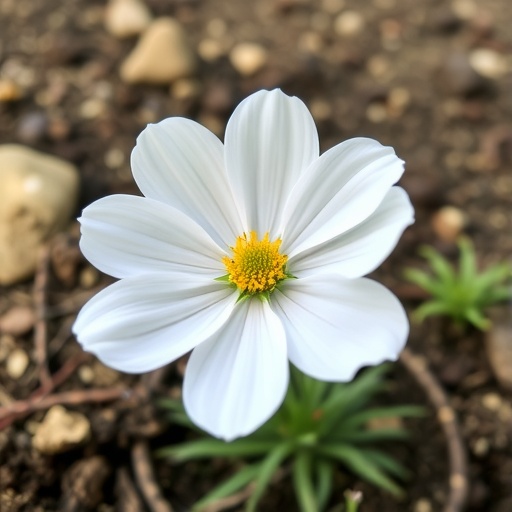
In a finding that could reshape how the world deals with one of the fertilizer industry’s most troublesome waste streams, researchers in China have shown that a single strain of plant-growth-promoting bacteria can transform phosphogypsum—a by-product of phosphoric acid production that is normally little more than a toxic, land-hungry stockpile—into a substrate capable of supporting vigorous plant growth. The study, published in the journal Environmental Geochemistry and Health, centers on a bacterium named Kosakonia oryziphila KC516, which the team isolated from the rhizosphere of Eleusine indica, a grass that had somehow managed to colonize an actual phosphogypsum deposit. That ecological origin proved telling: the strain had evolved in exactly the hostile, nutrient-poor environment that has defeated conventional revegetation efforts for decades.
Phosphogypsum, often abbreviated PG, is generated in enormous quantities as a by-product of the wet-process production of phosphoric acid, the chemical backbone of phosphate fertilizer manufacturing. For roughly every tonne of phosphoric acid produced, multiple tonnes of PG accumulate, and the overwhelming majority of it is simply piled into massive stacks that occupy land, threaten groundwater through leaching of sulfates, fluorides and residual acidity, and pose chronic pollution risks. Because PG is essentially compacted gypsum enriched with impurities, plants struggle to establish themselves directly on it: phosphorus is present but locked in poorly soluble forms, the physical structure is poor, and chemical conditions are unforgiving. Previous approaches have typically involved capping PG stacks with layers of imported soil, an expensive and only partially successful strategy that merely buries the problem rather than converting the material into a growth medium in its own right.
The research team, led by Jing Zhang of Kunming University together with colleagues including Yan-Ru Cao and Hua-Li Zhang of the Wuhan Institute of Technology, took a different tack. Rather than asking how to cover phosphogypsum, they asked whether the right microbe could make plants want to grow in it. From the rhizosphere of a plant thriving on a PG pile they screened for bacteria with strong acid-producing and phosphate-solubilizing capabilities—the two traits most relevant to unlocking the mineral nutrition trapped in gypsum. The strain that emerged, KC516, was confirmed as Kosakonia oryziphila, a species already known from earlier work as a plant associate and biocontrol agent in rice systems, but never before characterized in the context of phosphogypsum. In preliminary trials the bacterium promoted the growth of five different plant species, with by far the strongest response in Cosmos bipinnatus, the garden cosmos, a fast-growing ornamental that had already shown promise in earlier phytoremediation studies involving chromium-contaminated soils.
To dissect the mechanism, the team ran controlled pot experiments in which Cosmos bipinnatus was grown in a PG-based substrate, with and without inoculation with KC516, and then measured everything from germination rates and root architecture through to rhizosphere soil chemistry and the gene-expression profile of the plant roots. The phenotypic results were striking. Germination rate rose by 12 percent, plant height by 28 percent, root length by a dramatic 106 percent, and dry weight by 115 percent relative to uninoculated controls. Root length in particular is the parameter that matters most in a hostile substrate, because a plant’s ability to penetrate and exploit a growing medium determines how much water and nutrition it can access. Doubling root length in phosphogypsum essentially doubles the exploratory reach of the seedling in a medium where resources are scarce and chemically locked away.
The physiological measurements told a complementary story. Inoculated plants accumulated higher levels of photosynthetic pigments—the chlorophylls and carotenoids that power carbon fixation—as well as elevated concentrations of indole-3-acetic acid, the principal auxin hormone that drives cell elongation and root development. At the same time, levels of abscisic acid, the stress hormone that generally signals drought or chemical adversity and suppresses growth, declined slightly, as did soluble sugars, a change consistent with a shift away from stress physiology and toward active growth metabolism. Taken together, these shifts indicate that KC516 does not merely protect the plant from the harsh PG environment; it actively reprograms the plant’s hormonal state from a defensive posture into a growth-oriented one.
The geochemical side of the story is where the bacterium’s industrial significance becomes clearest. In the rhizosphere—the narrow zone of soil immediately surrounding the roots where plant and microbe chemistry interact—KC516 lowered soil pH and reduced the concentrations of calcium ions and sulfate ions, while increasing available phosphorus by 11.4 percent. The mechanism is a classic one in microbial ecology: by excreting organic acids, the bacterium protonates the mineral matrix of the phosphogypsum, dissolving calcium phosphate compounds that are otherwise insoluble and releasing phosphate into forms the plant can absorb. The drop in calcium and sulfate concentrations reflects the mobilization and uptake of these ions once the gypsum matrix begins to dissolve. In effect, KC516 acts as a chemical key, converting an inert mineral waste product into a slow-release nutrient source, with sulfur—an essential plant macronutrient in its own right—becoming available to the plant as a bonus.
To understand how the plant responds to this bacterial intervention at the molecular level, the researchers performed transcriptome sequencing on the roots, comparing gene expression between inoculated and uninoculated plants. The analysis revealed that KC516 upregulated suites of genes involved in hormone regulation, organic acid synthesis, and anion transport, and statistical analysis showed that these transcriptional changes were positively correlated with the measured growth and photosynthetic parameters. The hormone-related genes presumably amplify the auxin signal that drives root proliferation; the organic acid synthesis genes would feed back into the rhizosphere, since plant-derived organic acids cooperate with bacterial ones in solubilizing mineral phosphorus; and the anion transport genes include the machinery for taking up the sulfate released from the dissolving gypsum. The root, in other words, is not a passive beneficiary but an active participant, retooling its own biochemistry to exploit the geochemical window the bacterium opens.
Among 35 differentially expressed transcription factor families—regulatory proteins that control the expression of other genes—three emerged as particularly significant connectors between the bacterial treatment and the plant’s response. MYB-family transcription factors were associated with the accumulation of photosynthetic pigments, consistent with a growing body of work showing that MYB-related regulators control chloroplast biogenesis and chlorophyll biosynthesis. AP2/ERF transcription factors, well known for their roles in root development and stress signaling, were implicated in the dramatic root elongation observed in the inoculated plants. And bHLH-family factors were linked to organic acid synthesis, providing a regulatory handle on the very metabolic pathway that sustains phosphorus mobilization in the rhizosphere. This layered regulatory architecture—bacterial chemistry at the bottom, transcriptional reprogramming in the middle, and whole-plant physiology at the top—offers a mechanistically coherent picture of how a rhizosphere bacterium can convert an industrial waste into a functional growth medium.
The authors suggest that their findings provide both a theoretical foundation and a practical strain resource for two linked goals: expanding the disposal and utilization pathways for the world’s accumulating phosphogypsum, and achieving vegetation restoration directly on PG stockpile areas. Cosmos bipinnatus is an attractive candidate for such restoration because it is fast-growing, tolerant of marginal substrates, and has demonstrated aptitude for extracting heavy metals from contaminated sites in earlier studies, making it a plausible pioneer species for greening PG stacks. If inoculation with KC516 or similar strains can be scaled to field conditions, the approach could reduce reliance on costly soil capping, lower the long-term environmental liabilities of PG storage, and potentially contribute to a circular-economy vision in which fertilizer waste is itself converted back into productive, vegetated land.
The study also contributes a rich dataset to the scientific community, with the raw RNA-sequencing reads deposited in the NCBI Sequence Read Archive under BioProject accession PRJNA1501917, ensuring that other researchers can interrogate the transcriptomic responses independently. Future work will need to test whether the pot-experiment results hold up on actual phosphogypsum stacks, where climate, leaching, competing microbes and the full spectrum of PG impurities—including trace heavy metals and residual radionuclides that have long concerned regulators—will impose additional pressures. Whether the strong species-specific benefit to Cosmos bipinnatus extends to other candidates, and how the bacterial community as a whole behaves when a single introduced strain is applied at scale, remain open questions. But the core demonstration stands: a bacterium rescued from the rhizosphere of a weed growing on a waste pile can double root growth in that same waste, by rewriting both the geochemistry around the root and the genetic program within it. As phosphogypsum mountains continue to grow alongside global fertilizer demand, solutions that come from such humble, site-adapted microbes may prove among the most practical paths to making these industrial landscapes green.
Zhang, J., Dong, H.-T., Yang, Y.-C., Liu, R., Wang, S., Zhang, A.-L., Su, Y., Dong, M.-H., Cao, Y.-R., & Zhang, H.-L. (2026). Kosakonia oryziphila KC516 mediated growth promotion of Cosmos bipinnatus in phosphogypsum by modulating rhizosphere geochemistry and root transcriptome. Environmental Geochemistry and Health, 48, 573. https://doi.org/10.1007/s10653-026-03434-y
Cite Scienmag News
Morgan Morrow. (September 7, 2026). Plant growth bacterium boosts Cosmos bipinnatus in phosphogypsum via rhizosphere and root changes. Scienmag. https://scienmag.com/plant-growth-bacterium-boosts-cosmos-bipinnatus-in-phosphogypsum-via-rhizosphere-and-root-changes/
Morgan Morrow. "Plant growth bacterium boosts Cosmos bipinnatus in phosphogypsum via rhizosphere and root changes." Scienmag, 7 September 2026, https://scienmag.com/plant-growth-bacterium-boosts-cosmos-bipinnatus-in-phosphogypsum-via-rhizosphere-and-root-changes/. Accessed 7 September 2026.
Morgan Morrow. "Plant growth bacterium boosts Cosmos bipinnatus in phosphogypsum via rhizosphere and root changes." Scienmag. September 7, 2026. https://scienmag.com/plant-growth-bacterium-boosts-cosmos-bipinnatus-in-phosphogypsum-via-rhizosphere-and-root-changes/


