


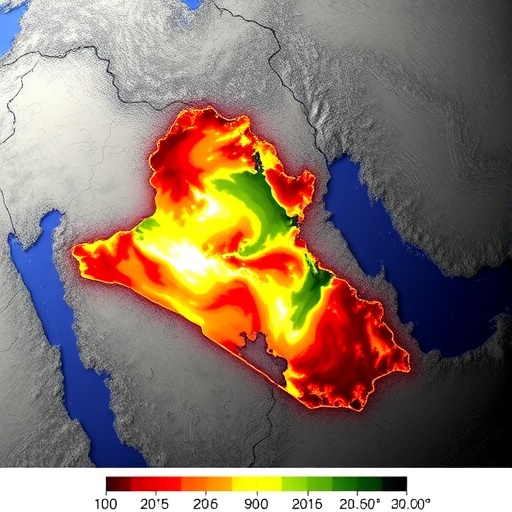
Researchers in Iraq have built machine-learning models that can predict the total ozone column over the country with remarkable accuracy, using nothing more than routinely available satellite meteorological data. The study, published in Theoretical and Applied Climatology, combines principal component analysis with artificial neural networks to forecast ozone levels across Mosul, Baghdad, Anbar, Basra and the country as a whole, offering a powerful new tool for atmospheric monitoring in a region on the front line of climate change.
Ozone is a paradoxical molecule in atmospheric science. High in the stratosphere, the ozone layer shields life on Earth from harmful ultraviolet radiation, but nearer the ground it is a damaging pollutant that irritates lungs, worsens respiratory disease and harms crops and ecosystems. Tracking the total ozone column, the summed amount of ozone from the surface to the top of the atmosphere, is therefore a central task in both climate and air-quality research. In Iraq, a country experiencing some of the most extreme warming trends on the planet, alongside dust storms, urbanization and industrial emissions, understanding what drives ozone variability has taken on new urgency.
The research team, led by Nagham T. Ibraheem of Mustansiriyah University in Baghdad, together with colleagues at the University of Duhok and Universiti Sains Malaysia, turned to NASA’s Atmospheric Infrared Sounder, or AIRS, instrument aboard the Aqua satellite. AIRS, which has been flying since 2002, measures temperature, humidity and other atmospheric properties at hundreds of pressure levels by detecting infrared radiation emitted by the Earth. From this data set, the team extracted monthly values covering 2013 through 2023 for five meteorological variables: tropopause temperature, tropopause pressure, tropopause relative humidity, tropopause height, and the thickness of the atmospheric layer between the 500 and 1000 hPa pressure surfaces, denoted ΔZ.
The choice of these variables is rooted in decades of ozone meteorology. The tropopause, the boundary between the churning weather of the troposphere and the stratified calm of the stratosphere, is where much of the action in total ozone occurs. When the tropopause is low and cold, a larger share of the ozone-rich stratosphere sits above it, inflating the total column; when it rises, the column shrinks. Similarly, the thickness between pressure levels is a direct measure of the average temperature of the lower atmosphere, and thick, warm layers are classically associated with low ozone, while thin, cold layers accompany high ozone. These relationships, first described in the mid-twentieth century by atmospheric pioneers such as G.M.B. Dobson and R.J. Reed, remain the backbone of statistical ozone prediction.
Before building any predictive model, the team characterized the ozone climatology itself. Monthly averaged total ozone over all four Iraqi stations showed a pronounced and consistent seasonal rhythm: maxima in winter and spring, minima in summer. This pattern reflects the interplay of stratospheric circulation and photochemistry, with ozone accumulating through the winter and being depleted photochemically as solar radiation intensifies toward the summer solstice. Geographically, the data revealed a clear north-south gradient: Mosul, in the country’s north at higher latitude, recorded the highest ozone columns, while Basra, in the far south near the Persian Gulf, recorded the lowest. Latitude matters for ozone because the stratospheric Brewer-Dobson circulation transports ozone from tropical production regions toward the poles, enriching higher latitudes.
The predictive modeling proceeded in two stages. First, the researchers applied principal component analysis, or PCA, a statistical technique that compresses many correlated variables into a small number of uncorrelated composite variables called principal components. Because tropopause pressure, height, temperature, humidity and layer thickness are all physically intertwined, feeding them raw into a regression model invites instability from multicollinearity. PCA sidesteps the problem. Using Varimax rotation to sharpen the interpretability of the components, the analysis showed that the first two principal components alone captured between 97.4 and 98.3 percent of the total variance in the meteorological data across all stations. Within these components, tropopause pressure and the 500 to 1000 hPa layer thickness emerged as the dominant predictors of ozone variability everywhere in the country.
Armed with these compressed variables, the team built principal component regression, or PCR, models, essentially multiple linear regressions performed on the principal component scores rather than the original variables. The MLR models explained a striking share of the ozone variance: the coefficient of determination, R², reached 0.874 for Mosul, 0.842 for Baghdad, 0.846 for Anbar, 0.788 for Basra and 0.893 for Iraq as a whole. All regression coefficients were statistically significant at the p < 0.005 level, and root-mean-square errors ranged from 4.505 to 4.97, expressed in the Dobson units conventionally used for column ozone. The nationwide model proved the strongest of the linear family, with a correlation coefficient of 0.891 and mean absolute error of 2.45.
Linear regression, however, has a fundamental limitation: it can only capture straight-line relationships between predictors and the target. Ozone’s dependence on meteorology involves nonlinearities arising from photochemistry, transport dynamics and threshold effects, and this is where the artificial neural networks entered. Neural networks are computational systems loosely inspired by biological neurons, consisting of layers of interconnected nodes that transform inputs through adjustable weights and nonlinear activation functions. Trained on historical data, they can learn arbitrarily complex input-output relationships without the analyst specifying an equation in advance.
The researchers experimented with a range of network architectures, varying the number of hidden layers and nodes, and evaluated different activation functions. The winning configuration proved strikingly parsimonious: two hidden layers of just four nodes each, using a Gaussian activation function. Despite its small size, this network delivered correlation coefficients between 0.949 and 0.957, mean absolute errors of 1.318 to 1.882, and root-mean-square errors of 2.995 to 4.024, a substantial improvement over the linear models. The best-performing network for all of Iraq achieved a correlation coefficient of 0.949 with an RMSE of 2.995 and an MAE of 1.318, meaning the model typically predicted the monthly ozone column to within roughly three Dobson units of the observed satellite value.
The implications extend beyond Iraq. The study demonstrates that a modest neural network, fed with freely available satellite retrievals of standard meteorological variables, can reconstruct ozone columns with an accuracy approaching that of dedicated ozone-observing instruments. This matters for regions where ground-based ozone measurements, historically made with Dobson and Brewer spectrophotometers, are sparse or absent. Iraq currently has no routine total ozone monitoring stations, so satellite-driven statistical models fill a genuine observational gap. The approach also offers a hedge against data gaps: if an ozone instrument fails or a satellite is decommissioned, meteorology-based models can estimate ozone retrospectively, preserving the long, continuous records that climate scientists depend upon to detect trends.
The work builds on a growing body of machine-learning ozone research worldwide, from LSTM recurrent networks forecasting column ozone in India to hybrid regression-neural models in China and ambient ozone prediction studies in Serbia and Iran. What distinguishes the Iraqi study is its rigorous compression of predictors through PCA before model training, which both simplifies the networks and clarifies the underlying physics. The identification of tropopause pressure and lower-atmospheric thickness as the controlling variables confirms, in a data-driven way, the classical understanding that total ozone is governed above all by the geometry and thermal structure of the upper troposphere and lower stratosphere.
For Iraq itself, the findings arrive at a consequential moment. The country faces intensifying heat waves, water scarcity and dust storms, all of which interact with atmospheric chemistry. Establishing a reliable, locally calibrated ozone prediction capability gives Iraqi environmental agencies a baseline against which future changes, whether driven by climate shifts, stratospheric ozone recovery or changing emissions, can be measured. As the authors note, the models provide monthly TOC estimates for any Iraqi location where the relevant AIRS meteorological fields are available, effectively creating a virtual ozone monitoring network spanning the entire country.
The study also underscores how the era of big satellite data is democratizing atmospheric science. A decade of AIRS observations, a laptop-scale neural network and classical multivariate statistics were sufficient to produce forecasts that would have required expensive instrumentation a generation ago. For developing nations bearing the brunt of climate change, such tools promise a path toward world-class environmental monitoring without world-class infrastructure budgets. The Iraqi team’s ozone models now stand as a template for extending the same methodology to other greenhouse gases and pollutants across the Middle East and beyond.
Cite Scienmag News
Russell Cooper. (September 7, 2026). AI and PCA model Iraq’s total ozone column over a decade. Scienmag. https://scienmag.com/ai-and-pca-model-iraqs-total-ozone-column-over-a-decade/
Russell Cooper. "AI and PCA model Iraq’s total ozone column over a decade." Scienmag, 7 September 2026, https://scienmag.com/ai-and-pca-model-iraqs-total-ozone-column-over-a-decade/. Accessed 7 September 2026.
Russell Cooper. "AI and PCA model Iraq’s total ozone column over a decade." Scienmag. September 7, 2026. https://scienmag.com/ai-and-pca-model-iraqs-total-ozone-column-over-a-decade/


