


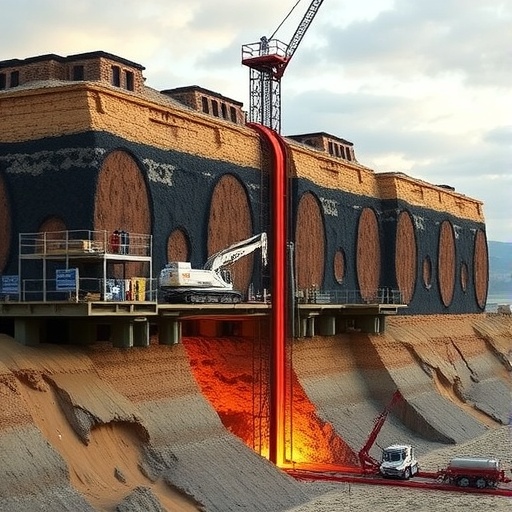
Deep beneath the loess hills of Gansu Province in northwestern China, engineers at the Haishiwan coal mine have demonstrated a new way to tame one of underground mining’s most violent hazards: the rockburst. In a study published in Environmental Earth Sciences, a research team led by Fangzhou Lu and Linming Dou of the China University of Mining and Technology describes how surface vertical well multi-strata hydraulic fracturing, or SVMSHF, was used to deliberately weaken dangerous rock layers hundreds of meters above a working face, releasing pent-up tectonic and mining-induced energy before it could be unleashed catastrophically on miners and equipment. The case study offers one of the most detailed field validations to date of the idea that rockbursts can be prevented not by reinforcing tunnels, but by surgically restructuring the overlying rock mass itself.
The context for the work is the relentless deepening of China’s coal mining operations. More than 210 coal mines in the country now operate at depths exceeding 800 meters, and over 60 have passed the 1,000-meter mark, while less than 20 percent of proven coal resources lie shallower than 1,000 meters. At these depths, the combination of high in-situ stress and intense mining disturbance makes rockburst—a sudden, explosive failure of coal or rock that can hurl debris into roadways and destroy entire working sections—a leading threat to safe extraction. Rockbursts are understood as dynamic disasters in which disturbances such as mining-induced tremors act on coal and rock masses that are already loaded close to their strength limits under high static stress. Prevention therefore hinges on two levers: reducing the static load carried by the coal around workings, and controlling the intensity of the dynamic loads that ripple through the strata as hard roof layers fracture.
The Haishiwan mine, located in the southern Yaojie Coalfield, presented an especially treacherous version of this problem. Its main target, the No. 2 coal seam, thickens and thins from 13.2 to 38.9 meters across the property and lies at burial depths of 720 to 958 meters in the first mining district. To de-stress the massive seam, the mine extracts an oil shale layer, designated No. 1 coal, roughly 40 meters above it as a “protective layer” using a single-pass, 4-meter-high fully mechanized face. In theory, this protective mining should relieve stress in the seam below and keep rockburst risk low. But the actual mining geometry conspired against that assumption. Ahead of the stopping line of panel LWC 6125-1 lay a block of unmined extra-thick coal—the study calls it the ETUPAC—bordered on three sides by goafs, the mined-out voids left by previous extraction. Effectively an isolated coal pillar, it sat beneath the goaf of protective panel LWO 6114, with the adjacent LWO 6115 fully mined to the south.
The danger revealed itself during the excavation of the 6126-1 Intake Gateroad within this block. Miners heard frequent coal bursting sounds, and under the triggering effect of strong mining-induced tremors, the roadway heading suffered roof falls, floor cracking, and broken anchor bolts, while the tunnel continuously deformed enough to impede its use. The physical explanation lies in the extraordinary mining heights elsewhere in the district. Neighboring faces in the No. 2 seam were extracted by top-coal caving at heights averaging around 25 meters—far beyond the reach of classical roof theories. Using key stratum identification methods, the team determined that five sub-key strata and one primary key stratum (PKS) overlie the ETUPAC, collectively controlling how the overburden behaves. Whereas the thin protective layer face allowed a stable “voussoir beam”—an articulated arch of fractured rock blocks—to form immediately at the first key stratum KS1, the 24-meter combined mining height on the other side of the block meant a voussoir beam could only form much higher, at KS4 or above.
From this contrast the researchers built their central theoretical contribution: a “combined cantilever + voussoir beam” overburden structure model for extra-thick seam mining under a protective layer. When a key stratum fractures, the rotation available to its broken blocks depends on the mining height and the bulking of collapsed rock below, quantified by the relation Δm = H − Σ(kᵢ−1)hᵢ, where H is mining height and kᵢ and hᵢ are the thickness and bulking factor of each underlying collapsed layer. If the available rotation space is smaller than the maximum articulation angle the blocks can tolerate—expressed as Δmax = M − √(2ql²/σc), with M the stratum thickness, l the initial fracture interval, q the applied load and σc the compressive strength—then a stable voussoir beam cannot form. Instead the stratum hangs over the goaf as a cantilever. At Haishiwan, laterally overhanging hard strata accumulated along the eastern and northern edges of the ETUPAC, while the high-position PKS bent downward without fracturing, forming a pressure arch whose arch feet pressed down on the rock above the coal block. The combined cantilever, pushed by both the voussoir beam’s advance stress and the arch, rotated progressively toward the large goaf, compacting the protective layer’s goaf above the ETUPAC and destroying its stress-relief effect.
Numerical modeling with the discrete element code UDEC confirmed the picture. The team built a 1,570-meter-long, 990-meter-high model along the coal seam strike, using Voronoi blocks to discretize the high-position strata and Mohr-Coulomb constitutive behavior with Coulomb-slip joints, loaded at the top by 2.22 megapascals representing 112 meters of overlying soil. The simulation showed that mining the protective layer dropped vertical stress in the underlying coal from 23.17 megapascals to 4.72 megapascals, a 79.63 percent reduction—exactly the relief a protective layer is supposed to deliver. But after the extra-thick seam faces were extracted and the goaf compacted, stress in the ETUPAC recovered relentlessly, ultimately peaking at 29.18 megapascals, roughly 25.94 percent above the original in-situ stress. Field measurements of surface subsidence told the same story: cumulative subsidence above the ETUPAC reached 3,500 to 4,500 millimeters even though only 4 meters of protective coal had been extracted there, proving the protective goaf was nearly fully compacted. The relief mechanism had silently reversed itself into a stress concentration mechanism.
The remedy the researchers proposed exploits a key asymmetry between two fracturing strategies. Horizontal well fracturing acts along a single stratum over long strike distances and suits pre-fracturing before a face is mined, but faces already extracted or in production instead need multiple key strata weakened at specific locations. Surface vertical wells, though limited in horizontal reach, can act on several strata simultaneously through the vertical section. The team’s target selection procedure ranked candidate layers by how much each would reduce a composite stiffness index W_TG—the ratio of the coal’s post-peak unloading modulus to the weighted-average elastic modulus of the overlying strata—when that layer’s elastic modulus was reduced by 50 percent in simulation. Drilling of the HSW-1 fracturing well, cased to 611 meters with N80 steel and logged for mud-loss zones marking bedding separation, confirmed four target stages, each with two perforation clusters, executed from the bottom up using wireline pump-down plug technology at pumping displacements of 16 to 18 cubic meters per minute.
The mechanics of the treatment are elegantly dual-purpose. For the cantilevered strata, injected water pressure diffuses outward from the fracture zone and superimposes an additional load q_H on the beam, raising the maximum tensile stress—which, for a cantilever of overhang length L under distributed load q, scales as 3qL²/bh²—until it exceeds the rock’s tensile strength and the overhang snaps, shortening the lever pressing on the coal below. For the high-position key strata, the induced fracture network weakens the rock so the pressure arch can no longer hold, breaking its loading pathway. In both cases, elastic energy stored by bending strata is released in small, controlled doses during treatment rather than in a single violent tremor during production. The three roles—strength weakening, premature cantilever collapse, and controlled energy release—address static load, geometry, and dynamic load simultaneously.
Field performance data validated the design. Microseismic monitoring during fracturing recorded an average of 113 events per stage, releasing about 7.0 × 10⁵ joules in total, with an ellipsoidal event cloud centered on the well. Fractures propagated along the NE154° azimuth of the regional maximum principal stress, with single-wing lengths of 109 meters north and 107 meters south and a vertical influence range of about 54.8 meters—geometrically well placed to cut off the overhanging strata loading the ETUPAC from both sides. Casing pressure traces across the pad fluid, fracture initiation and propagation, pressure escalation, and displacement stages matched the expected signatures, with a representative propagation-stage pressure of 10.9 megapascals confirming good wellbore sealing integrity. Most tellingly, fiber optic sensors in the JK1 monitoring borehole recorded tensile strain at 438 meters depth—within a 31.15-meter-thick siltstone sub-key stratum identified as KS-H—jumping 78.4 percent from 3,917 to 6,986 microstrain during treatment, then falling back to 2,080 microstrain as the stratum fractured and snapped the cable: direct physical evidence that a key layer had been broken and its stored energy released.
The mine-wide consequence was a dramatic de-escalation of seismic hazard. Before treatment, the SOS microseismic system showed a striking anomaly over the ETUPAC, with tremor frequency density peaking at 130 events per square meter and a high-density zone stretching 120 meters along strike—coinciding precisely with the roadway sections suffering dynamic damage. After fracturing, the peak density fell to 54 events per square meter, just 41.5 percent of the pre-treatment maximum, while the spatial distribution of tremors became markedly more uniform. Three high-energy tremors induced during the operation itself, including one of 1.65 × 10⁵ joules about 199 meters above the seam, were evenly distributed around the block and resolved as tensile and tensile-shear mechanisms, indicating orderly breakage of hard roof rather than instability of the coal. Dynamic manifestations in the corresponding roadways weakened noticeably. Taken together, the results establish surface vertical well multi-strata hydraulic fracturing as a practical, monitorable tool for rewriting the structural physics of a mine’s roof—transforming a hazard that builds invisibly over months of mining cessation into a controlled sequence of engineered, energy-releasing fractures.
Cite Scienmag News
Violet Maxwell. (September 6, 2026). Surface vertical well multistrata fracturing mitigates rockburst in extra-thick coal seam. Scienmag. https://scienmag.com/surface-vertical-well-multistrata-fracturing-mitigates-rockburst-in-extra-thick-coal-seam/
Violet Maxwell. "Surface vertical well multistrata fracturing mitigates rockburst in extra-thick coal seam." Scienmag, 6 September 2026, https://scienmag.com/surface-vertical-well-multistrata-fracturing-mitigates-rockburst-in-extra-thick-coal-seam/. Accessed 6 September 2026.
Violet Maxwell. "Surface vertical well multistrata fracturing mitigates rockburst in extra-thick coal seam." Scienmag. September 6, 2026. https://scienmag.com/surface-vertical-well-multistrata-fracturing-mitigates-rockburst-in-extra-thick-coal-seam/


