


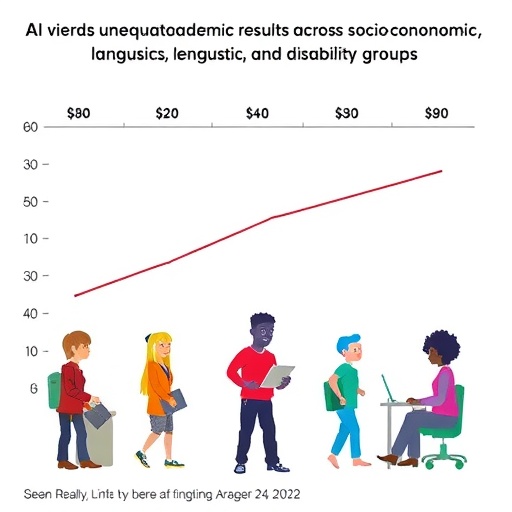
Generative artificial intelligence has been heralded as one of the great equalizers in modern education, a tool capable of placing a tireless tutor in the hands of any student with an internet connection. But a new international field experiment suggests the reality is far more complicated. The study, published in the journal Discover Sustainability, found that ChatGPT produces markedly different academic outcomes depending on students’ socioeconomic status, language background, and disability status—lifting some groups dramatically while quietly introducing new risks to others.
The research, conducted by Mayadhar Sethy of the Nabakrushna Choudhury Centre for Development Studies in Bhubaneswar, India, involved 240 university students drawn from eight countries. Rather than relying on surveys or self-reported perceptions of AI’s usefulness, the study employed a multigroup field experiment with a counterbalanced design. Each participant completed academic writing tasks under two conditions—once with access to ChatGPT and once without—and the order of the conditions was varied across participants to control for learning and fatigue effects. Because every student served as their own comparison in this within-subject structure, the design allowed the researcher to isolate the effect of the AI tool on individual performance with considerable precision.
The outcome measures went well beyond simple grades. The study assessed writing quality, the time students needed to complete tasks, their self-efficacy—their belief in their own academic capabilities—and their learning retention, that is, how much of the knowledge and skill gained during the task persisted afterward. Students were stratified in advance by socioeconomic status, language proficiency, and disability status, permitting the kind of fine-grained, intersectional analysis that has been largely missing from the rapidly expanding literature on AI in education.
The headline finding is that generative AI is not a uniform lever. Low-socioeconomic-status students showed greater improvements in writing quality than their high-SES peers, suggesting that the technology can meaningfully narrow one dimension of the achievement gap. Crucially, the study found that digital literacy mediated a substantial portion of these gains: students who possessed stronger skills in navigating, prompting, and evaluating digital tools extracted far more benefit from the same AI access. This points to a subtle but important mechanism—equal access to a tool does not translate into equal benefit if the underlying skills to exploit that tool are unequally distributed.
Language background produced one of the study’s most striking patterns. Students who were non-native speakers at a developing level of proficiency achieved the highest performance improvements of any group when given access to ChatGPT. For these students, the AI acted as a kind of real-time linguistic scaffolding, smoothing grammar, vocabulary, and phrasing barriers that would otherwise depress their written output. Yet the same group showed lower error detection—the ability to spot mistakes in AI-assisted text—and reduced retention of the material they worked on. In other words, the AI may have done so much of the cognitive heavy lifting that these students did not internalize what they produced, raising concerns about whether short-term performance gains come at the cost of durable learning.
Students with disabilities told yet another story. They reported the highest gains in self-efficacy, a finding with significant implications, since confidence in one’s academic abilities is strongly linked to persistence, engagement, and long-term educational attainment. However, this boost came with a cost: these students required more time to complete their tasks with the AI than their peers did. For a population already navigating educational systems designed without their needs in mind, the additional time burden represents a form of hidden labor that conventional measures of academic performance fail to capture.
Perhaps the study’s most sobering contribution is its intersectional analysis. Students who faced multiple disadvantages simultaneously—low socioeconomic status combined with developing language proficiency, or disability layered on top of economic hardship—experienced the largest immediate benefits from AI assistance. Yet they also carried the greatest risk to long-term learning outcomes. The groups that gained the most in the short run were those most vulnerable to the erosion of foundational skills, a dynamic the study’s author describes as context-dependent and uneven. The technology, in this reading, functions less as an equalizer than as an amplifier of whatever conditions already surround the learner: it rewards those with the skills to use it critically, flatters the output of those it assists most heavily, and quietly substitutes for the very practice that builds lasting competence.
The theoretical stakes here extend beyond education. Sociologists of technology have long warned that artifacts embody politics—that tools arrive embedded in social structures and tend to reproduce them unless deliberate interventions counteract that tendency. The present findings are a clean empirical demonstration of that principle. A single AI tool, deployed under identical experimental conditions, produced divergent effects across social strata. The divergence was not driven by the technology itself but by the interaction between the technology and pre-existing differences in digital literacy, evaluative capacity, language fluency, and accessibility needs.
What would a genuinely equitable integration of generative AI into education look like? The study’s conclusions sketch the outline. First, digital literacy cannot be assumed; it must be taught, and taught explicitly, particularly to students from low-SES backgrounds who stand to benefit enormously but only if they can wield the tool skillfully. Second, evaluative capacity—the ability to detect errors, judge quality, and remain critically engaged with AI-generated text—needs to become a core curricular objective, not an optional refinement. The finding that high-improvement groups showed poor error detection is a warning that fluency with AI can breed uncritical reliance. Third, accessibility must be designed in from the start rather than retrofitted, and the time costs borne by students with disabilities must be acknowledged and accommodated in assessment design. Without such supportive interventions, the study concludes, generative AI may reinforce the very structural disparities it is often promoted as correcting.
The research also carries a methodological lesson for the field. Much of the public debate about AI in education has been conducted at the level of anecdotes and aggregate averages—does AI help or hurt learning overall? This study demonstrates that the aggregate question may be the wrong one. A tool can simultaneously raise average performance while widening disparities, or it can lift disadvantaged groups in the short term while undermining their long-term retention. Only a stratified, counterbalanced, multigroup design of the kind employed here can detect these competing currents, and the study’s architecture offers a template for future work.
There are, of course, boundaries to what a single experiment can establish. The study measured immediate and short-term outcomes across academic writing tasks; whether the retention deficits observed here accumulate over semesters or years remains an open question. The sample, while international, comprised university students, and the dynamics may differ for younger learners. And ChatGPT itself is a moving target, with successive model generations altering the quality and character of the assistance provided. Still, the counterbalanced design and the stratification across three equity dimensions give the findings a solidity that few studies in this space have achieved. The work passed ethical review at eight institutions across the participating countries, including the University of Cape Town, the National Autonomous University of Mexico, the University of Oslo, the University of Delhi, the University of California, Berkeley, and the University of Cambridge, and was conducted in accordance with the Declaration of Helsinki.
The broader message lands with force at a moment when universities and school systems worldwide are racing to define AI policies. Bans and blanket permissions both miss the point the data makes: the effects of generative AI are not properties of the tool but of the encounter between the tool and the student. A policy that treats all students as identical users will systematically overshoot for some and undershoot for others. The promise of AI-assisted education is real—low-SES students writing better, non-native speakers finally competing on their ideas rather than their grammar, students with disabilities gaining confidence. But the promise comes bundled with perils—eroded retention, dulled critical faculties, and invisible time costs. Sustainable and inclusive AI integration, the study argues, requires addressing gaps in digital literacy, evaluative capacity, and accessibility head-on. The choice facing educators is not whether students will use these tools; it is whether the conditions of use will be shaped deliberately to produce equitable and meaningful learning, or left to reproduce the inequalities education is supposed to overcome.
Cite Scienmag News
Violet Maxwell. (September 6, 2026). AI yields unequal academic results across socioeconomic, linguistic, and disability groups. Scienmag. https://scienmag.com/ai-yields-unequal-academic-results-across-socioeconomic-linguistic-and-disability-groups/
Violet Maxwell. "AI yields unequal academic results across socioeconomic, linguistic, and disability groups." Scienmag, 6 September 2026, https://scienmag.com/ai-yields-unequal-academic-results-across-socioeconomic-linguistic-and-disability-groups/. Accessed 6 September 2026.
Violet Maxwell. "AI yields unequal academic results across socioeconomic, linguistic, and disability groups." Scienmag. September 6, 2026. https://scienmag.com/ai-yields-unequal-academic-results-across-socioeconomic-linguistic-and-disability-groups/


