


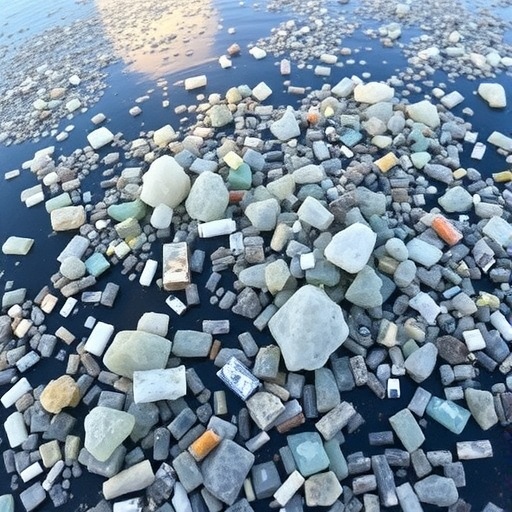
Microplastics have now been found in virtually every corner of the Arctic, from deep-sea sediments lying kilometers below the surface to freshly fallen snow on remote ice caps, and a sweeping new review warns that this contamination is not merely an environmental embarrassment but a potential amplifier of the very climate warming that is transforming the polar north. The study, led by Yihao Bian and colleagues at Tongji University with collaborators from the Norwegian Polar Institute and UiT The Arctic University of Norway, synthesizes decades of scattered research into the most comprehensive picture yet of how plastic fragments reach the Arctic, what they do once there, and why existing governance frameworks are failing to keep pace. Published in the journal Environmental Engineering, the review arrives with a stark conclusion: the Arctic needs a systematic, internationally coordinated governance framework for microplastic pollution before the problem becomes irreversible.
The most striking finding to emerge from the synthesis concerns the sheer dominance of microfibers in Arctic contamination. The researchers found that fibers make up roughly 92 percent of microplastics identified in Arctic snow and about 73 percent of those found in sea ice algae. These slender synthetic threads, shed from textiles, fishing gear, and countless industrial sources, behave very differently in the atmosphere than spherical or fragment particles. Their elongated shape gives them a much lower settling velocity relative to their mass, allowing them to remain airborne for far longer and travel enormous distances. Recent atmospheric modeling work cited in the review demonstrates that fiber geometry is a decisive factor in long-range transport, meaning that a polyester fleece jacket worn in Europe or North America can plausibly shed fibers that later precipitate onto Arctic snowfields thousands of kilometers away.
The pathways by which these particles converge on the polar north are multiple and complementary. Atmospheric transport delivers fibers with snowfall, a mechanism confirmed by landmark studies that found microplastics prevalent in snow sampled from the Alps to the Arctic and even in Antarctic snow. Ocean currents perform a second delivery service, with Atlantic waters carrying substantial fiber loads northward; research on the Eurasian Arctic has shown that microplastic distribution there is strongly influenced by both Atlantic inflows and the great Siberian rivers that drain industrialized continents. A third pathway involves local human activities—shipping, fishing, tourism, and research operations in the region itself—which, while smaller in absolute terms, contribute particles that can be more readily attributed and therefore more directly regulated. Riverine inputs, modeled numerically in recent studies, add a fourth stream of contamination flowing into the Arctic Ocean basin.
Once in the Arctic, microplastics do not simply sit inertly. The review details how sea ice acts as both a temporary sink and a vehicle for transport, with particles becoming frozen into the ice matrix and redistributed as the ice drifts across the pole. Modeling studies of particle incorporation within sea ice show that this trapping is efficient and that melting seasons release decades of accumulated plastic back into the water column. This release mechanism carries a troubling historical dimension: as Arctic sea ice retreats under warming conditions, a legacy of plastic frozen into older ice is being liberated, potentially delivering a concentrated pulse of contamination into waters that have never experienced it at those levels.
The biological consequences are already measurable at every level of the food web. Zooplankton in the Fram Strait have been documented ingesting microplastics, and gelatinous zooplankton ingestion may reduce the efficiency of the biological carbon pump by altering the sinking rates of fecal pellets that normally transport carbon to the deep ocean. The sea ice alga Melosira arctica, a keystone species anchoring ice-associated food webs, has been found to contain extraordinarily high microplastic concentrations—as much as 31,000 particles per cubic meter, more than ten times the levels in adjacent seawater—making it a potent vector for transferring plastics into ice-associated and benthic food webs. Arctic char, a commercially fished species central to northern food security, and procellariiform seabirds such as fulmars have both been shown to carry significant plastic burdens, and fulmars in particular serve as a pathway for exposure to persistent organic pollutants like polybrominated diphenyl ethers.
What elevates this review beyond a conventional pollution assessment is its systematic treatment of climate feedbacks—pathways through which microplastics may actively worsen Arctic warming. The first operates through albedo. Dark particles deposited on snow and ice reduce the surface reflectivity, causing more solar radiation to be absorbed and accelerating melt, a mechanism well established for black carbon and now increasingly recognized for plastics. Second, microplastics themselves emit greenhouse gases: laboratory studies have shown that plastics produce methane and ethylene as they degrade under environmental conditions, and experiments in soil and sediment systems have demonstrated that plastic presence can stimulate microbial methane production, sometimes by shifting microbial community composition toward methanogenic lineages. Third, plastics disrupt the ocean’s biological carbon pump by altering zooplankton fecal pellet sinking dynamics and carbon export, with modeling studies suggesting coherent but regionally variable carbon cycle responses. Fourth, atmospheric microplastics and nanoplastics may interfere with cloud formation processes, a pathway with potentially significant radiative consequences that remains poorly quantified. The review’s authors emphasize that these feedbacks could form a self-reinforcing loop in which plastic pollution accelerates the warming that, in turn, releases more plastic from melting ice.
Addressing a problem this pervasive demands reliable measurement, and the review devotes substantial attention to the technical challenge of monitoring microplastics across multiple Arctic media—snow, sea ice, seawater, sediment, and biological tissue. The authors highlight the utility of Nile Red fluorescent tagging as a rapid-screening approach for detecting and quantifying microplastics, alongside more definitive polymer identification techniques such as laser-induced breakdown spectroscopy, which has been applied to characterize heavy metal contamination associated with individual plastic particles. Crucially, they stress quality control: the Arctic’s pristine conditions make contamination from sampling equipment, clothing, and laboratory air a serious risk, and studies investigating procedural contamination during field sampling have shown that researchers themselves can introduce anthropogenic microparticles. Standardized quality assurance, quality control protocols, and consistent data reporting formats are identified as prerequisites for comparing results across the circumpolar region, and an ecosystem-scale monitoring plan developed under the Arctic Monitoring and Assessment Programme is presented as a foundation to build upon.
The regulatory landscape, by contrast, appears fragmented and insufficient. The review finds that Arctic-specific laws governing microplastics lack unity and consistency, with no harmonized thresholds analogous to the concentration limits used under the European REACH framework for chemical substances. The authors argue that a REACH-like system of quantitative thresholds would provide the enforceable benchmarks needed for meaningful action, and they call for strengthened international collaboration to address a pollutant that respects no jurisdictional boundaries. Their recommendation is grounded in the reality that while the Arctic’s Indigenous communities and ecosystems bear the consequences, the primary sources of contamination lie far to the south, making purely regional solutions structurally inadequate.
The urgency is compounded by emerging evidence that Arctic contamination is deepening over time. Sediment core studies from Greenland show that microplastic deposition increased significantly after 1950, tracking the global explosion of plastic production, while Norwegian coastal sediment cores reveal plastics penetrating into the region’s geological record. Citizen science surveys of Arctic beaches have documented concentrated accumulations of fragmented microplastic, and first-ever analyses of microplastics in the Vatnajökull Ice Cap confirm that even glaciers now carry the signature of global plastic production. Snow studies comparing urban and Arctic samples demonstrate that atmospheric transport of anthropogenic particles operates as a continuous conveyor belt toward the poles, not a sporadic event.
The review closes with a call to action that extends beyond science. Enhanced monitoring, rigorous policy development, and international cooperation are framed not as aspirations but as necessities, given that microplastics have infiltrated the Arctic food web, may be accelerating ice melt and greenhouse gas emissions, and threaten the stability of one of Earth’s most vulnerable ecosystems. As sea ice continues its retreat and human activity in the Arctic intensifies, the window for establishing effective governance of this pollution is narrowing. The authors’ message is unambiguous: the tiny particles now blanketing the Far North are a global responsibility, and only a systematic, internationally binding framework can hope to curb their accumulation before the Arctic’s plastic time bomb—frozen into its ice, snow, and sediments—detonates fully into its warming seas.
Cite Scienmag News
Violet Maxwell. (September 6, 2026). Microplastics reach the Arctic through transport, climate feedbacks, and policy gaps. Scienmag. https://scienmag.com/microplastics-reach-the-arctic-through-transport-climate-feedbacks-and-policy-gaps/
Violet Maxwell. "Microplastics reach the Arctic through transport, climate feedbacks, and policy gaps." Scienmag, 6 September 2026, https://scienmag.com/microplastics-reach-the-arctic-through-transport-climate-feedbacks-and-policy-gaps/. Accessed 6 September 2026.
Violet Maxwell. "Microplastics reach the Arctic through transport, climate feedbacks, and policy gaps." Scienmag. September 6, 2026. https://scienmag.com/microplastics-reach-the-arctic-through-transport-climate-feedbacks-and-policy-gaps/


