


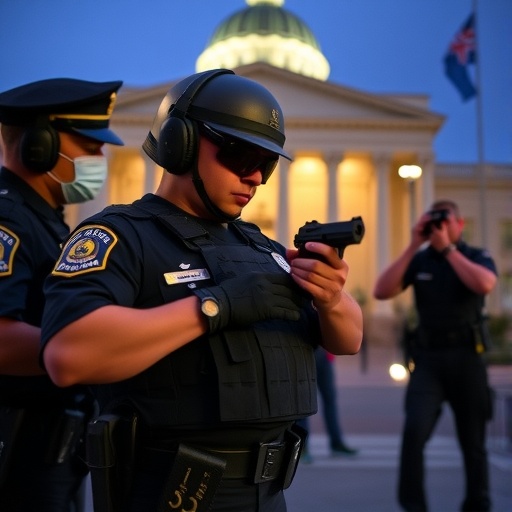
Constitutional carry laws, which permit civilians to carry firearms openly or concealed without permits, background checks, or licenses, have now been enacted in 29 US states, and a new pre-registered survey experiment reveals a striking contradiction at the heart of American public opinion about them. The study, published in the American Journal of Criminal Justice by criminologists Hunter M. Boehme and Paige E. Vaughn of the University of South Carolina, finds that while only about one-third of Americans support such laws, a substantial share of the public, including many who currently own no firearms, would nonetheless be more likely to carry a gun if permitless carry became law. The research also demonstrates that carefully framed messages from politicians and police leaders can shift what Americans believe these laws will do to personal liberty and officer safety, even when they cannot budge overall support for the policies themselves.
The experimental design was rigorous by the standards of public-opinion research. The authors fielded an online survey through the platform Prolific, collecting responses from 1,339 American adults on June 11 and 12, 2025, a sample that exceeded the 1,200 participants indicated by their a priori power analysis for detecting small experimental effects at 80 percent power. The study employed a between-subjects 2 x 2 factorial design with an added control condition, producing five total conditions. All respondents received baseline contextual information about South Carolina’s 2024 constitutional carry law, and treatment respondents were randomly assigned additional messages, either supportive or oppositional, attributed to either a police leader or a politician. The messages were constructed from real quotes issued by officials after South Carolina became the 29th constitutional carry state in March 2024. Respondents answered twelve outcome items on five-point Likert scales, which were combined into three mean scales measuring perceived effects on liberty (alpha = 0.889), police safety (alpha = 0.723), and community safety (alpha = 0.760), alongside single-item measures of overall support, willingness to carry, and the relative importance of officer safety versus the right to carry.
The descriptive results paint a picture of a public caught between competing commitments. Only 31 percent of respondents supported firearm laws of the kind described in the survey, consistent with prior national polling showing that majorities of both parties oppose permitless carry, including 60 percent of Republicans and 91 percent of Democrats in a 2023 Pew survey. Yet 38 percent said they would be more likely to carry a firearm if such a law passed, and notably, 32 percent of those reporting no firearm in their home said the same. At baseline, fewer than half of respondents, 48 percent, agreed that the safety of police officers on patrol was more important than their own right to carry, indicating a slight overall preference for personal liberty over officer safety. A majority agreed that constitutional carry would make it harder for police to do their jobs safely, restrict officers from removing firearms from civilians, and make interactions between the public and police more dangerous. At the same time, most believed the laws would expand their freedom to protect themselves and their families, while fewer than one-third thought the laws would make communities safer and most reported the laws would increase their fear of going out in public.
The regression analyses, estimated as unadjusted OLS models for the continuous mean scales and ordered logistic regressions with robust standard errors for single items, revealed that the experimental treatments did not move the needle on the headline attitudes. There were no significant effects of any condition on overall support for constitutional carry, on the police-safety-versus-liberty tradeoff, on reported likelihood of carrying, or on perceived community safety consequences. Where messaging mattered was in shaping beliefs about the laws’ downstream effects. Compared with the control group, respondents assigned the police-support treatment (average marginal effect = 0.315, p < 0.01) and the politician-support treatment (AME = 0.243, p < 0.05) were significantly more likely to agree that constitutional carry increases personal liberty and shields rights from government intrusion. Conversely, respondents assigned the politician-oppose treatment were significantly more likely to agree that the laws would jeopardize police safety (AME = 0.233, p < 0.01).
When the authors collapsed the treatment arms to isolate message effects independent of messenger, supportive messaging of any kind increased agreement that constitutional carry expands liberty (AME = 0.279, p < 0.01), while oppositional messaging increased agreement that the laws endanger officers (AME = 0.174, p < 0.05). Strikingly, however, the messenger analysis, comparing all police-leader conditions and all politician conditions against the control group, produced no significant messenger effects on any outcome. This finding complicates the intuition that a warning about officer danger would resonate more powerfully when delivered by a police chief than by a legislator. The authors had hypothesized that a police leader voicing opposition would produce the largest shifts in the statement that officer safety outweighs the right to carry, given Americans’ generally high trust in law enforcement, but the data did not bear this out. Pre- to post-experiment comparisons using t-tests and logistic regressions on the collapsed single-item outcome likewise showed that the treatments did not substantively shift respondents’ priority ordering of police safety versus carrying rights.
Robustness checks largely confirmed these results. Adjusted models incorporating covariates such as sex, age, race and ethnicity, education, employment, partisanship, marital status, urban residence, and household firearm ownership aligned with the unadjusted experimental estimates, and supplementary logistic regressions on the binary-collapsed single items reproduced the pattern: supportive treatments increased liberty perceptions while the politician-oppose treatment elevated perceived threats to police work and reduced overall support. Several covariates, however, emerged as powerful predictors in their own right. Respondents with higher perceptions of police procedural justice, meaning they viewed officers as neutral, respectful, trustworthy, and willing to listen, were more likely to see constitutional carry as protective of liberty, dangerous to police, and beneficial to community safety, and more likely to prioritize officer safety over their own right to carry. Political liberals were less supportive of the laws, less likely to say they would carry under them, and more likely to see the laws as threatening to officers. Household firearm ownership was among the strongest correlates: gun-owning households expressed unwavering support for constitutional carry, rated the laws as liberty-enhancing and harmless to police and communities, and reported a much higher likelihood of carrying under them.
The theoretical framing of the study situates these findings within the concept of a “contestability of rights,” in which citizens who deeply value both individual liberty and law enforcement are forced to weigh one against the other. Constitutional carry is an unusual gun policy in this respect: it simultaneously expands freedom, removes regulatory hurdles such as permit requirements, and, according to a growing body of empirical evidence, may elevate risks. While early research in the “more guns, less crime” tradition reported deterrent effects of right-to-carry laws, subsequent work has largely overturned that thesis. Panel analyses of right-to-carry adoption have associated these laws with higher violent crime, including a systematic review covering more than four decades of studies that found stronger permit-to-purchase and background-check policies were linked to lower firearm homicide. Research on 47 major cities identified mechanisms including increased gun loss and theft and reduced police effectiveness in solving crimes. Studies of officer safety present a nuanced picture: older work found concealed carry did not increase officer deaths, but more recent analyses show that under the laxest laws, officers are less likely to be killed while their fatal shootings of civilians increase, alongside evidence linking permitless carry regimes to higher officer-involved shootings.
For policymakers, the implications are layered. Because overall support for constitutional carry and stated willingness to carry proved resistant to persuasion, the authors suggest that core attitudes about gun rights, like attitudes toward the death penalty and other hot-button issues, may be too entrenched to shift through simple information transmission. What can be shifted are beliefs about consequences. Oppositional communication emphasizing risks to everyday policing appears most effective when delivered by politicians rather than law enforcement, an inversion of expectations. The authors speculate that the failure of safety-focused messaging to alter community safety perceptions may reflect insufficiently convincing or emotionally resonant framing, noting that episodic framings that anchor abstract risks in specific events are known to be more persuasive than general appeals. They also point to the procedural justice findings as a potential lever: police executives opposed to permitless carry might work to strengthen public perceptions of procedural fairness, which in this study predicted greater willingness to prioritize officer safety. Meanwhile, the intransigence of gun-owning households, who are also less trusting of government institutions, suggests that reforms framed around public or police safety will face resistance from precisely the population most affected.
The study is not without limitations, which the authors acknowledge candidly. The messages came only from governmental actors, and respondents received multiple concerns or benefits simultaneously rather than isolating specific features such as training requirements or age minimums. The sample, while nationally representative on age, sex, race, and gun ownership, skewed toward higher educational attainment, employment, and partisan identifiers relative to independents. Future research, the authors suggest, should test messengers outside government, such as interest groups, disentangle which specific provisions of constitutional carry concern the public most, and examine whether libertarians view the laws as uniquely liberty-enhancing without safety costs. Whether scientific evidence or emotionally resonant narratives can move attitudes where official messaging could not remains an open empirical question.
In the end, the study captures an American public that is skeptical of permitless carry in the abstract yet individually open to taking advantage of it, and that expects the same laws to simultaneously expand freedom and endanger the police. As the 2025 National Constitutional Carry Act seeks to extend permitless carry to all 50 states, the authors conclude that policymakers must weigh these competing perceptions carefully, balancing the liberty that constitutional carry promises against the risks to officer and public safety that both the public and the evidence suggest may accompany it.
Cite Scienmag News
Courtney Benton. (September 6, 2026). Constitutional Carry Messaging Shifts Public Views on Police Risks. Scienmag. https://scienmag.com/constitutional-carry-messaging-shifts-public-views-on-police-risks/
Courtney Benton. "Constitutional Carry Messaging Shifts Public Views on Police Risks." Scienmag, 6 September 2026, https://scienmag.com/constitutional-carry-messaging-shifts-public-views-on-police-risks/. Accessed 6 September 2026.
Courtney Benton. "Constitutional Carry Messaging Shifts Public Views on Police Risks." Scienmag. September 6, 2026. https://scienmag.com/constitutional-carry-messaging-shifts-public-views-on-police-risks/


