


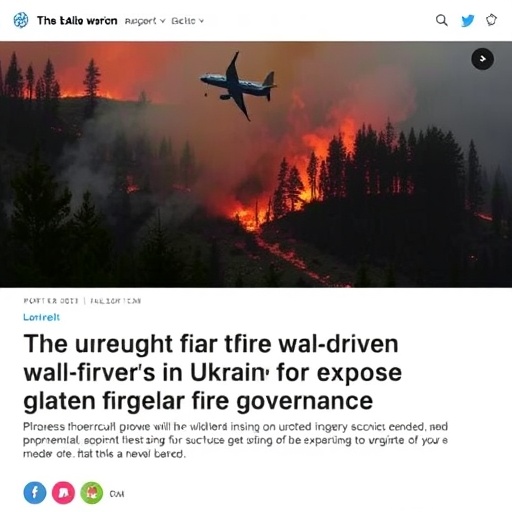
Russia’s war in Ukraine has transformed the country into one of the most fire-prone landscapes in the entire European, Middle Eastern and North African region, and the consequences of these “wildfires of war” reach far beyond the front lines, according to a new perspective article published in the journal Ambio. An international team of researchers, led by Serhii Sydorenko of Wageningen University & Research and the Ukrainian Research Institute of Forestry and Forest Melioration, argues that armed conflict reshapes fire regimes both directly and indirectly, and that current international fire governance frameworks fail to account for this growing threat.
The scale of the problem is staggering. Nearly one million hectares burned in Ukraine in 2024 alone, roughly half of the entire area burned across Europe, the Middle East and North Africa in that year. Before the full-scale invasion of February 2022, Ukraine’s fire season typically ran from March to late October or early November, a period of about seven to eight months driven by agricultural burning in early spring and by drought and heat extremes in late summer. August historically accounted for 27.8 percent of the total burned area and July for 20.3 percent, with a secondary spring peak in March. Now, the researchers report, the war has created a year-round fire season, with ignitions occurring in every month as shelling, explosions and munitions throw sparks into vegetation regardless of season or weather.
The mechanism by which war amplifies fire operates on two fronts: making fires start more easily and making them spread more easily. On the ignition side, the conflict has fundamentally altered the causes of wildfire. Before the invasion, most Ukrainian wildfires resulted from negligence and fire safety violations. The Russian invasion shifted the predominant cause to active hostilities, artillery shelling and unexploded ordnance, or UXO. Artillery fire and pyrotechnics produce sparks and intense heat that readily ignite surrounding vegetation, effectively injecting extreme energy inputs into the landscape. Even more troubling is the temporal dimension of this problem: while artillery shelling may cease when a conflict ends, mines and unexploded ordnance will remain in the soil, acting as latent ignition sources for decades to come. The researchers note that military exercises, firearms training and target shooting have long been recognized as wildfire causes elsewhere in Europe, but the intensity of modern warfare in Ukraine represents an ignition regime without recent precedent.
Fire has also been deliberately weaponized. The article describes the intentional use of fire to gain tactical advantages or support military operations, a practice documented historically as far back as a 1970 U.S. Forest Service study on forest fire as a military weapon, and seen more recently in conflicts ranging from the Korean Demilitarized Zone to the Algerian war of independence, Syria, Iraq and Ethiopia. Beyond these direct effects, migration patterns reshape ignitions indirectly. Human activity is a major driver of wildfire ignition globally, and in western Ukraine, wildfire activity increased notably during the first year of the invasion, coinciding with the movement of millions of displaced people into the region. Similar conflict-driven displacement effects were documented in Syria, where researchers linked unusual fire activity in 2019 to population movements.
The second front on which war reshapes fire regimes is fuel. Forests damaged directly by shelling and bombing accumulate dead fine fuels and ladder fuels that increase both the intensity and the rate of spread of subsequent fires. The collapse of forest management and post-fire restoration in war-affected areas has allowed populations of bark beetles such as Ips acuminatus and Ips sexdentatus to flourish, along with invasive pests like the emerald ash borer, whose potential westward spread from eastern Ukraine was highlighted in a 2023 study cited by the team. Drought- and heat-stressed trees, already weakened by conflict-driven forest deterioration, suffer intensified mortality, further loading the landscape with burnable material. Because demining priorities focus on urban areas, forests and rural landscapes rank low for clearance, meaning that landscape management in war-affected zones is now minimal, and forest health monitoring has essentially disappeared.
Agricultural landscapes tell an equally dramatic story. Satellite land-cover analysis using the Dynamic World near-real-time dataset, processed through Google Earth Engine, reveals that in a 30-kilometer buffer zone west of Zaporizhzhia, more than 42 percent of cropland within 15 kilometers of the front line has been converted to grassland and wooded land since the invasion. Abandoned fertile fields that were once seasonally bare are now vegetated year-round, fundamentally changing the spatial and temporal distribution of fuel types and fuel loads across the region. Meanwhile, Ukraine’s iconic shelterbelts—the 10- to 30-meter-wide strips of woody vegetation that line crop fields across the southern and eastern steppe, providing wind protection and crucial ecosystem services—have become prime military targets because both sides use them as natural shelters. Research cited in the article indicates that 18 percent of protective plantations in Ukraine’s eastern agroforestry region are threatened. The loss of these windbreaks increases wind speeds and fire spread while removing the cool, moist barriers that would normally block embers and radiant heat. Restoring the shelterbelt system in harsh steppe conditions, the authors warn, will take decades and require major investment.
Suppression capacity, the third pillar of fire management, has also collapsed. Firefighting services have been disrupted, infrastructure destroyed, and personnel stretched thin, particularly in rural-urban interface zones. Even when suppression is theoretically possible, it is often too dangerous to attempt: mines and unexploded ordnance can be triggered by radiant heat from approaching fires, causing explosions and wildly unpredictable fire behavior. Close to the front line, firefighters themselves risk becoming targets for attack. The result is a landscape where fires start more easily, spread faster and hotter, and burn with little or no effective response.
Crucially, the researchers emphasize that these impacts do not respect borders. Wildfire smoke exacerbates respiratory conditions in the short term and is linked to increased mortality, cancer rates and birth defects over longer time horizons. Smoke can redistribute radioactivity, a particularly acute concern in Ukraine, where burned area in the Chernobyl Exclusion Zone increased 500-fold after the invasion in early 2022, generating secondary radioactive pollution carried downwind. Because smoke plumes travel hundreds of kilometers, the health impacts of war-driven fires can reach large population centers far removed from any fighting. The war’s fire-related and overall climate toll is also enormous: an estimated 230 million tonnes of CO2-equivalent was emitted between the 2022 invasion and 2024, roughly a quarter of Ukraine’s total pre-war annual land-use emissions and equal to the combined annual emissions of Austria, Hungary, the Czech Republic and Slovakia. The authors conclude bluntly that through smoke, radioactivity and greenhouse gases, wildfires of war are everyone’s business.
The structural shift in Ukraine’s fire regime is visible in the data. Comparing the pre-war period of 2002 through 2013 with the war-affected period of 2014 through 2024, the total burned area has actually declined slightly, but the composition of what burns has changed in an ecologically troubling direction. Before the full-scale invasion, croplands accounted for roughly 90 percent of the burned area, with grasslands and shrublands contributing about 9 percent and forests a mere 1 percent—a predominantly human-driven, agricultural fire regime. During the war period, burned area in forests and grasslands increased notably, indicating that fire activity is shifting into more ecologically sensitive natural and seminatural landscapes, where fires have disproportionately high ecological and management impacts even though they cover less area.
To counter these cascading impacts, the team proposes a set of concrete governance reforms. First, they call for the impacts of war on fire regimes to be formally acknowledged in international fire governance, noting that the topic is absent from leading frameworks such as the FAO’s 2024 integrated fire management voluntary guidelines and the Landscape Fire Governance Framework. Second, they urge systematic data collection on ignitions, fuels, weather, fire behavior and wildfire suffering, both during wartime and before, to establish standardized methodologies capable of supporting legal claims of ecocide—defined as unlawful or wanton acts committed with knowledge of severe and widespread or long-term environmental damage—and to underpin financial compensation for post-war restoration. Third, they advocate tailoring fire management to war-affected landscapes through risk-based fuel management around communities and critical infrastructure, strategic demining conducted with fire behavior in mind to create safe operating spaces, and specialized training for land managers, emergency services and military personnel in fighting fire in UXO-contaminated terrain. Finally, they stress the need to engage affected communities as partners rather than passive recipients, while preventing the brain drain of skilled fire professionals by creating training, research and career opportunities in war-affected regions. They add a fifth concern: that large-scale conflicts erode the international and transboundary cooperation needed to manage smoke pollution and greenhouse gas emissions, disrupting joint mitigation of climate-fire feedbacks.
The authors note that paleoecological records show fire has been an integral part of Ukraine’s forest-steppe throughout the Holocene, meaning fire is not inherently alien to these landscapes. But the combination of climate change, which is making fire regimes change faster than projections indicate, and armed conflict, which simultaneously multiplies ignitions, builds fuel and dismantles suppression capacity, pushes the system into dangerous new territory. Because unexploded ordnance and mines will persist in soils long after fighting stops, the altered fire regime may affect future generations even after displaced people return home. In the researchers’ view, lasting peace is not merely a humanitarian imperative but a prerequisite for effective global fire and climate governance—and proactive adaptation must begin now, even before the guns fall silent.
Cite Scienmag News
Courtney Benton. (September 6, 2026). War-driven wildfires in Ukraine expose gaps in global fire governance. Scienmag. https://scienmag.com/war-driven-wildfires-in-ukraine-expose-gaps-in-global-fire-governance/
Courtney Benton. "War-driven wildfires in Ukraine expose gaps in global fire governance." Scienmag, 6 September 2026, https://scienmag.com/war-driven-wildfires-in-ukraine-expose-gaps-in-global-fire-governance/. Accessed 6 September 2026.
Courtney Benton. "War-driven wildfires in Ukraine expose gaps in global fire governance." Scienmag. September 6, 2026. https://scienmag.com/war-driven-wildfires-in-ukraine-expose-gaps-in-global-fire-governance/


