


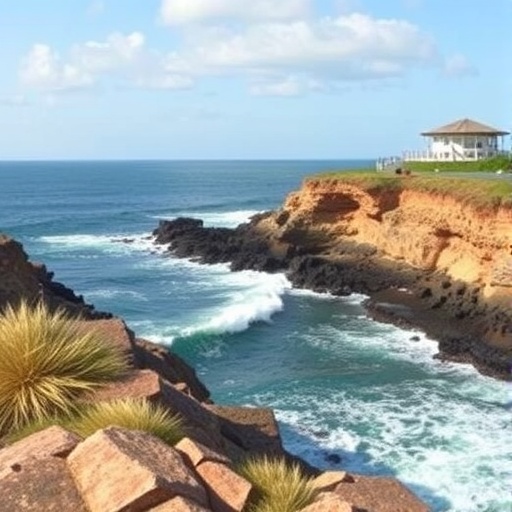
As global temperatures continue to climb and polar ice caps melt, sea levels are rising at an unprecedented rate, posing dire challenges for coastal areas worldwide. These vulnerable zones face increasing threats from storm surges, extreme precipitation, tsunamis, and other climate-induced phenomena. In response to this growing crisis, an international team of researchers led by Dr. Ravindra Jayaratne at the University of East London (UEL) has embarked on a pioneering project aimed at revolutionizing coastal defense engineering through the integration of cutting-edge scientific insights and practical policy frameworks. This initiative promises to reshape how coastal infrastructure is planned, designed, and implemented on a global scale.
A central goal of this ambitious project is to influence the revision of internationally recognized engineering standards, particularly the American Society of Civil Engineers’ ASCE/SEI 7 guidelines, which underpin the structural design of buildings and coastal defenses worldwide. Dr. Jayaratne and his colleagues seek to incorporate novel data on coastal processes and hybrid engineering solutions into these codes, ensuring that future infrastructure is resilient against the increasing magnitude and frequency of extreme coastal events intensified by climate change. By updating these standards, the project endeavors to directly impact the safety and sustainability of coastal communities across continents.
This international endeavor draws on a wealth of expertise from multiple countries, joining forces with partners from the UK, the United States—including the University of Michigan—and Japan’s renowned Waseda University. These collaborators contribute diverse perspectives on coastal dynamics, tsunami risk, and flood resilience, enriching the project’s approach. The partnership leverages insights from two Royal Society-funded research exchanges, which investigated failure modes of coastal defense structures during massive wave impacts and explored nature-based strategies like the use of saltmarshes as buffers to absorb wave energy.
One of the innovative aspects of this research is the synthesis of green, grey, and hybrid infrastructure concepts. Conventional hard engineering methods—such as sea walls, levees, and breakwaters—although robust, are often rigid and costly, sometimes resulting in unintended ecological consequences. In contrast, nature-based solutions employ living systems, like saltmarsh vegetation and wetlands, which naturally attenuate wave forces through complex root structures and flexible biomass. Hybrid approaches integrate engineered barriers with these ecological elements, potentially enhancing resilience while reducing environmental footprints.
Field research conducted in The Wash, a tidal estuary in East Anglia, England, forms a crucial part of the data-gathering efforts underpinning this project. Here, scientists are meticulously monitoring saltmarsh ecosystem dynamics, wave interactions, sediment transport, and coastal morphology to quantify how these natural environments modulate wave energy and protect shorelines. By collecting high-resolution environmental data, the researchers aim to calibrate advanced computational models that simulate coupled hydrodynamic and geotechnical processes under extreme storm scenarios.
Dr. Jayaratne’s expertise in coastal engineering and flood modeling, accumulated over more than a quarter-century, informs this project’s rigorous scientific foundation. His prior contributions to international tsunami design criteria highlight his deep understanding of how large-scale oceanic wave mechanics translate into structural forces on coastal defenses. This knowledge is pivotal to developing practical engineering guidelines that balance safety margins with cost-effectiveness, particularly in light of accelerating climate hazards.
The project also seeks to engage governmental agencies and policymakers to ensure that research outputs translate into actionable strategies. Collaboration with UK regulatory bodies, including the Environment Agency and DEFRA, as well as Japanese coastal authorities managing tsunami and flood risks, establishes vital communication channels. Such multi-level engagement fosters mutual learning and alignment of best practices, facilitating the adoption of resilient engineering solutions adapted to diverse sociopolitical contexts.
Beyond the technical scope, this research underscores the need to frame coastal resilience as a multidisciplinary challenge intersecting engineering, ecology, public policy, and social equity. Dr. Jack Clough, co-investigator from UEL’s Sustainability Research Institute, highlights this integrated perspective, noting that climate adaptation requires solutions that not only protect infrastructure but also maintain ecosystem integrity and support community livelihoods over the long term. These insights herald a paradigm shift from engineering as an isolated discipline to a collaborative endeavor.
To bridge the gap between empirical science and real-world decision-making, the project plans to develop user-friendly policy briefs, interactive decision-support software, and international forums where scientists, engineers, policymakers, and stakeholders convene. These platforms aim to demystify technical findings, foster dialogue, and promote consensus on adaptive coastal strategies that can accommodate evolving climate risks. Ultimately, these tools will empower coastal managers with evidence-based options rooted in both natural and engineered solutions.
The transformative potential of such integrative approaches cannot be overstated. As climate-induced coastal hazards intensify globally, relying solely on traditional engineering methods may prove insufficient or unsustainable. By validating and codifying hybrid defense systems that incorporate living shorelines, sediment dynamics, and resilient infrastructure design, this research offers a blueprint for societies striving to secure their coastlines for future generations.
Given the scale and urgency of these challenges, the initiative’s success could inspire broader international collaborations aimed at harmonizing climate adaptation frameworks for shore protection. As newly updated engineering standards and policy guidelines emanate from this work, they stand to influence millions of residents living in coastal zones prone to flooding and erosion, thereby reducing vulnerability and enhancing community resilience.
The University of East London’s project exemplifies how transdisciplinary science combined with proactive policy engagement can lead to innovative pathways for managing complex environmental risks. In an era where the anthropogenic footprint reshapes natural systems and amplifies disaster risks, such integrative research is paramount. It offers hope that through knowledge-driven and collaborative action, humanity can better coexist with the dynamic and powerful forces shaping our oceans and coastlines.
News Publication Date: Not specified
Web References:
– https://www.asce.org/publications-and-news/codes-and-standards/asce-sei-7-22
– https://ascelibrary.org/doi/book/10.1061/9780784414248
Keywords
Coastal engineering, flood control, ocean engineering, environmental management, risk communication, applied ecology, natural resource management, environmental impact assessments, environmental policy, floods, ocean waves, tidal waves, tsunamis, wave height, storm surges
Cite Scienmag News
Bethany Barker. (May 28, 2026). Global Initiative Aims to Set Future Benchmarks for Coastal Defense. Scienmag. https://scienmag.com/global-initiative-aims-to-set-future-benchmarks-for-coastal-defense/
Bethany Barker. "Global Initiative Aims to Set Future Benchmarks for Coastal Defense." Scienmag, 28 May 2026, https://scienmag.com/global-initiative-aims-to-set-future-benchmarks-for-coastal-defense/. Accessed 3 September 2026.
Bethany Barker. "Global Initiative Aims to Set Future Benchmarks for Coastal Defense." Scienmag. May 28, 2026. https://scienmag.com/global-initiative-aims-to-set-future-benchmarks-for-coastal-defense/


