


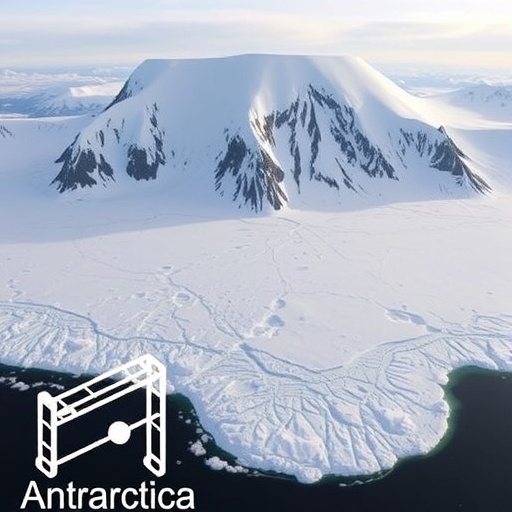
A groundbreaking study from the Institute for Basic Science (IBS) Center for Climate Physics at Pusan National University in South Korea sheds new light on the dynamic behavior of the Antarctic ice sheet over the past three million years, revealing increased sensitivity to atmospheric carbon dioxide (CO₂) following a pivotal climate shift approximately one million years ago. Published recently in Nature Geoscience, this research leverages advanced paleoclimate simulations in conjunction with sophisticated ice-sheet modeling to explore how Antarctica’s vast ice cover has responded to long-term climate fluctuations and what this means for future sea-level rise predictions.
Antarctica harbors the largest ice mass on the planet, playing a crucial role in regulating global sea levels. Its response to climate forcings is complex and mediated by several interacting processes including atmospheric temperatures, oceanic conditions, and geophysical feedbacks. Approximately one million years ago, the Earth experienced the Mid-Pleistocene Transition (MPT), a major climatic reorganization where glacial cycles shifted from a roughly 40,000-year periodicity to stronger, more prolonged ice ages spanning around 100,000 years. While this transition significantly influenced global climate patterns, how Southern Hemisphere ice sheets, especially Antarctica’s, adapted has remained enigmatic, primarily due to the scarcity of long-term climate data and realistic ice sheet models suitable for such extended timescales.
To address these gaps, the research team utilized a state-of-the-art paleoclimate computer simulation developed at the IBS Center. This high-resolution model reconstructs atmospheric temperature and precipitation patterns spanning the last three million years, offering unprecedented temporal and spatial detail. These data were then inputted into the Penn State University ice-sheet–ice-shelf model, known for its comprehensive treatment of ice dynamics including flow regimes, thermal conditions within the ice, and interactions with floating ice shelves like those adjoining the Ross and Weddell Seas. By coupling these climate and ice sheet models on powerful supercomputers dedicated to foundational scientific research, the team generated a physically consistent, continuous representation of Antarctic ice sheet evolution aligned with changing environmental forcings.
The simulation results are striking. They indicate that post-MPT, the Antarctic ice sheet entered a novel dynamical regime characterized by heightened sensitivity to decreases in atmospheric CO₂. Crucially, the model reveals a critical CO₂ concentration threshold around 240 parts per million (ppm). Below this level, modest fluctuations in CO₂ result in disproportionately large variations in Antarctic ice volume. This nonlinear response challenges previous assumptions of gradual ice mass changes, suggesting instead that the ice sheet can transition abruptly in response to crossing certain climate tipping points.
Such sensitivity has profound implications for understanding ice sheet physics. The increased responsiveness appears to stem from a combination of climatic and geophysical feedbacks occurring around the MPT. First, glacial ocean temperatures around Antarctica became substantially colder, which inhibited basal melting of the ice below sea level—an important control on ice sheet stability. Colder oceans reduce the heat flux beneath floating ice shelves, thus limiting calving and promoting ice mass retention. Second, the global sea level dropped significantly, by approximately 50 to 100 meters compared to present-day, reducing hydrostatic pressure on the Antarctic bedrock underneath the ice shelves. This unloading effect drove a gradual isostatic uplift of the bedrock, reinforcing ice thickening along coastal margins and enhancing ice sheet persistence.
Together, these interconnected processes established larger, more stable Antarctic ice sheets during 100,000-year glacial cycles characteristic of the last million years, distinctively different from prior periods. The findings underline that the Antarctic ice sheet does not evolve in a simple linear manner but rather exhibits threshold behaviors with marked regime shifts, profoundly altering its climate sensitivity over geological timescales.
Lead author Dr. Yun Kyung-Sook remarked on the transformative nature of these results: “Our study reveals that after the Mid-Pleistocene Transition, the Antarctic ice sheet became dramatically more responsive to changes in atmospheric CO₂ and temperature forcing. Rather than evolving incrementally, the system passes through a critical threshold, triggering abrupt and enhanced ice volume changes.” This enhanced responsiveness points to the importance of identifying similar thresholds in Earth’s climate system, particularly given ongoing anthropogenic CO₂ emissions.
Moreover, the research highlights the nuanced interplay between atmospheric CO₂ levels, ocean temperatures, and solid Earth geophysics in governing ice sheet dynamics. Unlike simpler models that treat ice sheets as passive responders, this work demonstrates that feedback mechanisms such as bedrock uplift and ocean-ice interactions critically amplify or dampen ice sheet responses. These findings compel a reconsideration of how future climate scenarios are modeled, especially regarding predictions of Antarctic ice loss and resultant sea level rise.
Professor Axel Timmermann, co-author and director of the IBS Center for Climate Physics, emphasized the broader significance: “Our results indicate that the Antarctic ice sheet might be more vulnerable—and dynamic—than previously believed. This has profound ramifications for sea level projections and underscores the urgency of monitoring Antarctic conditions closely as human-caused warming progresses.” Understanding these sensitivity thresholds can improve model fidelity, better informing policymakers and coastal planners about potential rapid ice sheet responses in a warming world.
In addition to advancing fundamental glaciology and paleoclimate science, this investigation opens new pathways for exploring how large ice masses respond to intertwined climatic and geophysical changes across multiple temporal scales. It exemplifies the power of integrating sophisticated climate reconstructions with dynamic ice sheet models run on cutting-edge computational resources to unravel complex Earth system processes.
As the planet continues to warm and atmospheric CO₂ concentrations rise beyond pre-industrial levels, insights gleaned from ancient climate transitions such as the Mid-Pleistocene offer vital analogs for anticipating future ice sheet behavior. This study not only demonstrates the past variability of Antarctic ice in relation to CO₂ but also serves as a cautionary tale about the risks of crossing critical climatic thresholds that could accelerate ice mass loss with consequential impacts on global sea level and climate feedbacks.
In summary, the synergistic approach combining paleoclimate simulation with physics-based ice sheet modeling reveals that around one million years ago, Antarctica’s ice sheets entered a more sensitive dynamical state linked to CO₂ falling below ~240 ppm. This threshold marked a fundamental shift in ice sheet behavior, fostering larger, longer-lasting glaciations through ocean cooling and geophysical feedbacks. These findings refine our understanding of ice sheet-climate interactions and hold crucial lessons for projecting future Antarctic ice response amid ongoing anthropogenic climate change.
News Publication Date: 28-May-2026
Web References: 10.1038/s41561-026-01979-2
Cite Scienmag News
Sloane Callahan. (May 28, 2026). Antarctic Ice Became Dramatically More Sensitive to Climate Change Following Ice Age Shift 1 Million Years Ago. Scienmag. https://scienmag.com/antarctic-ice-became-dramatically-more-sensitive-to-climate-change-following-ice-age-shift-1-million-years-ago/
Sloane Callahan. "Antarctic Ice Became Dramatically More Sensitive to Climate Change Following Ice Age Shift 1 Million Years Ago." Scienmag, 28 May 2026, https://scienmag.com/antarctic-ice-became-dramatically-more-sensitive-to-climate-change-following-ice-age-shift-1-million-years-ago/. Accessed 4 September 2026.
Sloane Callahan. "Antarctic Ice Became Dramatically More Sensitive to Climate Change Following Ice Age Shift 1 Million Years Ago." Scienmag. May 28, 2026. https://scienmag.com/antarctic-ice-became-dramatically-more-sensitive-to-climate-change-following-ice-age-shift-1-million-years-ago/


