

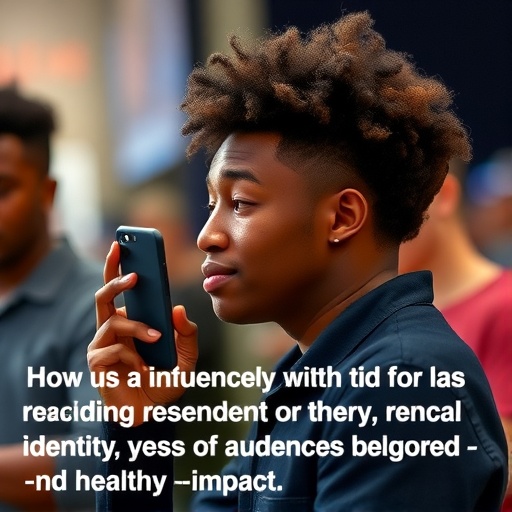
Food marketers increasingly use people for paid promotions who share the racial and ethnic identities of their target audiences because such “identity congruence” is seen as persuasive. This strategy has migrated to social media, where it can reach millions of users daily including youth who may be less likely to recognize it as advertising.
However, while large numbers of consumers base their food purchases on influencer posts and adolescents are exposed to unprecedented levels of social media food marketing, little is known about the psychological mechanisms that make these messages persuasive, particularly among racial and ethnic minority youth.
A new study by a team of psychology and health researchers addresses some of these questions.
It found that racial and ethnic minority youth reported paying more attention to influencers who looked like them and shared their racial identity. Moreover, this heightened visual interest was associated with stronger engagement with social media posts and a stronger preference for unhealthy foods.
The results suggest that identity-based social media marketing may be a powerful mechanism in shaping adolescents’ eating behavior.
“Adolescence is a critical period for social modeling,” explains Emily Balcetis, an associate professor in New York University’s Department of Psychology and the lead author of the study, which appears in The Journal of Experimental Social Psychology. “When influencers share those identities, they grab attention, and as a result, signal what people like their followers do, value, and eat.”
“Who delivers the message matters,” adds Marie Bragg, an associate professor in the Department of Population Health at NYU Grossman School of Medicine and one of the paper’s authors. “Some minority adolescents are more influenced by unhealthy food marketing when it comes from influencers who share their racial or ethnic identity. They carry greater weight for teens in forming a sense of who they are.”
The researchers examined this dynamic through two experiments.
Experiment One: Testing Visual Interest and Impact of Influencers’ Posts
The researchers studied the impact of influencers’ visuals among both female and male Black and non-Hispanic White teenagers. The sample of more than 500 teens—aged 13 to 19—was shown images of a single adolescent or young adult promoter endorsing a product. The researchers manipulated the race of the promoter and the product included but kept other details identical so that across sets, the general look and feel of the image and surrounding details remained as similar as possible. Two sets included Black promoters and two sets included White promoters. In some sets, these promoters were depicted endorsing unhealthy foods (e.g., an Oreo snack pack) while in others they were shown endorsing a non-food product (e.g., a business card). Participants were randomly assigned to view only one version of any post.
To gauge food preferences of the study’s participants, the researchers created 20 pairs of snacks that appeared on the screen side by side. Each pair consisted of a less healthy, non-nutritious snack and a healthier snack. To create pairings, they selected foods that matched on visual features like color, shape, and size—for instance, a green popsicle with a cucumber.
The participants, who were randomly assigned to these experimental conditions, were asked to assess both how “cool, attractive, and interesting” the person in the post and the post itself were—along with how much the person in the post grabbed their attention or caught their eye. The participants, who reported the likelihood they would “like,” comment on, or share the post, also viewed pairs of snacks and reported which one they would like to eat right now by selecting one of two options within each pair of choices.
The results showed the following:
- The effect of promoter racial congruity on visual interest was significant for Black, but not for White, adolescents. Black participants found posts that included racially congruent promoters more interesting than ones that included incongruent promoters.
- When posts included unhealthy foods, teens who reported greater visual interest—which occurred among Black teens more so than among White teens—also showed an increase in unhealthy foods they chose.
- Overall, there were no differences among participants with respect to engagement with posts. However, Black, but not White, adolescents were more likely to engage with posts that they found visually interesting, regardless of the type of product endorsed.
- Among Black participants, seeing a racially congruent—compared to an incongruent— promoter strengthened visual interest in the post, which increased the likelihood of engaging with the post when that promoter endorsed unhealthy food products.
Experiment Two: Testing the Broader Impact of Race-Congruent Promoters
The second experiment aimed to understand if these messages affected other non-White racial groups in the same way. To do so, the researchers recruited nearly 900 teenage participants—a sample that included those who identified as Black, East Asian, Hispanic, or non-Hispanic White.
The method was nearly identical to the first experiment. The primary difference was the addition of East Asian and Hispanic male and female promoters endorsing the same unhealthy food or non-food products as in the first experiment—while retaining the posts with Black and White promoters used previously.
The results were similar to those of the first experiment—most notably, the effect of promoter racial congruity on visual interest was significant for all non-White adolescent groups but not for White adolescents. Black, East Asian, and Hispanic participants found posts that included racially congruent promoters more interesting than ones which included incongruent promoters. And, crucially, visual interest again related to unhealthy food choices: as visual interest in the posts that promoted unhealthy foods (vs. non-food products) increased, adolescents selected unhealthy food over healthier options.
“At a time when adolescents are exposed to social media food marketing on a daily basis, this research identifies visual interest as a key mechanism linking racially targeted marketing to unhealthy food preferences,” concludes Balcetis.
The paper’s other authors were: Jordan Daley, an NYU research fellow at the time of the study*, Eunha Choi, an NYU graduate student, and Omni Cassidy, an assistant professor in the Department of Population Health at NYU Grossman School of Medicine.
The study was funded by the National Cancer Institute, part of the National Institutes of Health (R01CA248441).
# # #
*Editor’s note: Jordan Daley will be a member of the faculty in the Department of Psychology at Loyola University of Chicago beginning in August 2026.
Journal
Journal of Experimental Social Psychology
Method of Research
Experimental study
Subject of Research
People
Article Title
Seeing oneself in the feed: Racialized targeting in food marketing and its impact on adolescents’ visual interest and unhealthy food preferences
Article Publication Date
25-Jun-2026
James Devitt
New York University
james.devitt@nyu.edu
Office: United States
Cell: 914-522-3774
Journal
Journal of Experimental Social Psychology
Method of Research
Experimental study
Subject of Research
People
Article Title
Seeing oneself in the feed: Racialized targeting in food marketing and its impact on adolescents’ visual interest and unhealthy food preferences
Article Publication Date
25-Jun-2026
Tags
bu içeriği 600 ile 800 kelime arasında olacak şekilde ve alt başlıklar ve madde içermiyecek şekilde ünlü bir science magazine için İngilizce olarak yeniden yaz. Teknik açıklamalar içersin ve Viral science news olacak şekilde İngilizce yaz. Haber dışında başka bir şey içermesin. Haber içerisinde 8 ile 10 paragraf olsun ve toplam uzunluk 600 ile 800 kelime arasında kalsın. Cevapta sadece haber olsun. Ayrıca haberi yazdıktan sonra içerikten yararlanarak aşağıdaki başlıkların bilgisi var ise haberin altında doldur. Eğer yoksa bilgisi ilgili kısmı yazma.:
Subject of Research:
Article Title:
News Publication Date:
Web References:
References:
Image Credits:
Keywords


