

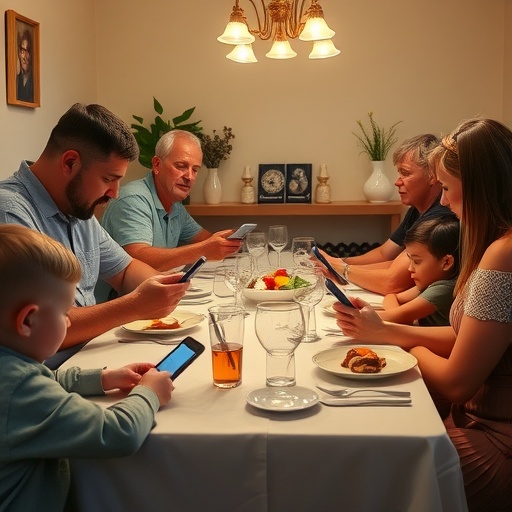
The family dinner table, long idealized as a sacred space for connection and conversation, is undergoing a profound digital transformation. A new study from the University of Arizona reveals that the ritual of shared meals is now saturated with screens, with more than 70% of American parents and children engaging with media devices while sitting together to eat. This finding, published in JAMA Pediatrics, offers one of the most detailed snapshots yet of how deeply technology has penetrated a cornerstone of family life, challenging assumptions that shared physical presence alone is enough to maintain meaningful interaction.
The research, led by Jiawen Wu, a doctoral student in the Department of Communication at the College of Social and Behavioral Sciences, was designed as a comprehensive survey capturing media habits during mealtimes across a diverse sample of families with children aged 4 to 10. While the study does not delve into the specific content being consumed or the motivations behind it, the sheer prevalence of the behavior marks it as a significant public health and developmental concern. Matthew Lapierre, an associate professor and the study’s senior author, emphasized that the 70% figure is substantial enough to warrant urgent further investigation into its consequences for child development and family dynamics.
One of the study’s most striking and counterintuitive discoveries is the apparent independence of parent and child media use. The data showed no significant covariation, meaning that a parent absorbed in their smartphone does not reliably predict that their child will be doing the same, and vice versa. This defies the conventional wisdom that parental behavior directly models and shapes a child’s media consumption in the moment. The implication for clinical intervention is substantial: therapeutic strategies aimed at curbing screen time at the table cannot simply target parents with the expectation of a trickle-down effect. Instead, clinicians may need to develop separate, parallel behavioral modification approaches tailored specifically to adults and children.
Wu articulates a critical psychological nuance that the study brings to light—the distinction between physical presence and genuine attentional engagement. Parents often operate under the assumption that their mere bodily presence at the dinner table constitutes quality time. However, the research suggests this presence can functionally dissolve into a form of absence when their cognitive and emotional resources are consistently absorbed by a screen. This phenomenon of “technoference,” where digital devices intrude upon and erode face-to-face interactions, transforms a potentially rich developmental environment into a collection of individuals coexisting in a shared space without genuine connection.
The investigation also uncovered significant ethnic variations in how media is consumed during meals, adding a layer of cultural complexity to the findings. African American parents reported higher rates of shared media use, co-consuming content with their children rather than isolating themselves with a personal device. In contrast, Asian American parents reported significantly more child-only media use, where children engage with screens independently. These patterns highlight that media consumption is not a monolithic behavior; it manifests as either a potentially bonding joint activity or a solitary escape, each carrying different developmental implications. Shared viewing, for instance, can serve as a vehicle for parental mediation and discussion, whereas individual use may represent a missed opportunity for interaction.
The type of device proved to be a powerful determinant of the social dynamics at play. The study found a clear bifurcation between passive and active consumption across different screen sizes. Parents predominantly engaged in active use on smartphones, complemented by passive consumption like television viewing. Children mirrored this duality, switching between actively playing video games and passively watching content. The hardware itself dictates the social architecture of the experience: a large-screen television, by its communal nature, still allows for a collective viewing experience that can serve as a conversational springboard. Conversely, the small-screen ecosystem of tablets, smartphones, and portable gaming consoles is engineered for an individualized experience, creating private sensory bubbles that shut out the surrounding family members. Co-author Cecilia Sada Garibay, a fellow doctoral student, noted that while all forms of media use disrupt communication, a shared television program at least offers the potential to become a shared topic of conversation, unlike the isolating glow of a personal tablet.
Despite the negative connotations, the researchers urge caution in issuing blanket condemnations before more is known about the contextual role of media. Lapierre raises the provocative possibility that in some households, media might serve a functional purpose, such as defusing conflict or filling conversational voids that would otherwise generate friction. However, the overarching goal of the research is to equip healthcare professionals with the evidence needed to have informed conversations with families. The data provides a concrete foundation for encouraging parents to be more mindful about media consumption during mealtimes and to recognize that putting down the phone is a conscious act of prioritizing the developmental need for genuine, unmediated human connection.
Subject of Research: Parent and Child Media Use During Family Meals in US Households
Article Title: Parent and Child Media Use During Family Meals in US Households
News Publication Date: 15-Jun-2026
Web References: JAMA Pediatrics Study
References: 10.1001/jamapediatrics.2026.2182
Image Credits: Not provided in source material.
Keywords: Family mealtime, media use, screen time, parent-child interaction, technoference, child development, mobile devices, family communication, shared media use, ethnic differences, JAMA Pediatrics


