

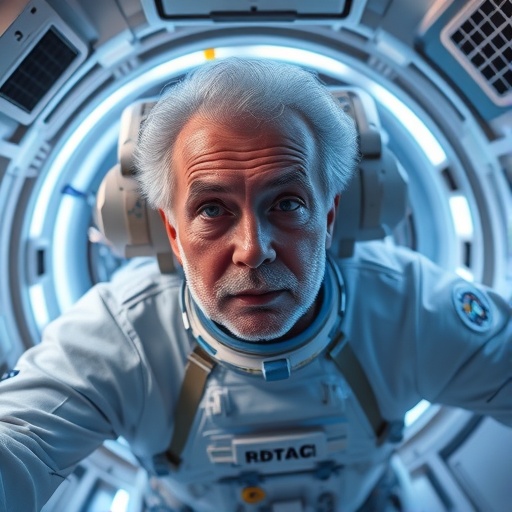
A new study has revealed that the extreme environment of deep space triggers molecular changes in the liver that mirror the hallmarks of accelerated aging, offering a powerful new laboratory model for understanding why our organs deteriorate over time and how we might slow that decline. Researchers at the University of Central Florida’s College of Medicine, collaborating with multiple institutions, exposed animal models to a carefully calibrated cocktail of galactic cosmic radiation and simulated microgravity matching the dose astronauts would accumulate on a trip to Mars. Within just 24 hours of radiation exposure, the team observed widespread genetic reprogramming in hepatic tissue — the liver’s functional core — characterized by a surge in cellular senescence, chronic inflammation, and the early stirrings of fibrosis. These are the same biological failures that creep through aging bodies on Earth, but in space they hit fast-forward.
The liver was chosen as the sentinel organ because it sits at the crossroads of metabolism, filtering toxins, producing vital proteins, and regulating energy balance. When microgravity shifts bodily fluids and radiation slices through DNA strands, hepatocytes — the liver’s workhorse cells — begin to lose their identity. The new work, published in GeroScience, maps this identity crisis at the epigenetic level, pinpointing a disrupted dialogue between microRNAs and the TGF-β signaling pathway. MicroRNAs are short, non-coding RNA molecules that silence genes by binding to messenger RNA, fine-tuning vast biological circuits. TGF-β is a master cytokine that orchestrates tissue repair and inflammation. In the livers of simulated space travelers, the brakes that normally restrain TGF-β activity were lifted, pushing cells into a zombie-like senescent state where they stop dividing but refuse to die, leaking inflammatory signals that damage neighboring tissue.
To confirm that these changes were relevant to real human biology, the scientists cross-referenced their laboratory data with blood samples collected from astronauts during NASA’s landmark Twins Study and the Inspiration4 commercial mission. The same genetic signatures appeared in the human circulatory system, indicating that the liver’s distress signals were detectable far beyond the organ itself. “We’ve got this raw data from human studies, and they show that some of these changes are similar,” explains Michal Masternak, professor of medicine and leader of the investigation. “That tells us we’re identifying useful molecular targets that one day could help protect astronauts during long-duration space missions.” The convergence of rodent models and astronaut blood work strengthens the case that the lesions of spaceflight are not random accidents but conserved biological responses to extreme environmental stress.
The implications for aging research on Earth are profound. Aging is not a single disease but a synchronized collapse of multiple systems — metabolic, immune, structural — that unfolds over decades, making it extraordinarily difficult to dissect in real time. Space, however, compresses this timeline, enabling researchers to watch the entire cascade ignite within days. Masternak notes that this accelerated timeline could unlock the earliest triggers of age-related organ failure. If scientists can identify the initial molecular dominoes that tip a liver cell toward senescence and fibrosis during spaceflight, they may be able to develop therapies that intercept the same process in an aging human on Earth, potentially preserving organ function and healthspan.
One such therapeutic avenue explored in the study involves molecules known as antagomirs — chemically engineered oligonucleotides that bind to and neutralize specific microRNAs. By designing antagomirs that selectively inhibit the microRNAs driving the TGF-β overactivation, the team was able to dial back the inflammatory and fibrotic programs in their experimental models. This is not a distant promise; antagomir technology is already being tested in clinical trials for other diseases, and the space-aging connection could accelerate its application for a range of age-related pathologies, from liver fibrosis to cardiovascular decline.
The research also underscores the hidden health toll that will accompany humanity’s push deeper into the solar system. While much of the public conversation around space exploration focuses on rocket engineering and life support hardware, the silent erosion of astronaut livers, bones, and brains by radiation and microgravity remains one of the greatest unsolved challenges for missions to Mars and beyond. The study found that the damage is not merely speculative — it is measurable, rapid, and, at the molecular level, frighteningly similar to what physicians see in patients with advanced metabolic liver disease.
UCF’s team is now expanding its work with students at the forefront of space medicine. Doctoral candidate Md Tanjim Alam, who processed astronaut samples for the study, says the experience reshaped his scientific focus. “I really want to understand how space travel influences human health, particularly its effects on aging and cancer.” His colleague Sarah S. Siddiqi adds that the research breaks the stereotype that aging biology is only about elderly populations. “We study aging across different stages of life and different environments, including space. I want to better understand diseases that are increasingly prevalent and find ways to recognize them earlier.” As commercial spaceflight expands and more ordinary people venture beyond Earth’s atmosphere, the lessons being learned today about the liver’s vulnerability in space may become the foundation of tomorrow’s anti-aging medicines for everyone.
Subject of Research:
The effects of space radiation and microgravity on liver aging, focusing on miRNA‑TGF‑β networks associated with cellular senescence and fibrosis.
Article Title:
Space radiation and microgravity as models of accelerated aging: modulation of hepatic miRNA‑TGF‑β networks associated with senescence and fibrosis
News Publication Date:
23-Jun-2026
Web References:
10.1007/s11357-026-02365-x
References:
GeroScience, DOI: 10.1007/s11357-026-02365-x
Image Credits:
Photo by UCF College of Medicine
Keywords:
Space medicine, space research, liver, aging, microgravity, cosmic radiation, cellular senescence, fibrosis, microRNA, TGF-β, antagomirs, astronaut health


