


view more
Credit: KyotoU / Yusuke Onoda
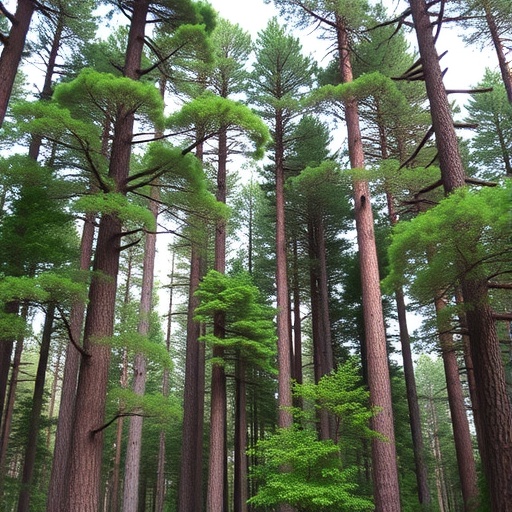
Kyoto, Japan — Forests are shaped by light competition. The trees that grow the tallest have access to the most sunlight, blocking the rays and rendering the shaded space around them inhospitable to shorter trees below. In this stem exclusion phase of forest succession, the shorter trees often die. Yet scientists have observed that in old growth forests, trees of vastly different sizes successfully coexist, proving that reaching the top of the canopy is not the sole winning strategy for survival in a forest environment.
The height diversity of trees in mature forests indicates that light competition and species coexistence can balance out in forest succession. To understand how, quantifying light competition among trees is essential, but the complex architectural structures of natural forests and individual crowns have hindered rigorous scientific evaluation. A team of researchers from Kyoto University resolved to take on the challenge and solve this mystery.
“The competition for light among trees is frequently referred to as an evolutionary arms race, but trees of vastly different sizes successfully coexist in mature forests,” says first author Yusuke Onoda. “We became interested in this paradox.”
The team chose an approach with a novel framework analyzing a tree’s relative growth rate, or the speed at which a tree grows relative to its size, separated into two key factors: light interception efficiency, which indicates how much sunlight a tree captures per unit of biomass, and light use efficiency, which describes how effectively a tree converts the intercepted sunlight into biomass. To test their framework in the wild, the scientists mapped the crown shapes and 3D light profiles of each tree within 12 different forest plots of varying ages in Japan, totaling more than 2,000 individual trees of 50 different species.
The results revealed a mechanistic explanation behind how light competition quantitatively drives secondary forest succession. In younger stands, or plots in a forest, taller trees have disproportionate advantages in light capture, forcing rapid height stratification. In older stands, however, the higher light use efficiency of shade-tolerant species enables them to thrive under tall canopies, promoting vertical species coexistence.
By uncovering the hidden mechanics of forest succession, this study offers a new perspective on how trees navigate light competition and establishes a new principle that explains how forests change across time and space. These insights have the potential to improve climate modeling and enable smarter forest management.
The team is applying their approach to other forest sites of different ages across various climate zones, including warm temperate and tropical forests. They hope this will validate and establish their framework as a general, universal principle on a global scale.
###
The paper “Partitioning tree growth into light interception and use efficiencies clarifies the role of light competition in secondary forest succession” appeared on 8 July 2026 in the Journal of Ecology, with doi: 10.1111/1365-2745.70375
About Kyoto University
Kyoto University is one of Japan and Asia’s premier research institutions, founded in 1897 and responsible for producing numerous Nobel laureates and winners of other prestigious international prizes. A broad curriculum across the arts and sciences at undergraduate and graduate levels complements several research centers, facilities, and offices around Japan and the world. For more information, please see:
Journal
Journal of Ecology
Method of Research
Observational study
Subject of Research
Not applicable
Article Title
Partitioning tree growth into light interception and use efficiencies clarifies the role of light competition in secondary forest succession
Article Publication Date
8-Jul-2026
COI Statement
The authors declare no conflict of interest regarding this work.
Whitney Hubbell
Kyoto University
hubbell.whitney.4a@kyoto-u.ac.jp
bu içeriği 600 ile 800 kelime arasında olacak şekilde ve alt başlıklar ve madde içermiyecek şekilde ünlü bir science magazine için İngilizce olarak yeniden yaz. Teknik açıklamalar içersin ve Viral science news olacak şekilde İngilizce yaz. Haber dışında başka bir şey içermesin. Haber içerisinde 8 ile 10 paragraf olsun ve toplam uzunluk 600 ile 800 kelime arasında kalsın. Cevapta sadece haber olsun. Ayrıca haberi yazdıktan sonra içerikten yararlanarak aşağıdaki başlıkların bilgisi var ise haberin altında doldur. Eğer yoksa bilgisi ilgili kısmı yazma.:
Subject of Research:
Article Title:
News Publication Date:
Web References:
References:
Image Credits:

