

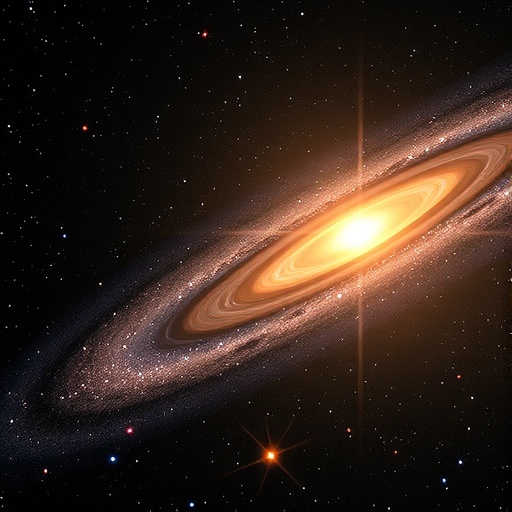
A cosmic treasure hunt has just redefined the boundary of the visible universe. An international team using the European Space Agency’s Euclid space telescope has uncovered 31 quasars blazing from a time when the cosmos was barely 5 percent of its current age. Among them is a new record-holder, EUCL J172902.75+641018.1, whose light began its journey a mere 670 million years after the Big Bang, shattering the previous distance record by 15 million years. The findings, published in Astronomy & Astrophysics on July 6, 2026, more than triple the number of known quasars at such extreme distances and open a unique window into the universe’s darkest chapter.
Quasars are the violently luminous cores of young galaxies, where supermassive black holes millions to billions of times the mass of the Sun gorge on infalling gas and dust. The resulting accretion disk shines with the power of trillions of suns, making quasars visible across the entirety of cosmic history. Because their light must traverse most of the observable universe to reach us, these objects act as natural flashlights that illuminate the intervening gas, particularly during the epoch of reionization. This poorly understood era marks the moment when the first stars and galaxies flooded the universe with ultraviolet radiation, stripping electrons from the neutral hydrogen fog that had pervaded space since the cooling after the Big Bang.
Until now, astronomers had confirmed only nine quasars beyond a redshift of seven, corresponding to a look-back time of nearly 13 billion years. Their scarcity has frustrated attempts to decipher how the earliest black holes assembled so quickly and how they influenced the reionization of the cosmos. Spotting them is fiendishly difficult: cosmic expansion stretches their ultraviolet light deep into the near-infrared, precisely where Earth’s own atmosphere glows with a bright, contaminating background. Ground-based telescopes alone struggle to pluck these faint signals from the sky glow, like trying to hear a whisper at a rock concert.
Euclid, launched in July 2023, was designed from the outset to beat this challenge. Its Near-Infrared Spectrometer and Photometer (NISP) and wide-field Visible Camera scan thousands of square degrees with a sensitivity that reaches magnitude 24.5, probing 10 to 100 times fainter than any previous wide-field survey. The team fed Euclid’s optical and near-infrared images into machine-learning algorithms trained to recognize the characteristic “dropout” signature — a sudden break in a quasar’s spectrum caused by the absorption of all light blueward of the Lyman-alpha line by neutral hydrogen along the line of sight. Candidates were then vetted with deep spectroscopic follow-up using the Keck Observatory, Magellan Telescopes, and the Large Binocular Telescope in Arizona, which delivered the definitive redshifts.
The haul of 31 confirmed quasars includes the faintest and least massive supermassive black holes ever seen at such distances. “The quasars presented in this paper are fainter, less luminous, and have somewhat lower-mass black holes than the ones that we discovered before,” said Xiaohui Fan, Regents Professor of Astronomy at the University of Arizona’s Steward Observatory. “Having a space telescope like Euclid dedicated to this purpose allows us to hunt for the smaller, less luminous ones that we weren’t able to go after before.” Fan’s team, along with colleagues now at the University of Michigan, provided essential ground-based spectroscopy, teasing out the light fingerprints that confirm both distance and black hole mass.
The record-breaking quasar, EUCL J172902.75+641018.1, shines from a cosmic epoch just 670 million years old. For context, the entire history of stars, galaxies, and planets that followed is more than 20 times longer. Daming Yang, a doctoral student at Leiden Observatory and first author of the paper, underscores the urgency: “With only a few quasars known beyond redshift seven, we simply cannot answer these questions. Finding more of them at such distances — and pushing to even greater distances — is the only way forward.” The new sample immediately provides a more representative census, revealing a population of actively growing black holes that bridges the gap between the very first seeds and the behemoths observed later in cosmic time.
The implications stretch far beyond census-taking. Early analyses of the second-most distant quasar in the sample, detailed in a companion paper led by Silvia Belladitta of the Max Planck Institute for Astronomy, show that it is enshrouded in a dusty, gas-rich galaxy that is furiously forming new stars. This hints that the hosts of the earliest quasars are dense, chaotic environments capable of funneling enormous amounts of material toward the central black hole while simultaneously building the galaxy around it. Precisely how such massive black holes — containing the mass of billions of suns — condensed from primordial gas in just a few hundred million years remains a profound theoretical puzzle. Each new quasar from this era adds a data point that can stress-test models of rapid black hole growth via direct collapse, super-Eddington accretion, or heavy seed scenarios.
With only one and a half years of Euclid data analyzed, this discovery is merely the opening act. The full six-year survey is forecast to uncover hundreds more high-redshift quasars, including the first ever beyond redshift eight. The next Euclid data release, expected in late 2026, will offer the largest map of the universe ever produced from space in both infrared and visible light. Beyond the hunt for ancient quasars, this monumental dataset promises breakthroughs on the nature of dark energy and dark matter, cementing Euclid’s role as a transformative observatory for cosmology. For now, the newfound beacons are already piercing the cosmic dark, illuminating the infancy of the structured universe.
Subject of Research: Not applicable
Article Title: 10.1051/0004-6361/202658883
News Publication Date: 6-Jul-2026
Web References: https://www.aanda.org/articles/aa/full_html/2026/07/aa58883-26/aa58883-26.html
References: D. Yang et al., Astronomy & Astrophysics, 2026, DOI: 10.1051/0004-6361/202658883
Image Credits: ESA
Keywords
quasars, early universe, supermassive black holes, Euclid space telescope, reionization, high-redshift, cosmology, Astronomy & Astrophysics


