

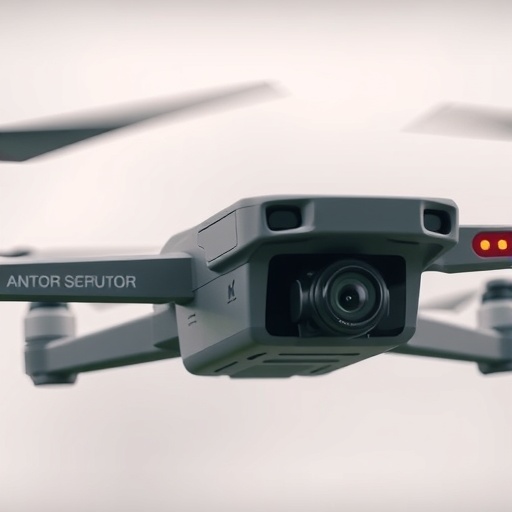
Drones have promised a future where the sky buzzes with automated deliveries, inspections, and cinematography, but that promise comes with a precarious edge. A sudden gust of wind, a software glitch, or a momentary loss of communication can send a quadrotor spinning toward a building, a crowd, or the ground. Now, a University of Houston engineer has built a real-time safety net that could finally make these agile machines trustworthy enough for widespread use. Marzia Cescon, the David C. Zimmerman Assistant Professor of Mechanical & Aerospace Engineering, has developed an onboard “safety supervisor” that acts like an invisible force field, autonomously steering a drone away from danger without human intervention.
Quadrotors — the four-rotor helicopters that dominate the consumer and commercial drone market — are prized for their ability to hover, dart through tight spaces, and execute complex maneuvers. But that agility comes at a cost. Their flight dynamics are inherently unstable, and even advanced autopilots can be caught off guard when a wind shear or sensor anomaly pushes the aircraft beyond its operational envelope. Traditionally, safety has been the responsibility of the human pilot or a pre-programmed mission planner, but neither can react rapidly enough to every unpredictable event. Cescon’s work reimagines safety as a continuous, mathematically rigorous negotiation between what the drone wants to do and what it should do to stay alive.
The core of her system is a module that implements run-time assurance (RTA), a framework borrowed from high-criticality systems like spacecraft and nuclear reactors. RTA continuously monitors the health of the primary controller and can override it if a violation of safety constraints is imminent. In Cescon’s design, the supervisor sits transparently alongside the drone’s existing flight controller, intervening only when necessary. She describes it as an invisible fence that defines the boundary between safe and unsafe flight. The moment the supervisor predicts the drone will breach that fence, a corrective action is injected, nudging the aircraft back into the safe region.
The mathematics behind this fence is a Control Barrier Function (CBF), a tool from nonlinear control theory that has recently gained traction in robotics. A CBF certifies whether a given state — the drone’s tilt, angular velocity, altitude, or lateral position — is safe, and if not, it computes the minimal adjustment needed to restore safety. What makes Cescon’s implementation novel is that it works in real time on actual drone hardware, reconciling the elegant abstractions of CBF theory with the messy realities of sensor noise, processing delays, and aerodynamic drag. The supervisor monitors the drone’s tilt and three-dimensional position at high frequency, solving an optimization problem in milliseconds to determine whether the upcoming trajectory will violate a predefined safety envelope. If a violation is predicted, the algorithm seamlessly takes control of the throttle and rotor speeds to yank the drone away from disaster.
One of the key findings from the research, published in the American Society of Mechanical Engineers’ Journal of Dynamic Systems, Measurement and Control, is that CBF-based RTA can be layered on top of standard optimal controllers — like linear quadratic regulators or model predictive controllers — without extensive re-engineering. Cescon and her team tested multiple integration schemes, revealing practical tradeoffs between conservatism and agility. A supervisor that is too cautious might prevent the drone from completing its mission, while one that is too lenient could allow a crash. The sweet spot, they found, depends on tuning the barrier function’s parameters to match the specific airframe and environment, a process that could eventually be automated through machine learning.
The implications extend far beyond laboratory experiments. Drones are increasingly used for infrastructure inspection, agricultural monitoring, and emergency response, often operating near people and property. Current safety measures mostly rely on geofencing — crude virtual boundaries that can disable a drone but cannot actively steer it away from a moving hazard like a crane or a sudden downdraft. Cescon’s supervisor provides a dynamic, reactive alternative. It could keep a delivery quadrotor from colliding with a balcony when a gust destabilizes its descent, or prevent a search-and-rescue drone from tumbling when a wind eddy strikes behind a building. Because the safety layer operates independently of the primary flight software, it acts as a fault-tolerant backstop even if the main autopilot suffers a software crash.
Regulators and industry leaders have been searching for certified run-time assurance methods to unlock beyond-visual-line-of-sight operations and urban air mobility. The Federal Aviation Administration and its international counterparts have signaled that future drone certifications will require verifiable safety guarantees, not just statistical reliability. Cescon’s framework directly addresses that need by providing a proof-based safety layer: if the CBF conditions are met, the system is mathematically guaranteed to remain within the safe set. As she notes, the work fills a critical gap between the elegant theory of control barrier functions and the deployable, real-world control systems that drone manufacturers actually use.
The research, co-authored under the title “A Run-Time Assurance Approach for Safe Control of a Quadrotor,” will appear in the September 2026 issue of the journal, but the algorithms have already been validated on real hardware at the University of Houston’s Advanced Learning, Artificial Intelligence and Control laboratory. While there is more engineering work needed to ruggedize the system for all-weather flight and to reduce the computational footprint for lightweight drones, the demonstration marks a turning point. For the first time, a quadrotor has flown with a provably correct safety supervisor that intervenes in milliseconds, offering a glimpse of a future where drones are not just smart, but unambiguously safe.
Subject of Research: A run-time assurance safety system for quadrotor drones using Control Barrier Functions to prevent crashes in real time.
Article Title: A Run-Time Assurance Approach for Safe Control of a Quadrotor
News Publication Date: April 7, 2025
Web References: https://asmedigitalcollection.asme.org/dynamicsystems/article-abstract/148/5/051003/1230696/A-Run-Time-Assurance-Approach-for-Safe-Control-of?redirectedFrom=fulltext
References: Journal of Dynamic Systems, Measurement and Control, Vol. 148, Issue 5, Article 051003 (September 2026)
Image Credits: University of Houston
Keywords
Drone safety, quadrotor, Control Barrier Function, run-time assurance, aerial robotics, nonlinear control, cyber-physical systems, autonomous flight, fault tolerance, safety supervision


