


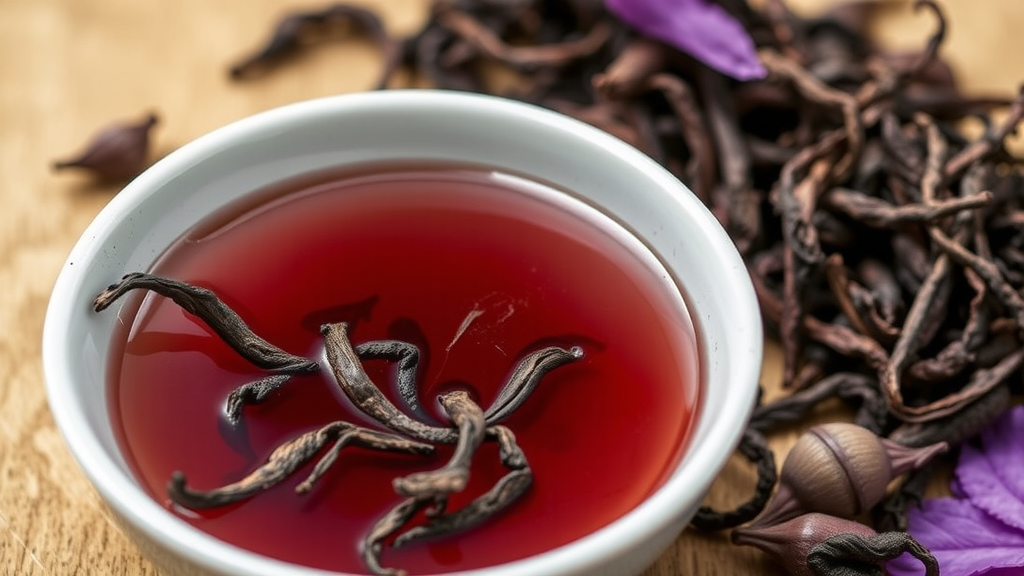
Purple tea is having a moment. Among the most striking members of this colorful family is Zijuan, a Chinese cultivar of the tea plant Camellia sinensis var. assamica whose leaves carry an unusual load of anthocyanins, the same pigments that color blueberries and red cabbage. When processed into oolong tea and then roasted, Zijuan undergoes a chemical transformation so dramatic that it changes everything from the color of the liquor in the cup to the molecules that reach the nose. A new study published in Food Chemistry: X has now mapped that transformation in unprecedented detail, tracking how three roasting intensities reshape the sensory quality, pigment content, and volatile chemistry of this distinctive tea.
The research team, led by Chao Sun and Mengting Zhu, worked with fresh Zijuan leaves harvested in June 2025 from a plantation in Menghai County, in China’s Yunnan Province, picking the standard one bud with three leaves. The leaves were processed into oolong tea using a carefully standardized protocol: solar and static withering, two rounds of shaking with cooling intervals, piling, fixation at 280 degrees Celsius, rolling, and a two-stage drying sequence. After a three-day rest, the finished tea was divided into four batches. One batch was left unroasted as a control, while the others were roasted for two hours at 80, 110, or 150 degrees Celsius, representing light, medium, and high roasting intensities. All compositional data were expressed on a dry-weight basis to correct for the moisture that roasting drives off, which fell from just over 4 percent in the control to about 1.1 percent in the most heavily roasted sample.
Sensory evaluation followed the Chinese national standard GB/T 23776-2018, with a panel of seven trained assessors, each with more than five years of experience, scoring the teas on a 100-point system weighted toward taste and aroma. The results told a nuanced story. The lightly roasted tea earned the highest overall score of 91.7, praised for an elegant, sweet aroma and a thick, mellow taste with only slight astringency. The unroasted control scored 89.4, with a distinctly spicy aroma but noticeable astringency. Medium roasting produced a score of 89.5 and a return of the spicy, varietal character, while the high-roasted tea scored 90.8, distinguished by a pronounced roasted aroma and the highest taste score of all, a thick and robust mouthfeel with classic oolong character.
Instrumental color analysis of the tea liquors mirrored these impressions. The control tea, rich in anthocyanins, produced a light brownish-red liquor with a visible purple hue. Light and medium roasting shifted the liquor toward a brighter brownish-yellow, a color generally considered more desirable for oolong tea. But heavy roasting reversed the trend: the liquor darkened significantly, its brightness measured by the L* parameter dropping to 16.69 compared with 20.31 in the control, and the purple tone reappeared. The researchers attribute this to two converging processes, the complexation of anthocyanins with other polyphenols under thermal stress and the accumulation of brown melanoidins generated by advanced Maillard reactions, which together darken the infusion and reduce its visual clarity.
Beneath the sensory shifts lay systematic changes in the tea’s non-volatile chemistry. Anthocyanins, the signature compounds of Zijuan, declined steadily with roasting intensity, falling from 2.62 milligrams per gram in the control to 2.11 milligrams per gram after high roasting, a loss of roughly 19.5 percent. Under intense heat, anthocyanins are prone to structural cleavage, including chalcone ring-opening, and can degrade into phenolic acids and aldehydes or participate in co-pigmentation and polymerization with oxidized polyphenols. This pigment breakdown helps explain the visual migration from a purple-tinged liquor to a brownish-red one, and may also contribute to the softening of astringency that panelists noticed in the roasted samples.
The catechins, the bitter and astringent polyphenols central to tea taste, displayed their own choreography. Epi-type catechins, which made up nearly 88 percent of the total, remained stable under light and medium roasting but dropped significantly under high roasting, with epigallocatechin falling by almost 11 percent and epicatechin by more than 12 percent. Meanwhile, the non-epi-type catechin gallocatechin surged by 51.63 percent, a hallmark of thermal epimerization in which epi-forms convert to their non-epi counterparts under heat. Gallic acid rose from 0.51 to 0.80 milligrams per gram, likely released by thermal hydrolysis of galloylated catechins such as EGCG and ECG. The net effect was a 6.33 percent decline in total catechins under high roasting, a shift that weakens the interactions between polyphenols and salivary proteins and helps explain why heavily roasted tea tastes smoother and more full-bodied despite its darker character.
Sugars and amino acids, the fuel for flavor-generating thermal reactions, followed a rise-and-fall pattern. Soluble sugars initially increased from 7.85 to 8.21 milligrams per gram under light roasting, possibly through partial hydrolysis of polysaccharides, then fell to 6.57 milligrams per gram under high roasting as they were consumed in Maillard-type pathways. L-theanine, the predominant amino acid in tea and a key contributor to umami and mellowness, declined relentlessly across the roasting gradient, from 1.19 milligrams per gram in the control to just 0.53 after high roasting. Caffeine, by contrast, stayed essentially flat across all treatments, which means the reduced bitterness of roasted tea owes more to catechin changes than to any loss of this alkaloid.
The volatile chemistry revealed the most spectacular changes of all. Using headspace solid-phase microextraction coupled with gas chromatography-mass spectrometry, the team identified 64 volatile compounds across the treatments. The unroasted control contained only 29 volatiles, dominated by floral oxygenated terpenes such as hotrienol and linalool. Light roasting actually reduced total volatile content, yet improved perceived aroma, likely because diminishing green and sulfurous notes stopped masking the remaining floral and sweet compounds. Medium roasting exploded the volatile inventory to 55 compounds and more than doubled total abundance, introducing 22 new substances including terpenes, pyrroles, and the Strecker aldehydes 3-methylbutanal and 2-methylbutanal, direct chemical evidence of Maillard and Strecker reactions consuming sugars and amino acids. High roasting pushed further, generating roast-aroma pyrazines and furfuryl pyrroles while degrading many fresh, green volatiles, restructuring the profile toward nutty and roasted notes.
Multivariate statistics sharpened the picture. A partial least squares-discriminant analysis model, validated with a 200-permutation test to rule out overfitting, cleanly separated the samples by roasting intensity and identified ten key discriminant volatiles, led by the pyranoid and furanoid oxides of linalool, followed by linalool itself, alpha-farnesene, and 2-pentylfuran. Many of these compounds are associated with floral and fruity aromas, marking them as the chemical fulcrum on which the sensory character of Zijuan oolong turns. The researchers are careful to note that these statistical discriminants are not necessarily the aroma-active compounds themselves, but they provide a powerful fingerprint of how far the roasting process has progressed.
The practical implications reach beyond one purple cultivar. The study demonstrates that roasting is not a simple dial from raw to burnt but a staged chemical program: light roasting polishes and balances, medium roasting builds complexity and varietal intensity, and high roasting delivers the roasted depth that some oolong drinkers prize. Because consumer preferences vary, the authors emphasize that no single roasting level is universally optimal; instead, producers can select intensity according to the flavor profile and market position they want. For a cultivar as chemically distinctive as Zijuan, whose anthocyanin-rich matrix responds to heat in ways conventional green-leaf teas do not, that kind of compositional roadmap could help transform an ancient craft into a precision process, one carefully controlled degree at a time.
Subject of Research: Effects of roasting intensity on the sensory quality and chemical composition of anthocyanin-rich Zijuan oolong tea
Article Title: Effect of roasting intensity on sensory quality and chemical composition of Zijuan oolong tea
Article References: Sun, C., Song, T., Hu, J., Wang, M., Chen, C., Tian, Y., Yang, Y., Luo, Q., Li, Y., Shen, S., Liu, B., & Zhu, M. (2026). Effect of roasting intensity on sensory quality and chemical composition of Zijuan oolong tea. Food Chemistry: X, 39, Article 104462. https://doi.org/10.1016/j.fochx.2026.104462
Image Credits: AI Generated
DOI: 10.1016/j.fochx.2026.104462
Keywords: Zijuan tea, oolong tea, roasting, anthocyanins, catechins, L-theanine, Maillard reaction, volatile compounds, flavor chemistry, tea sensory evaluation, purple tea, Food Chemistry
Cite Scienmag News
Bethany Barker. (September 24, 2026). Purple Tea Under Fire: How Roasting Reshapes the Chemistry and Flavor of Zijuan Oolong. Scienmag. https://scienmag.com/purple-tea-under-fire-how-roasting-reshapes-the-chemistry-and-flavor-of-zijuan-oolong/
Bethany Barker. "Purple Tea Under Fire: How Roasting Reshapes the Chemistry and Flavor of Zijuan Oolong." Scienmag, 24 September 2026, https://scienmag.com/purple-tea-under-fire-how-roasting-reshapes-the-chemistry-and-flavor-of-zijuan-oolong/. Accessed 4 October 2026.
Bethany Barker. "Purple Tea Under Fire: How Roasting Reshapes the Chemistry and Flavor of Zijuan Oolong." Scienmag. September 24, 2026. https://scienmag.com/purple-tea-under-fire-how-roasting-reshapes-the-chemistry-and-flavor-of-zijuan-oolong/


