


The human brain remains the most efficient computer ever built, running on roughly the same electrical power as a dim twenty-watt refrigerator bulb while performing calculations that would require megawatts of electricity from a conventional machine. The secret to this extraordinary efficiency lies in the brain’s architecture: billions of neurons calculate and store memories in the very same physical space, eliminating the costly shuttling of information that plagues modern electronics. Today’s computers, by contrast, burn enormous amounts of power constantly moving data back and forth between separate processor and memory units across a motherboard, a bottleneck that has motivated engineers for decades to search for hardware that mimics the brain’s unified approach to computing and memory.
That search has now produced a striking result. Researchers led by Professor Yang Li at Suzhou University of Science and Technology have built a flexible, ultra-fast artificial synapse printed entirely from room-temperature liquid inks, and the device can dissolve on demand in just six minutes. Writing in the International Journal of Extreme Manufacturing, the team demonstrates that high-performance, brain-inspired hardware does not require extreme vacuum chambers, rare metals, or permanent electronic waste. The finding challenges a long-standing assumption in the electronics industry that cutting-edge neuromorphic devices must be fabricated in energy-hungry cleanroom environments using rigid silicon and heavy metal electrodes, materials that eventually contribute to the millions of tons of non-recyclable electronic waste discarded around the world every year.
The central obstacle that has held back soft, carbon-based computing components is a stubborn material conflict. Organic compounds are naturally poor conductors of electricity, and every past attempt to push their switching speeds into a useful range forced engineers back to rigid metal plates deposited in vacuum chambers, undoing the very advantages that made organic electronics attractive in the first place. Flexible substrates and printable inks promised cheap, lightweight, and biologically compatible devices, but without a way to achieve fast, reliable electrical switching in a purely solution-processed material, the field remained stuck at the laboratory bench.
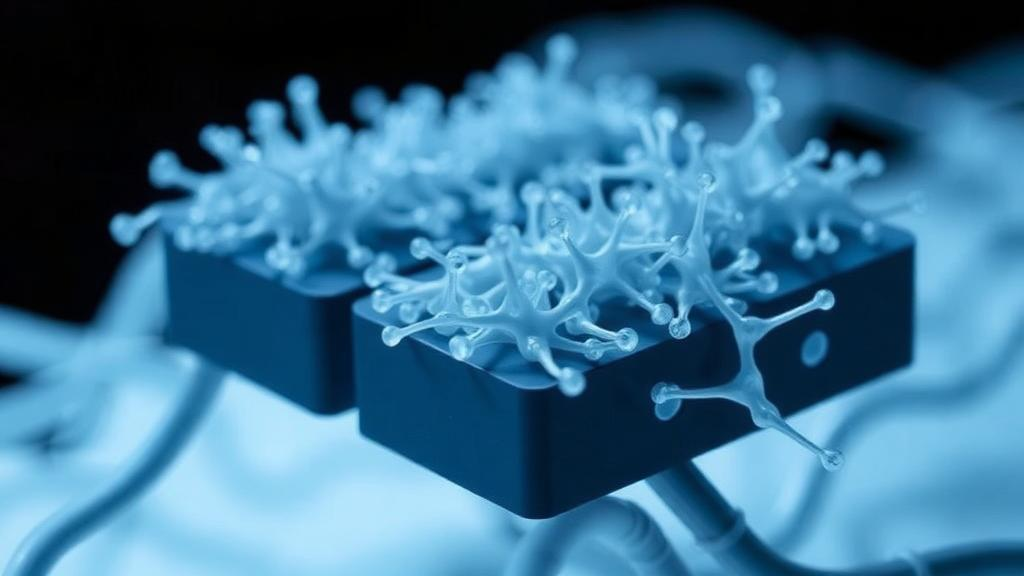
Professor Li’s team bypassed this trade-off through an elegant piece of molecular engineering. They assembled organic porphyrin molecules into a rigid, two-dimensional lattice known as a hydrogen-bonded organic framework, abbreviated TCPP-HOF. In this material, hydrogen bonds act like microscopic structural beams, locking the molecules into flat sheets stacked just 0.35 nanometers apart, a spacing roughly one hundred thousand times narrower than a single human hair. The result is a material that combines the processability of a liquid ink with the structural order of a crystal, giving charge carriers the precisely aligned pathways they need to move quickly while remaining fully compatible with low-temperature, solution-based manufacturing.
Functionally, this orderly architecture behaves like a microscopic turnstile that remembers every electrical pulse passing through it. When a forward voltage pulse strikes the sheet, electric charges slip into designated molecular resting pockets, paving a low-resistance path and raising the device’s electrical conductance, much as a biological synapse grows stronger each time a memory is reinforced. A reverse voltage pulse draws those charges back out, resetting the connection. Because the molecular lanes are precisely aligned, this switching happens in just 26 nanoseconds, roughly twenty million times faster than a human eyelid can blink, while the device reliably holds ten distinct memory levels. That combination of speed and multi-level storage is exactly what neuromorphic computing demands, since artificial neural networks rely on synapses whose strength can be tuned gradually and retained over time.
To test how well the hardware handles real computational work, the researchers printed a ten-by-ten grid of these synapses on a flexible polyimine plastic base and ran it through standard handwritten-digit recognition trials, a classic benchmark for evaluating neuromorphic hardware. The printed array correctly identified the digits with 97.23 percent accuracy, coming remarkably close to the 99.24 percent theoretical ceiling achieved by standard software running on conventional computers. For a device manufactured entirely from printable liquid inks at room temperature, that performance gap is narrow enough to suggest that solution-processed organic frameworks could eventually compete with far more expensive fabrication routes in practical machine-learning hardware.
Durability, often the weak point of flexible electronics, also held up under stress. The flexible organic layers kept working even after the sheet was bent two hundred consecutive times around a tight five-millimeter curve, a deformation far more severe than the gentle flexing a wearable device would typically experience. Then came the most unusual demonstration: once the device finished its job, dipping it into a warm chemical wash broke down the polymer base and the hydrogen-bonded framework into soluble monomers in six minutes flat, leaving behind only minimal inert residue. In effect, the chip can be programmed to disappear, converting what would normally be permanent electronic waste into simple, recoverable molecular building blocks.
The manufacturing implications are considerable. Because the entire device is built from solution-based inks, brain-inspired chips of this kind could be rolled out using conventional spray-coating and inkjet printers, skipping the multi-million-dollar vacuum systems that silicon fabs depend on. That opens the door to low-cost, distributed production of neuromorphic hardware, potentially in facilities far removed from the specialized foundries that dominate semiconductor manufacturing today. The immediate applications lie in bendable medical patches and short-term wearable monitors that process health data directly on the body and then dissolve when no longer needed, eliminating both the disposal problem and the privacy concerns associated with discarded sensors that still hold personal information.
Challenges remain before such devices can leave the laboratory. The researchers are now working to scale the ten-by-ten grid into larger crossbar arrays, the dense mesh structures needed to run realistic neural network workloads, while simultaneously engineering ultra-thin moisture barriers to keep the water-soluble circuits functioning reliably in humid outdoor air. Protecting a deliberately dissolvable device from everyday moisture without sealing it so thoroughly that it can no longer be broken down is a delicate balancing act, and it will determine whether transient neuromorphic electronics can survive outside controlled environments. The team’s progress on both fronts will be closely watched by a field increasingly interested in sustainable, transient electronics.
Even so, the demonstration marks a meaningful convergence of three goals that have often been pursued separately: brain-inspired computing performance, printable low-temperature manufacturing, and environmentally responsible disposal. A single material system, held together by nothing more exotic than hydrogen bonds and printed from liquid ink, now delivers nanosecond switching, ten stable memory states, near-software-level recognition accuracy, mechanical flexibility, and complete dissolvability in six minutes. If the scaling and moisture-barrier work succeeds, the idea that powerful computing hardware must be permanent, rigid, and wasteful may soon look as outdated as the vacuum tubes it once replaced.
Subject of Research: Solution-processed hydrogen-bonded organic framework artificial synapses for transient neuromorphic computing
Article Title: Printable brain-inspired chips that compute at lightning speed and vanish in minutes
Article References: Printable brain-inspired chips that compute at lightning speed and vanish in minutes. (n.d.). Original publication
Image Credits: AI Generated
DOI: Not provided
Keywords: neuromorphic computing, artificial synapse, hydrogen-bonded organic framework, porphyrin, transient electronics, printed electronics, flexible electronics, dissolvable devices, wearable sensors, handwritten digit recognition, solution processing, electronic waste
Cite Scienmag News
Cassandra Pierce. (October 4, 2026). Printable Artificial Synapses Compute in Nanoseconds and Dissolve in Six Minutes. Scienmag. https://scienmag.com/printable-artificial-synapses-compute-in-nanoseconds-and-dissolve-in-six-minutes/
Cassandra Pierce. "Printable Artificial Synapses Compute in Nanoseconds and Dissolve in Six Minutes." Scienmag, 4 October 2026, https://scienmag.com/printable-artificial-synapses-compute-in-nanoseconds-and-dissolve-in-six-minutes/. Accessed 4 October 2026.
Cassandra Pierce. "Printable Artificial Synapses Compute in Nanoseconds and Dissolve in Six Minutes." Scienmag. October 4, 2026. https://scienmag.com/printable-artificial-synapses-compute-in-nanoseconds-and-dissolve-in-six-minutes/


