


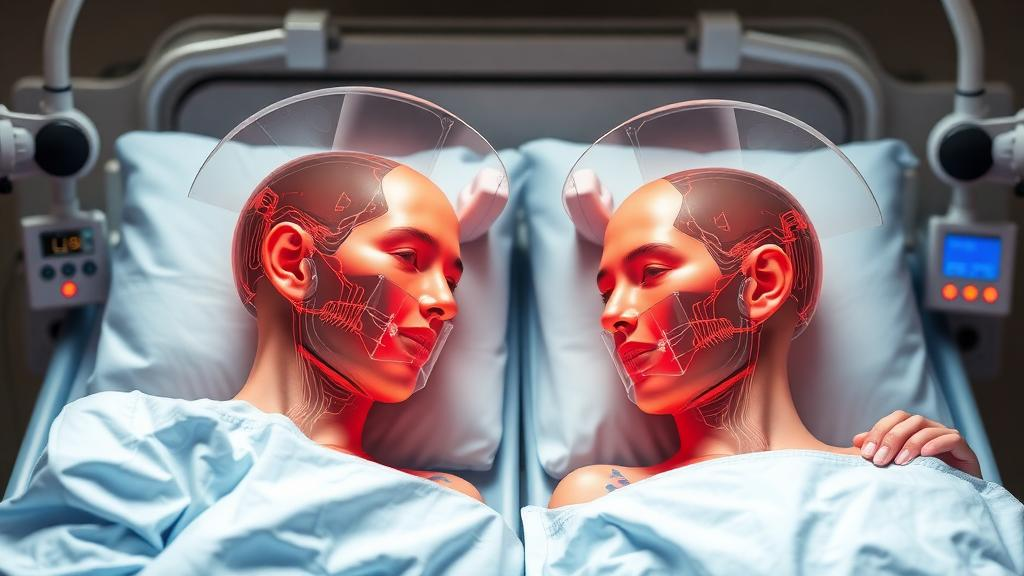
Imagine a critically ill patient lying in an intensive care unit, their body locked in a dangerous struggle between infection and immune collapse. Now imagine that before a physician administers a single drug, they can first test that treatment on a living, breathing virtual replica of the patient—a computational model that simulates how this specific person’s immune system will respond. That is the ambitious vision behind a landmark research contract awarded to the University of Vermont, where trauma surgeon and researcher Gary An will lead the largest research award in the university’s history: a project worth up to $38 million to build artificial intelligence-powered digital twins for treating the sickest patients in medicine.
The funding comes from the Advanced Research Projects Agency for Health, or ARPA-H, a federal agency within the U.S. Department of Health and Human Services that backs pioneering, high-impact medical research. The anticipated five-year initiative, known as ReSCUED—Reprogramming Severe Critical Illness Using Extensible Digital Twins—is part of ARPA-H’s Critical Illness Immunological Reprogramming and Control Point Learning Engine, or CIRCLE, program. If the technology performs as hoped, researchers believe it could shorten intensive care unit stays by at least 25 percent. The stakes are enormous: each year, 4.6 million Americans are treated in ICUs, at a cost of up to $70 billion annually.
The project targets one of medicine’s most stubborn problems: the disordered immune response that drives the defining diseases of critical care, including severe trauma, burns, and sepsis. Sepsis, a life-threatening reaction to infection, occurs when the body’s immune system triggers widespread toxic inflammation that damages healthy tissues and can rapidly progress to organ failure. Treating it demands urgent ICU care with intravenous fluids, blood pressure support, antibiotics, and often machines such as ventilators or dialysis to prop up failing organs. Yet even with these interventions, many patients never recover their immune balance.
“Sepsis is a huge health care problem, and one that will only get bigger as the population gets older and we get better at keeping people alive,” said An, the project’s principal investigator and a professor in the Department of Surgery at UVM’s Larner College of Medicine. He explained that before intensive care units existed, patients simply died, but modern organ support technologies now keep people alive longer even when their bodies cannot escape what he calls the immune dysfunction hole. “The multidimensional dynamics of immune dysfunction is too complex for a person, even an expert, to comprehend. But we can train a computational model to do that,” An said.
The concept of a digital twin is borrowed from engineering. A digital twin is a mathematical model of a real-world object, process, or system that uses real-time data to predict performance, identify problems, and guide decision-making. The aerospace industry offers a familiar illustration: sensors on an aircraft engine continuously stream performance information to a computational model that forecasts how that specific engine will behave over time, allowing operators to optimize maintenance and operations. Health care researchers now envision the same principle applied to human physiology, with personalized models forecasting how a disease will progress in an individual patient as molecular and clinical data are continuously added and analyzed.
Under the ReSCUED approach, the process begins with intensive data collection. A critically ill patient’s blood will be drawn every six hours, with measurements taken of the critical cells, proteins, and molecules circulating in the sample. Physiological monitoring adds another stream of information. These data feed into the patient’s digital twin, which generates a real-time picture of the immune response and continuously refines its forecast as the patient’s condition evolves. The model then becomes the testing ground: clinicians can evaluate potential treatment strategies using FDA-approved medications virtually, before administering anything to the actual patient.
The ultimate product is an AI-based “virtual consultant” designed to analyze highly complex biological interactions that exceed human cognitive capacity. The system would suggest intervention strategies tailored to a specific patient, simulate their effects, and present the results to the treating physician. “The complexity of critical illness exceeds what any individual can interpret in real time. Artificial intelligence gives us a way to evaluate those complex biological dynamics and determine how existing treatments might be used more effectively for a particular patient,” An said. “Our goal is to give clinicians a more precise understanding of what is happening within an individual patient and provide information that could help them select the right treatment at the right time.”
The initiative is deliberately multidisciplinary and multi-institutional. UVM’s Larner College of Medicine will serve as the lead institution, with An’s team focusing on developing the computational models and the digital twin platform. Patient data will be collected at three clinical sites: Wake Forest University School of Medicine and the University of Alabama at Birmingham Heersking School of Medicine, both participating through the Quantum Leap Healthcare Collaborative, and Washington University School of Medicine. Two private-sector partners bring specialized technologies. The DNA Medicine Institute of Cambridge, Massachusetts, will contribute a bedside molecular testing platform originally developed for the International Space Station, while InflammaSense, a California-based medical technology company, will provide wearable monitors that measure activity in the vagus nerve, a key regulator of inflammation.
The project is structured as a milestone-based initiative lasting up to five years. During the first three years, researchers will develop and validate the digital twin and demonstrate its ability to predict patient outcomes computationally. Only if those milestones are achieved will subsequent phases test the technology in additional experimental settings and, eventually, in clinical trials involving critically ill patients. By the end of the project, the team hopes to deliver an integrated platform combining physiology, molecular testing, computational modeling, and artificial intelligence to support clinical decision-making, with the goals of improving treatment selection, reducing ICU length of stay, and improving outcomes. The work is also expected to create new computational modeling jobs at Larner and strengthen Vermont’s growing biotechnology and AI research ecosystem.
Beyond the ICU, the implications could reach far wider. If successful, the technology developed through ReSCUED could establish a foundation for treating a broad range of diseases in which patients respond differently to the same therapies—a central challenge of modern medicine. “This is the kind of work that can redefine what is possible in medicine. By combining artificial intelligence with deep expertise in biology and clinical care, UVM researchers are helping build a future in which treatment can be informed by the unique biology of each patient,” said Kirk Dombrowski, UVM’s vice president for research and economic development. University leadership has framed the award as a historic milestone, with President Marlene Tromp noting that the level of federal investment reflects the potentially life-saving impact of digital twins in medical diagnosis and treatment. The research is funded in part by ARPA-H, and the views expressed by the researchers do not necessarily represent the official policies of the United States Government.
Subject of Research: AI-powered digital twins for personalized treatment of critically ill ICU patients
Article Title: Your AI twin could save your life: UVM awarded up to $38 million to build “digital twins” for treating critically ill patients
Article References: Your AI twin could save your life: UVM awarded up to $38 million to build “digital twins” for treating critically ill patients. (n.d.). Original publication
Image Credits: AI Generated
DOI: Not provided
Keywords: digital twins, artificial intelligence, critical care, sepsis, ICU, ARPA-H, immune response, computational modeling, precision medicine, University of Vermont, clinical decision support, biotechnology
Cite Scienmag News
Mallory Mcbride. (October 4, 2026). AI Digital Twins Could Transform Intensive Care in Landmark $38 Million Federal Project. Scienmag. https://scienmag.com/ai-digital-twins-could-transform-intensive-care-in-landmark-38-million-federal-project/
Mallory Mcbride. "AI Digital Twins Could Transform Intensive Care in Landmark $38 Million Federal Project." Scienmag, 4 October 2026, https://scienmag.com/ai-digital-twins-could-transform-intensive-care-in-landmark-38-million-federal-project/. Accessed 4 October 2026.
Mallory Mcbride. "AI Digital Twins Could Transform Intensive Care in Landmark $38 Million Federal Project." Scienmag. October 4, 2026. https://scienmag.com/ai-digital-twins-could-transform-intensive-care-in-landmark-38-million-federal-project/


