


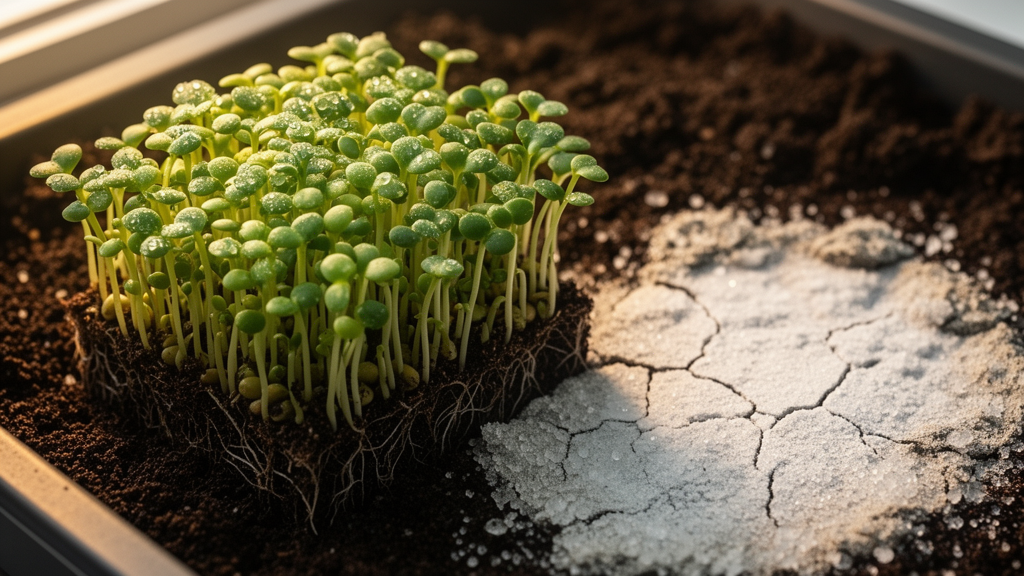
Lentils are one of humanity’s oldest crops, a staple pulse that has fed civilizations across the Middle East, South Asia and beyond for thousands of years. Yet the humble legume is under siege from the very ground it grows in. Drought, soil salinity and alkalinity are among the most punishing abiotic stresses in agriculture, and they quietly throttle lentil yields across millions of hectares worldwide. Now, a team of researchers at the ICAR-Indian Agricultural Research Institute in New Delhi has produced the first comprehensive proteomic portrait of how lentil seedlings cope with all three stresses at once, and their findings, published in Genome Biology, could reshape the way breeders build climate-resilient lentil varieties.
The study, led by Dharmendra Singh of the Division of Genetics, together with Jyoti Taunk, Ankita Tripathi, Jyotika Bhati and Madan Pal Singh, set out to answer a deceptively simple question: what, at the level of individual proteins, separates a lentil line that shrugs off drought, salt and alkaline soils from one that collapses? While physiological responses to stress in lentil have been studied before, no one had previously dissected the molecular machinery of tolerance using proteomics across all three stress types. The team’s work fills that gap, and it does so with a level of technical rigor that makes the results difficult to ignore.
The researchers began by comparing lentil genotypes that differ sharply in their stress behavior, including tolerant lines such as PDL-1 and PDL-2 and the sensitive line L-4076. Before touching a mass spectrometer, they phenotyped the plants under drought, salinity and alkalinity treatments, measuring a battery of physiological traits that included the accumulation of osmolytes, the synthesis and retention of chlorophyll, the production of hydrogen peroxide, and the activity of antioxidant enzymes. These measurements revealed clear genotypic differences: tolerant lines managed osmotic regulation more effectively, preserved their photosynthetic apparatus longer, and mounted stronger antioxidant responses, while sensitive lines showed the characteristic signatures of cellular damage.
Those physiological observations set the stage for the molecular core of the study. Using ultra performance liquid chromatography coupled with tandem mass spectrometry, or UPLC-MS/MS, the team profiled the seedling proteomes and identified a striking total of 707 differentially abundant proteins, abbreviated DAPs, that distinguish tolerant from sensitive genotypes across the three stress conditions. The breakdown by stress type is itself informative: 283 DAPs responded under drought, 213 under salinity, and 211 under alkalinity. That the largest number appears under drought suggests that water deficit, which disrupts nearly every aspect of plant metabolism simultaneously, demands the broadest proteomic reprogramming of the three.
Perhaps the most biologically intriguing finding is what the three stresses share. Ninety-five DAPs were common across drought, salinity and alkalinity, forming a kind of core stress-response toolkit. Functional annotation showed that these shared proteins are involved in protein biogenesis, cellular transport, photosynthesis, RNA regulation, defense and detoxification. In other words, whether the threat is dehydration, excess sodium ions or a punishingly high soil pH, lentil seedlings appear to recruit a common set of molecular players to keep their cellular house in order. This convergence makes evolutionary and physiological sense: all three stresses, at their root, impose osmotic strain and oxidative damage on plant cells, and the plant’s first line of defense is to stabilize its proteins, maintain transport homeostasis and neutralize reactive oxygen species before they shred membranes and DNA.
Functional enrichment analysis deepened that picture. The differentially abundant proteins clustered into several major functional categories: photosynthesis and energy metabolism, transcription and translation, protein folding and degradation, and antioxidative defense. Under stress, a tolerant lentil seedling must walk a metabolic tightrope. It needs energy to fuel repair and osmotic adjustment, but photosynthesis is precisely the process most vulnerable to stress, because damaged chloroplasts leak electrons and generate destructive radicals. The proteomic data suggest that tolerant lines rebalance the photosynthetic machinery and its associated energy metabolism in a way that sensitive lines fail to do, while simultaneously ramping up the chaperones and proteasomal components that refold or recycle damaged proteins.
The oxidative defense story emerged as the centerpiece of the study. By integrating the proteomic results with transcriptomic data, the researchers highlighted two enzymes as central components of the antioxidative shield: superoxide dismutase and monodehydroascorbate reductase. The logic of this pairing is elegant. Superoxide dismutase sits at the front line of the cell’s radical defense, converting superoxide anions, the first and most dangerous reactive oxygen species generated under stress, into hydrogen peroxide. But hydrogen peroxide is itself harmful, so a second enzyme, monodehydroascorbate reductase, helps regenerate ascorbate, the antioxidant that mops up peroxide through the ascorbate-glutathione cycle. Together, the two enzymes form a relay that channels toxic radicals into harmless water. The finding that these enzymes stand out as hubs in the integrated analysis suggests that the capacity to keep this relay running at speed may be a defining feature of tolerant lentil genotypes.
Good proteomics lives or dies on validation, and the team took the necessary step of confirming their mass spectrometry findings at the transcript level. Using quantitative real-time polymerase chain reaction, they measured the expression of five of the differentially abundant proteins at one, two and three days after stress imposition. The qRT-PCR results corroborated the proteomic patterns, lending confidence that the protein abundance changes reflect genuine, coordinated stress responses rather than technical artifacts. The time-course design also adds a dynamic dimension, showing that the molecular response unfolds over the first critical days of stress exposure, when the fate of a seedling is largely decided.
The practical implications extend well beyond basic biology. Lentil breeding has long relied on physiological traits as selection markers, but physiological measurements are slow, environment-sensitive and often confounded. A defined set of proteins, and the genes encoding them, offers breeders and biotechnologists a molecular shortlist for marker development, genomic selection or even gene editing. Because 95 proteins respond to all three stresses, a single breeding strategy targeting the shared core could plausibly deliver broad-spectrum tolerance, a far more efficient proposition than chasing each stress separately. The authors note that the proteins identified in the study provide new insight into lentil’s interconnected regulatory mechanisms against abiotic stresses, and that interconnectedness is exactly what makes the dataset valuable: it maps the wiring diagram of stress adaptation rather than listing isolated parts.
The work also arrives at a moment of urgency. As climate change intensifies drought episodes and irrigation practices continue to salinize and alkalinize soils in major pulse-growing regions, the gap between lentil demand and supply threatens to widen. A crop that can maintain photosynthesis, manage osmotic balance and neutralize radicals under multiple stresses simultaneously is not a luxury but a necessity for food security in South Asia, the Middle East and the dryland tropics. By revealing, for the first time, the proteomic signatures that separate tolerance from sensitivity in lentil seedlings, this study hands researchers a molecular map of where to look next. The differential abundance of proteins across a wide and complex regulatory network, as the authors conclude, mediates lentil’s metabolic adaptation to drought, salinity and alkalinity, and decoding that network may prove to be one of the most consequential steps yet toward lentils that thrive on the degraded soils of a warming world.
Subject of Research: Proteomic and physiological mechanisms of drought, salinity and alkalinity stress tolerance in lentil
Article Title: Integrating physiological and proteomics signatures for understanding drought, salinity and alkalinity stress tolerance mechanisms in lentil
Article References: Singh, D., Taunk, J., Tripathi, A., Bhati, J., & Singh, M. P. (2026). Integrating physiological and proteomics signatures for understanding drought, salinity and alkalinity stress tolerance mechanisms in lentil. Genome Biology. https://doi.org/10.1186/s13059-026-04171-2
Image Credits: AI Generated
DOI: 10.1186/s13059-026-04171-2
Keywords: lentil, proteomics, abiotic stress, drought, salinity, alkalinity, differentially abundant proteins, antioxidative defense, superoxide dismutase, monodehydroascorbate reductase, UPLC-MS/MS, plant physiology
Cite Scienmag News
Alan Morgan. (October 9, 2026). Protein Clues Reveal How Lentils Survive Drought, Salt and Alkaline Soils. Scienmag. https://scienmag.com/protein-clues-reveal-how-lentils-survive-drought-salt-and-alkaline-soils/
Alan Morgan. "Protein Clues Reveal How Lentils Survive Drought, Salt and Alkaline Soils." Scienmag, 9 October 2026, https://scienmag.com/protein-clues-reveal-how-lentils-survive-drought-salt-and-alkaline-soils/. Accessed 9 October 2026.
Alan Morgan. "Protein Clues Reveal How Lentils Survive Drought, Salt and Alkaline Soils." Scienmag. October 9, 2026. https://scienmag.com/protein-clues-reveal-how-lentils-survive-drought-salt-and-alkaline-soils/


