

Sunday, August 16, 2026
Science
No Result
View All Result
  • Login
  • HOME
  • SCIENCE NEWS
  • CONTACT US
  • HOME
  • SCIENCE NEWS
  • CONTACT US
No Result
View All Result
Scienmag
No Result
View All Result
Home Science News Earth Science

Planetary trapped waves link South America and Africa through ocean teleconnections

July 27, 2026
in Earth Science
Reading Time: 2 mins read
0
Planetary trapped waves link South America and Africa through ocean teleconnections

Planetary trapped waves link South America and Africa through ocean teleconnections

65
SHARES
587
VIEWS
Share on FacebookShare on Twitter
ADVERTISEMENT

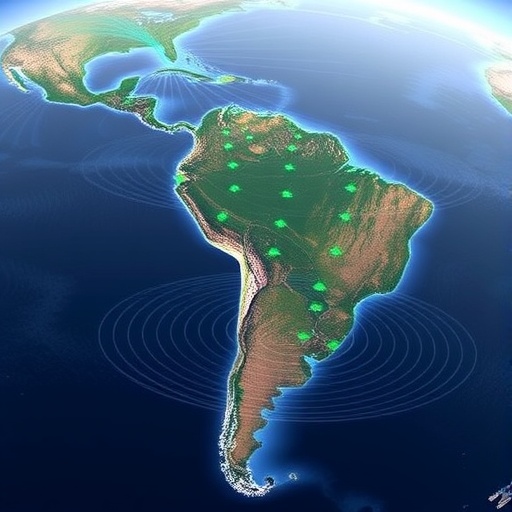
A new study suggests that “planetary trapped waves” traveling through the ocean-atmosphere system may act as a hidden relay, linking climate signals from South America to Africa across thousands of kilometers. Researchers report that these waves can couple with ocean circulation patterns to create teleconnections that span both intercontinental and trans-basin distances.

Using an integrated analysis framework that combines oceanic variability with wave dynamics, the team investigated how large-scale disturbances propagate westward and then become “trapped” in preferred pathways. Such trapping allows specific wave modes to persist long enough to interact with far-field currents rather than dissipating locally.

The findings point to an efficient mechanism for transferring variability from the Atlantic sector near South America toward African waters. Instead of relying solely on winds or surface temperature anomalies, the study emphasizes that wave-guided propagation can reorganize ocean signals deep into the basin, effectively synchronizing remote regions.

Crucially, the researchers describe how the trapped waves modulate the strength and timing of oceanic anomalies by steering the system’s heat and momentum transport. That steering alters upper-ocean conditions first, which then cascade into broader patterns through coupled ocean processes.

Beyond explaining a single event, the results indicate a recurring pathway that can generate climate-relevant correlations between continents. The authors highlight that such connectivity may influence rainfall variability, marine ecosystem conditions, and heat distribution—factors that depend on both large-scale dynamics and regional feedbacks.

From a forecasting perspective, the study raises the possibility that monitoring wave activity could improve early-warning signals for downstream impacts. If the trapped-wave pathways reliably precede teleconnection patterns, they could be incorporated into predictive systems that currently emphasize slower ocean adjustment or local forcing.

The work also underscores why some correlations between South American and African climates have been difficult to interpret with traditional mechanisms alone. By introducing a wave-based conduit, the authors offer a unifying explanation for how signals can appear coherently across distant basins.

Overall, the research reframes oceanic teleconnections as a dynamic, wave-mediated process. The team’s interpretation suggests that planetary trapped waves are not just theoretical curiosities, but practical drivers that can transport climate information across the Atlantic.

The study’s conclusions, published in Communications Earth & Environment in 2026, provide a fresh target for future modeling and observation campaigns. With better detection of trapped-wave signatures, scientists may be able to anticipate intercontinental ocean-climate linkages with greater confidence.

Subject of Research: Oceanic teleconnections and planetary trapped wave dynamics linking South America and Africa.

Article Title: Planetary trapped waves drive intercontinental and trans-basin oceanic teleconnections between South America and Africa.

Article References: Poli, L., Artana, C., Costa Da Silva, A. et al. Communications Earth & Environment (2026). https://doi.org/10.1038/s43247-026-03849-6

Image Credits: AI Generated

DOI: 10.1038/s43247-026-03849-6

Tags: coupled ocean circulation patternsintercontinental climate variabilitylarge-scale disturbance propagationocean teleconnectionsocean wave dynamicsocean-atmosphere systemoceanic heat and momentum transportPlanetary trapped wavesremote ocean signal transferSouth America-Africa climate linkstrans-basin climate teleconnectionswave-guided propagation
Share26Tweet16
Previous Post

Cocrystal Enables Fixed-Dose Empagliflozin and Metformin Bilayer for Bioequivalence

Next Post

AI Detection Model Uses Noncontact Multimodal Data for Early Parkinson’s Diagnosis

Related Posts

Tropical Forest Biomass Responds to Diverse Climate Controls
Earth Science

Tropical Forest Biomass Responds to Diverse Climate Controls

August 16, 2026
Survey-Based Model Reveals How Preparedness Constraints Shape Cholera Transmission in Sudan
Earth Science

Survey-Based Model Reveals How Preparedness Constraints Shape Cholera Transmission in Sudan

August 16, 2026
Waste-Based Retrofits Improve Thermal Performance in North Sinai Social Housing
Earth Science

Waste-Based Retrofits Improve Thermal Performance in North Sinai Social Housing

August 16, 2026
AI Optimizes Visible-Light Degradation of Acid Orange 25 with Ag/N-TiO2 Persulfate
Earth Science

AI Optimizes Visible-Light Degradation of Acid Orange 25 with Ag/N-TiO2 Persulfate

August 16, 2026
Rhizosphere Effects on Oklahoma Winter Wheat Yield Drive Probes for Beneficial Microbes
Earth Science

Rhizosphere Effects on Oklahoma Winter Wheat Yield Drive Probes for Beneficial Microbes

August 16, 2026
Tropical Forcing Drove Widespread Millennial Monsoon Variability Over 3.5 Million Years
Earth Science

Tropical Forcing Drove Widespread Millennial Monsoon Variability Over 3.5 Million Years

August 15, 2026
Next Post
AI Detection Model Uses Noncontact Multimodal Data for Early Parkinson’s Diagnosis

AI Detection Model Uses Noncontact Multimodal Data for Early Parkinson’s Diagnosis

  • Mothers who receive childcare support from maternal grandparents show more

    Mothers who receive childcare support from maternal grandparents show more parental warmth, finds NTU Singapore study

    27656 shares
    Share 11059 Tweet 6912
  • University of Seville Breaks 120-Year-Old Mystery, Revises a Key Einstein Concept

    1061 shares
    Share 424 Tweet 265
  • Bee body mass, pathogens and local climate influence heat tolerance

    682 shares
    Share 273 Tweet 171
  • Researchers record first-ever images and data of a shark experiencing a boat strike

    546 shares
    Share 218 Tweet 137
  • Groundbreaking Clinical Trial Reveals Lubiprostone Enhances Kidney Function

    531 shares
    Share 212 Tweet 133
Science

Embark on a thrilling journey of discovery with Scienmag.com—your ultimate source for cutting-edge breakthroughs. Immerse yourself in a world where curiosity knows no limits and tomorrow’s possibilities become today’s reality!

RECENT NEWS

  • Tropical Forest Biomass Responds to Diverse Climate Controls
  • Survey-Based Model Reveals How Preparedness Constraints Shape Cholera Transmission in Sudan
  • Waste-Based Retrofits Improve Thermal Performance in North Sinai Social Housing
  • KAIST develops semiconductor neuron that harnesses noise to selectively process signals

Categories

  • Agriculture
  • Anthropology
  • Archaeology
  • Athmospheric
  • Biology
  • Biotechnology
  • Blog
  • Bussines
  • Cancer
  • Chemistry
  • Climate
  • Earth Science
  • Editorial Policy
  • Marine
  • Mathematics
  • Medicine
  • Pediatry
  • Policy
  • Psychology & Psychiatry
  • Science Education
  • Social Science
  • Space
  • Technology and Engineering

Subscribe to Blog via Email

Success! An email was just sent to confirm your subscription. Please find the email now and click 'Confirm Follow' to start subscribing.

Join 5,149 other subscribers

© 2025 Scienmag - Science Magazine

Welcome Back!

Login to your account below

Forgotten Password?

Retrieve your password

Please enter your username or email address to reset your password.

Log In
No Result
View All Result
  • HOME
  • SCIENCE NEWS
  • CONTACT US

© 2025 Scienmag - Science Magazine
