


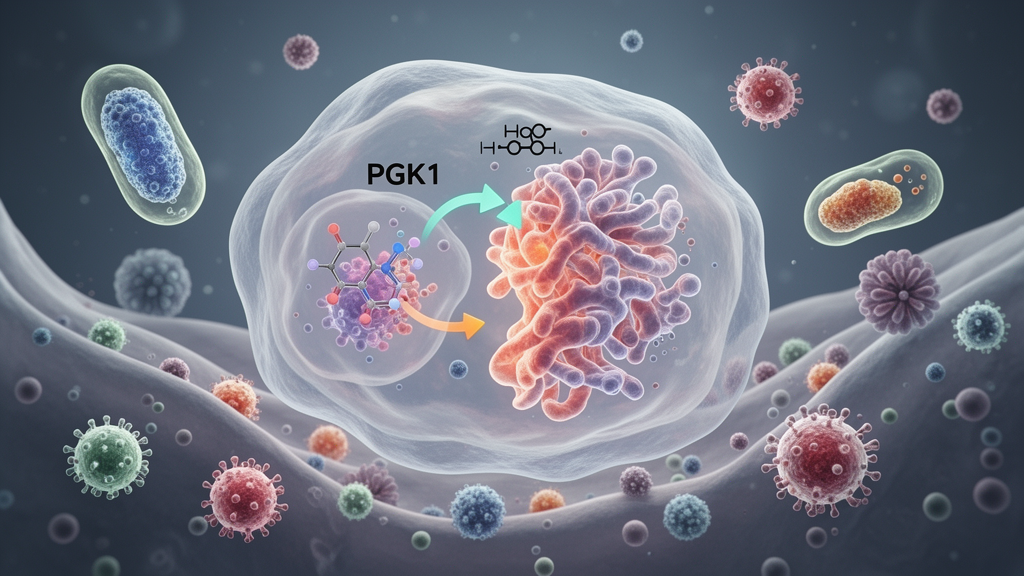
Phosphoglycerate kinase 1 (PGK1), an enzyme best known for its role in cellular glycolysis, also functions as a non-canonical protein kinase that can restrict replication across a range of RNA and DNA viruses, according to an experimental study led by researchers at the Chinese Academy of Agricultural Sciences. In vitro experiments and mouse studies found that PGK1 directly interacted with and phosphorylated the host chaperone HSP90AA1, lowering its protein-folding activity and promoting its K27-linked ubiquitination and proteasomal degradation. As levels of HSP90AA1 declined, viral proteins that depend on the chaperone became unstable and were degraded, disrupting replication of influenza A virus, Sendai virus, vesicular stomatitis virus and herpes simplex virus 1. The results identify a host-directed antiviral mechanism that operates independently of PGK1’s established metabolic function.
The study, published in Science China Life Sciences, examined PGK1 as a possible defense against viruses that must exploit host-cell machinery to produce and stabilize their proteins. Because viral genomes mutate frequently, direct-acting antiviral drugs can lose effectiveness as resistance emerges. Host-directed approaches instead target cellular factors required by viruses, potentially reducing the opportunities for viral escape, although the safety and specificity of any intervention would need to be established. In the reported experiments, the antiviral effect attributed to PGK1 did not require its canonical role in glycolysis. Instead, PGK1 acted as a “moonlighting” protein through its protein kinase activity.
HSP90AA1 was identified as a key target of this non-canonical activity. The molecular chaperone helps fold and stabilize a broad range of cellular proteins, but viruses also exploit it to maintain newly synthesized viral proteins. Through laboratory experiments and mouse studies, the researchers found that PGK1 bound directly to HSP90AA1 and phosphorylated it. This phosphorylation reduced the chaperone’s activity and increased K27-linked ubiquitination, a molecular signal associated here with subsequent degradation through the proteasome. The resulting loss of HSP90AA1 destabilized viral proteins that relied on it and impeded the replication process. The findings therefore support a mechanism in which PGK1 weakens a shared host resource rather than directly attacking a viral enzyme, genome or structural component.
The study also uncovered a possible viral countermeasure. Influenza A virus nucleoprotein competed with HSP90AA1 for binding to PGK1, thereby interfering with the PGK1-HSP90AA1 pathway. This molecular competition may allow influenza A virus to reduce PGK1’s access to the chaperone and preserve the host protein needed to stabilize viral proteins. The observation was presented as a potential form of viral immune evasion, linking the host defense pathway with a virus-specific strategy for countering it. Together, the results expand the recognized functions of PGK1 beyond glycolysis and connect cellular metabolism, protein homeostasis and antiviral defense through a pathway involving a host chaperone used by multiple viruses.
The evidence comes from laboratory experiments and animal studies rather than a clinical evaluation, and the work does not establish that modulating PGK1 would be safe or effective as a treatment in people or animals. HSP90AA1 participates in numerous essential cellular processes, so altering its stability or activity could affect normal host-cell function. The authors noted that further studies would be required to assess the safety, specificity and therapeutic feasibility of targeting the pathway. Although the experiments support PGK1-HSP90AA1 as a candidate host-directed antiviral axis with activity against several viruses, the present results establish a biological mechanism and a rationale for additional investigation, not a ready clinical intervention.
Subject of Research: PGK1-mediated degradation of HSP90AA1 as a broad-spectrum host-directed antiviral mechanism
Article Title: A classic metabolic enzyme reveals a hidden role in broad-spectrum antiviral defense
Article References: A classic metabolic enzyme reveals a hidden role in broad-spectrum antiviral defense. Original publication (Bibliographic details unavailable.)
Image Credits: AI Generated
DOI: Not provided
Keywords: PGK1, HSP90AA1, antiviral defense, host-directed therapy, viral replication, protein kinase, molecular chaperone, influenza A virus, protein degradation, viral immune evasion, classic, metabolic
Cite Scienmag News
Kristina Jarvis. (October 26, 2026). PGK1 kinase activity disables a host chaperone to restrict multiple viruses. Scienmag. https://scienmag.com/pgk1-kinase-activity-disables-a-host-chaperone-to-restrict-multiple-viruses/
Kristina Jarvis. "PGK1 kinase activity disables a host chaperone to restrict multiple viruses." Scienmag, 26 October 2026, https://scienmag.com/pgk1-kinase-activity-disables-a-host-chaperone-to-restrict-multiple-viruses/. Accessed 26 October 2026.
Kristina Jarvis. "PGK1 kinase activity disables a host chaperone to restrict multiple viruses." Scienmag. October 26, 2026. https://scienmag.com/pgk1-kinase-activity-disables-a-host-chaperone-to-restrict-multiple-viruses/


