

Monday, October 26, 2026
Science
No Result
View All Result
  • Login
  • HOME
  • SCIENCE NEWS
  • CONTACT US
  • HOME
  • SCIENCE NEWS
  • CONTACT US
No Result
View All Result
Scienmag
No Result
View All Result
Home Science News Biology

Captive Rüppell’s vultures display extensive, graded vocal repertoires

October 26, 2026
in Biology
Drew Townsend
By Drew Townsend Scienmag Editorial Profile - Cell Biology
Reading Time: 2 mins read
0
Captive Rüppell’s vultures display extensive, graded vocal repertoires

Captive Rüppell’s vultures display extensive, graded vocal repertoires

65
SHARES
587
VIEWS
Share on FacebookShare on Twitter
ADVERTISEMENT

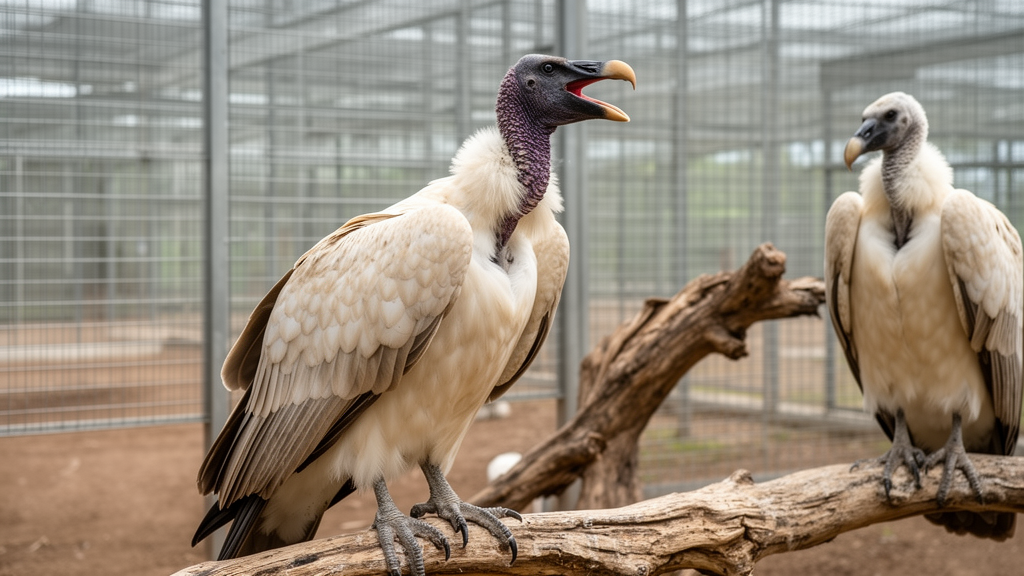
A peer-reviewed observational study reports that Rüppell’s vultures produce an extensive, graded vocal repertoire, with calls recorded from eggs, chicks and adults in captive settings. Published in PLOS One as “The complex, graded vocal repertoire of the social Rüppell’s vulture,” the study characterizes the species as highly social and proposes that this lifestyle might help explain the variety of its vocalizations. The authors present the social explanation as a possibility rather than a tested cause, and the observations were confined to birds at two Dutch institutions rather than free-ranging populations.

Researchers collected data from September 2024 to May 2025 at Vogelpark Avifauna and Diergaarde Blijdorp in the Netherlands. A camera-and-microphone system mounted on a tripod documented general group activity and feeding. A separate nest microphone enabled passive monitoring of parent–chick vocalizations in nest 3, while the incubation-room setup captured vocalizations associated with the hatching process.

Other recordings were obtained during veterinary procedures, including a one-month-old chick being ringed and weighed. These approaches placed microphones in different settings, allowing the study to cover developmental stages and contexts ranging from close handling to group activity and caregiving. The recordings included pre-hatching vocalizations from an internally pipped egg identified as 25G4.

The researchers also recorded the same chick at one month of age during a veterinary procedure, as well as a nest-camera sequence showing its mother, Ayla, feeding it. Chick 25G15 was recorded in the incubation room one day after hatching and while breaking through the shell of its egg. Together, the material documents vocal behavior across egg, chick and adult stages and includes both direct vocalizations and recorded interactions such as parent–chick exchanges, group activity and feeding.

The central result is that Rüppell’s vulture vocalizations form a complex repertoire with graded variation. The research frames the species’ social behavior—group living, feeding interactions and parent–chick communication—as a possible factor contributing to that complexity, but the captive observational design does not establish why the repertoire developed or whether the same patterns occur throughout wild populations. Its contribution is therefore a detailed characterization of calls and call contexts using complementary recording methods across the early life cycle.

Because the observations came from particular birds at two institutions, the findings should be interpreted as evidence about the repertoire documented in those settings rather than a complete census of Rüppell’s vulture vocal behavior in nature.

Subject of Research: Vocal repertoire and social behavior in captive Rüppell’s vultures

Article Title: Rüppell’s vultures have an impressively extensive vocal repertoire, which might be driven by the highly social behavior of this critically endangered species

Article References: Rüppell’s vultures have an impressively extensive vocal repertoire, which might be driven by the highly social behavior of this critically endangered species. Original publication (Bibliographic details unavailable.)

Image Credits: AI Generated

DOI: Not provided

Keywords: Rüppell’s vulture, vocal repertoire, animal communication, bioacoustics, social behavior, parent–chick communication, captive birds, conservation, PLOS One, ppell, vultures, impressively

Cite Scienmag News

Drew Townsend. (October 26, 2026). Captive Rüppell’s vultures display extensive, graded vocal repertoires. Scienmag. https://scienmag.com/captive-ruppells-vultures-display-extensive-graded-vocal-repertoires/

Drew Townsend. "Captive Rüppell’s vultures display extensive, graded vocal repertoires." Scienmag, 26 October 2026, https://scienmag.com/captive-ruppells-vultures-display-extensive-graded-vocal-repertoires/. Accessed 26 October 2026.

Drew Townsend. "Captive Rüppell’s vultures display extensive, graded vocal repertoires." Scienmag. October 26, 2026. https://scienmag.com/captive-ruppells-vultures-display-extensive-graded-vocal-repertoires/


Tags: animal communicationavian communication in social raptorsbioacousticsbird vocalizations during incubation and feedingcaptive bird vocalization studiescaptive birdscaptive versus wild bird vocalization researchconservationgraded vocal communication in birdsimpact of social lifestyle on bird callsimpressivelymonitoring bird behavior with microphone technologyobservational study of vulture communicationparent–chick communicationPLOS OneppellRüppell’s vultureRüppell’s vulture vocal repertoiresocial behaviorsocial behavior of vulturesvocal development in raptor speciesvocal repertoirevocal repertoire of endangered vulturesvultures
Share26Tweet16
Previous Post

Edited book reviews heterocyclic approaches in anticancer drug research

Next Post

Attention pooling trims batch-one GPU memory by 62% in transformer hashing

Related Posts

Digital-twin model identifies two candidate drugs for delaying preterm labor
Biology

Digital-twin model identifies two candidate drugs for delaying preterm labor

October 26, 2026
Selective antifungal outperformed amphotericin B in mice without kidney injury
Biology

Selective antifungal outperformed amphotericin B in mice without kidney injury

October 26, 2026
Warm-climate tracking may have helped crocodilian relatives survive the dinosaur extinction
Biology

Warm-climate tracking may have helped crocodilian relatives survive the dinosaur extinction

October 26, 2026
Observational study reveals complex calls in endangered Rüppell’s vultures
Biology

Observational study reveals complex calls in endangered Rüppell’s vultures

October 26, 2026
Autism-risk mouse models reveal two opposing brain states
Biology

Autism-risk mouse models reveal two opposing brain states

October 26, 2026
Stem Cell Reports appoints Bonnet and Relaix as associate editors
Biology

Stem Cell Reports appoints Bonnet and Relaix as associate editors

October 26, 2026
Next Post
Attention pooling trims batch-one GPU memory by 62% in transformer hashing

Attention pooling trims batch-one GPU memory by 62% in transformer hashing

  • Mothers who receive childcare support from maternal grandparents show more optimized

    Mothers who receive childcare support from maternal grandparents show more parental warmth, finds NTU Singapore study

    27656 shares
    Share 11059 Tweet 6912
  • University of Seville Breaks 120-Year-Old Mystery, Revises a Key Einstein Concept

    1061 shares
    Share 424 Tweet 265
  • Bee body mass, pathogens and local climate influence heat tolerance

    682 shares
    Share 273 Tweet 171
  • Researchers record first-ever images and data of a shark experiencing a boat strike

    546 shares
    Share 218 Tweet 137
  • Groundbreaking Clinical Trial Reveals Lubiprostone Enhances Kidney Function

    531 shares
    Share 212 Tweet 133
Science

Embark on a thrilling journey of discovery with Scienmag.com—your ultimate source for cutting-edge breakthroughs. Immerse yourself in a world where curiosity knows no limits and tomorrow’s possibilities become today’s reality!

RECENT NEWS

  • Attention pooling trims batch-one GPU memory by 62% in transformer hashing
  • Captive Rüppell’s vultures display extensive, graded vocal repertoires
  • Edited book reviews heterocyclic approaches in anticancer drug research
  • Research report: Robotic lab sets up and runs optics experiments on demand

Categories

  • Agriculture
  • Anthropology
  • Archaeology
  • Athmospheric
  • Biology
  • Biotechnology
  • Blog
  • Bussines
  • Cancer
  • Chemistry
  • Climate
  • Earth Science
  • Editorial Policy
  • Marine
  • Mathematics
  • Medicine
  • Pediatry
  • Policy
  • Psychology & Psychiatry
  • Science Education
  • Science News
  • Social Science
  • Space
  • Technology and Engineering

Subscribe to Blog via Email

Enter your email address to subscribe to this blog and receive notifications of new posts by email.

Join 5,151 other subscribers

© 2025 Scienmag - Science Magazine

Welcome Back!

Login to your account below

Forgotten Password?

Retrieve your password

Please enter your username or email address to reset your password.

Log In
No Result
View All Result
  • HOME
  • SCIENCE NEWS
  • CONTACT US

© 2025 Scienmag - Science Magazine

Discover more from Science

Subscribe now to keep reading and get access to the full archive.

Continue reading