


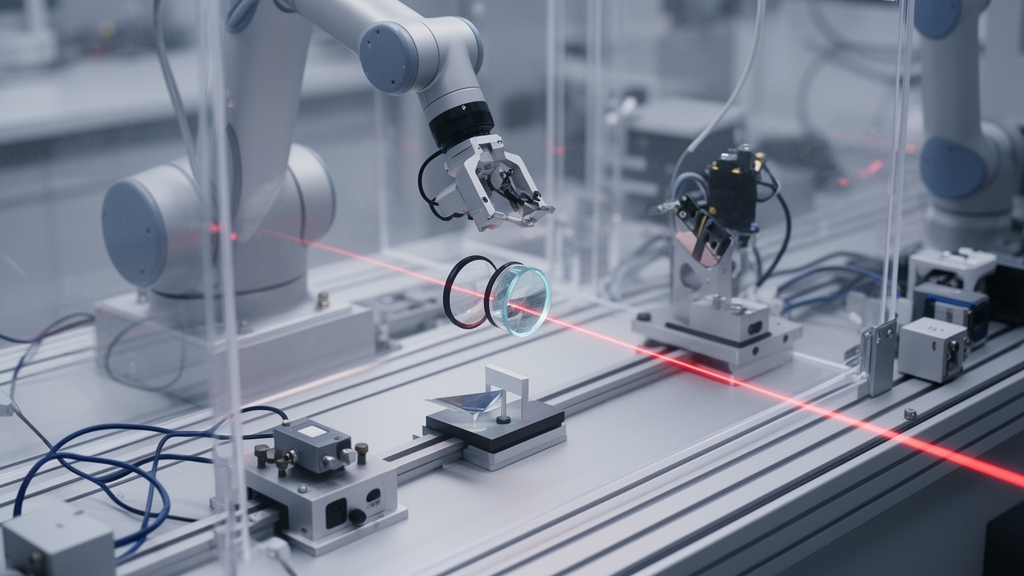
MIT engineers have developed a reconfigurable robotic laboratory that can assemble optical components from scratch, align them with micron-scale precision and maintain a working laser despite physical disturbances. In a tabletop demonstration, a seven-jointed robotic arm performed 50 autonomous maneuvers within 30 minutes to construct a functional laser cavity from two mirrors and a light-amplifying crystal. The system also detected disturbances and automatically repositioned components to preserve the laser’s intensity.
The result is a laboratory prototype designed to take over the repetitive setup and continuous adjustment required for precision optics experiments without manual intervention. Optical experiments underpin the development of technologies including phone and television displays, cameras, solar cells, sensors, augmented- and virtual-reality devices and quantum systems. Researchers conducting these experiments must position and tune lasers, mirrors, lenses, cameras and other instruments in exact arrangements.
According to the MIT team, some manually prepared setups take days or months, depending on their complexity, and the work must be repeated when the configuration changes. Motorized tuners can automate individual adjustments, but the team aimed to automate the complete sequence, from an unconfigured table to a fully aligned setup, while also enabling one experiment to be dismantled and another assembled from the same parts. The system centers on a robotic arm with seven movable joints attached to a metallic tabletop.
The robot picks up and places lenses, mirrors and other optical components, each of which is installed in a custom 3D-printed plastic housing. These housings allow the arm to grip, transport and release each item safely. A QR code etched into the top of every housing identifies the component and contains information such as whether it is a lens or a mirror, along with its exact dimensions and capabilities.
Each housing also has a magnetic base that helps stabilize the component after the arm places it on the table. The standardized physical format supplies the robot with information about what an item is and how it can be handled, while the shared work surface allows different experimental arrangements to be reconstructed. Fine alignment is handled by a separate Wi-Fi-enabled fine-adjustment tool that clips onto the mounts of standard optical components.
The motorized tool can wirelessly turn adjustment knobs, such as those used to change a mirror’s angle. The researchers said the tool is at least as precise as human adjustment and, in practice, much more precise. Two cameras above the table provide a bird’s-eye view of the experimental arrangement.
Together with the robotic arm and fine-adjustment tool, a software stack directs every stage of setup and tuning. Its functions include recognizing a specified component, determining how to approach and pick it up safely, selecting where to move it, avoiding collisions with other parts of the experiment and continuously adjusting the completed configuration. In the remote user interface, an experimenter can drag the icon for a mirror to a new position and confirm the change, after which the robot moves the corresponding physical mirror to that location on the table.
To demonstrate the platform, the researchers instructed the robot to assemble a laser cavity, an arrangement in which two mirrors flank a crystal and a beam of light travels repeatedly between them. With each pass, the light also crosses the crystal, which amplifies its intensity until the light escaping the setup is intense enough to form a laser. Co-lead author Seou Choi said the team selected an optics demonstration that was reasonably challenging because it requires extensive alignment and substantial knowledge of the components.
According to the report, it was not a task a new trainee could complete in an afternoon. The robot nevertheless positioned and tuned the parts through 50 autonomous maneuvers, producing a functional cavity within 30 minutes. The work is a tabletop proof of concept rather than a demonstration across a broad collection of optical instruments or experimental arrangements.
Beyond assembling the apparatus, the system was designed to recover its configuration when performance deteriorated. The researchers physically disturbed the setup, including moving a component randomly on the table, and the robot readjusted the arrangement to maintain the laser’s intensity. This self-recovery function addresses a persistent problem in optical experiments: even tiny vibrations or temperature changes can degrade performance and potentially cause valuable data to be lost before it is gathered.
The demonstrated procedure therefore did more than place equipment. It repeatedly evaluated the operating state of the cavity and changed component positions in response to deterioration. The report described this behavior in the tabletop laser-cavity demonstration and did not establish how the system would perform with every possible optical configuration or under long-term operation.
The researchers are expanding the platform both physically and virtually. Their current plans include improving the system’s physical sensing, maneuvering and overall working space. They are also developing a cloud-based application that would give users virtual access to the physical robot through a simple interface.
In the longer-term vision, scientists anywhere could remotely submit experimental protocols or questions that a robotic laboratory would then set up and run autonomously. The developers also envisage pairing tabletop systems with a nearby library of physical components fetched and delivered by another robot. Such an arrangement could build and run experiments, dismantle them and establish new configurations on demand, or continuously monitor an experiment that requires active attention around the clock.
These capabilities remain developmental; the report does not present remote cloud access or a component-delivery service as operational systems available to outside researchers. The team is already using the robotic laboratory to investigate promising carbon-capture materials. By illuminating those materials with light having specified properties, the researchers can obtain information about how a material absorbs carbon dioxide.
The broader aim is to accelerate testing of advanced materials for energy, imaging, sensing and other optical applications. The developers say robotic laboratories could help industry evaluate prototypes more quickly, including products involving cameras, displays, solar cells and augmented- or virtual-reality goggles. These are proposed applications rather than measured commercial results.
The demonstrated work concerns the robotic platform and its tabletop laser-cavity tasks, while the cloud interface, physical sensing, maneuvering, workspace and possible integration with a component library remain under development. Several constraints define the project’s current stage. The system was shown with one tabletop setup and standard optical components held in machine-readable housings, rather than with an arbitrary collection of laboratory equipment.
The report does not provide timing comparisons with manual assembly, quantitative improvements in experimental accuracy or results from independent users, so it does not establish how much time the system would save in a working research laboratory. Nor does the laser-cavity demonstration show that the robot can execute the full range of experiments envisioned for a remote automated facility. Named “A Framework for Closed-Loop Robotic Assembly, Alignment and Self-Recovery of Precision Optical Systems,” the research was slated for presentation at the Intelligent Robots and Systems conference in September 2026.
Its demonstrated advance is an integrated system that can assemble, tune and recover a precision optical setup, offering a concrete step toward laboratories capable of reconfiguring and running optics experiments on demand.
Subject of Research: Closed-loop robotic assembly, alignment and self-recovery of precision optical systems
Article Title: Robotic lab sets up and runs optics experiments on demand
Article References: Robotic lab sets up and runs optics experiments on demand. Original publication (Bibliographic details unavailable.)
Image Credits: AI Generated
DOI: Not provided
Keywords: robotic laboratory, automated science, optics experiments, laser cavity, robotic assembly, precision alignment, self-recovery systems, carbon-capture materials, MIT engineering, Robotic, sets, runs
Cite Scienmag News
Katie Riggs. (October 26, 2026). Research report: Robotic lab sets up and runs optics experiments on demand. Scienmag. https://scienmag.com/research-report-robotic-lab-sets-up-and-runs-optics-experiments-on-demand/
Katie Riggs. "Research report: Robotic lab sets up and runs optics experiments on demand." Scienmag, 26 October 2026, https://scienmag.com/research-report-robotic-lab-sets-up-and-runs-optics-experiments-on-demand/. Accessed 26 October 2026.
Katie Riggs. "Research report: Robotic lab sets up and runs optics experiments on demand." Scienmag. October 26, 2026. https://scienmag.com/research-report-robotic-lab-sets-up-and-runs-optics-experiments-on-demand/


