


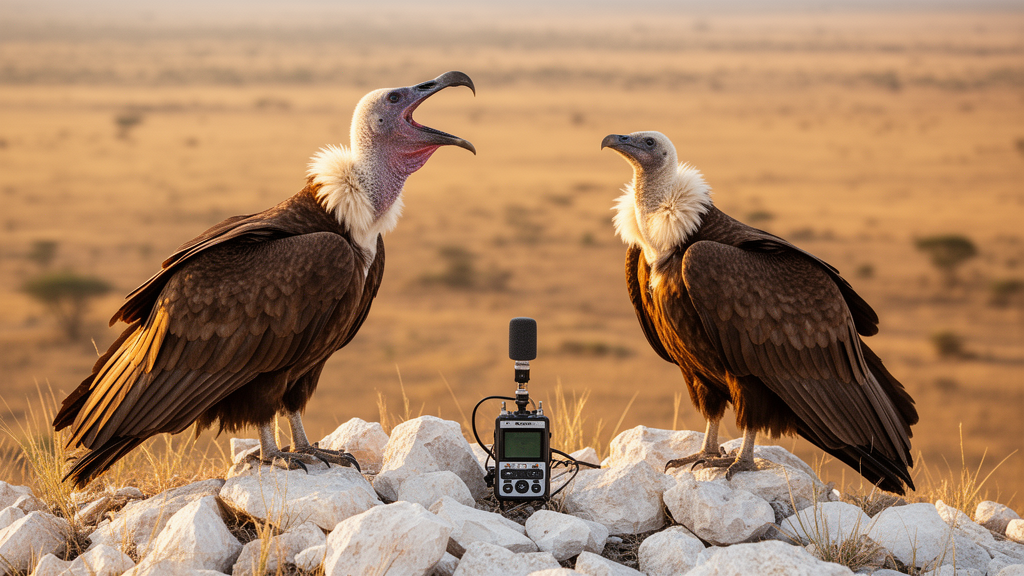
Rüppell’s vultures produce a broad and variable repertoire of calls, according to an observational study of the critically endangered species published in PLOS One. Connor Proudfoot and his colleagues recorded 2,500 vocalizations from adults, chicks and eggs at two colonies in the Netherlands, identifying 16 distinct call types. Some calls were clearly separated from one another, while others blended into graded variations. The findings show that the birds have a complex vocal repertoire, although the study did not determine the precise function or meaning of every call.
Proudfoot conducted the work for his master’s thesis in Jorg Massen’s Vulture Cognition Lab at Utrecht University. He spent 150 hours recording Rüppell’s vultures at Diergaarde Blijdorp in Rotterdam and at Avifauna in Alphen aan den Rijn. Because eggs at Blijdorp were incubated artificially, the researchers were also able to record vocalizations from eggs and chicks. Each sound was analyzed individually for its duration, pitch and number of distinct syllables, or notes. Those measurements allowed the team to classify the recordings into 16 call types and assess the variability within them.
The number of call types exceeded the average reported for birds. Proudfoot cited a study of more than 800 bird species that found an average of six to eight calls per species, compared with 16 in Rüppell’s vultures. Variation within those types was also notable: some were distinct, whereas others shifted or blended together. “That blending of calls shows there is flexibility in how the birds communicate,” Proudfoot said. “For example, they can convey not just that they are excited, but also how excited they are.” The authors characterized the result as a graded vocal repertoire rather than a simple set of fixed signals, but the observational scope means that the information carried by particular calls was not directly established.
Rüppell’s vultures live in the Sahel and East Africa and breed in colonies of up to 1,000 birds. Within these groups, some individuals rank higher than others, smaller groups may forage together, and dozens of vultures can encounter one another while competing for access to a carcass. The researchers proposed that such social complexity may be associated with sophisticated communication, but the study focused on describing the vocal repertoire rather than experimentally testing how each sound changes birds’ behavior. The authors also suggested that the findings could support comparisons among vulture species that occupy similar environments and consume similar food but differ in social organization. Additional species would need to be studied to test whether the relationship between sociality and vocal complexity observed in primates also applies more broadly to vultures.
The study identified two possible applications for captive conservation, neither of which was tested as an intervention. Chicks began vocalizing inside the egg two days before hatching. Because eggs in zoos are often incubated artificially, parents may not hear these early calls and could be less prepared for the chick’s arrival; playing recordings might potentially improve parental preparation and successful rearing, but that possibility requires further evaluation. The researchers also proposed that sounds made by a mating pair could encourage other pairs to mate, suggesting that playback of pair sounds might help stimulate breeding in captive populations. These are potential applications based on the observed vocal behavior, not demonstrated improvements in captive breeding. The study instead establishes that endangered Rüppell’s vultures communicate with at least 16 recognizable call types and substantial variation among them, providing a foundation for future work on the information those calls convey and whether they can be used effectively in conservation programs.
Subject of Research: Acoustic communication and vocal-repertoire complexity in endangered Rüppell’s vultures
Article Title: ‘Silent’ vultures turn out to use a wide range of sounds to communicate
Article References: ‘Silent’ vultures turn out to use a wide range of sounds to communicate. Original publication (Bibliographic details unavailable.)
Image Credits: AI Generated
DOI: Not provided
Keywords: Rüppell’s vulture, animal communication, vocalization, bioacoustics, social behavior, conservation, captive breeding, bird cognition, observational study, PLOS One, Silent, vultures
Cite Scienmag News
Drew Townsend. (October 26, 2026). Observational study reveals complex calls in endangered Rüppell’s vultures. Scienmag. https://scienmag.com/observational-study-reveals-complex-calls-in-endangered-ruppells-vultures/
Drew Townsend. "Observational study reveals complex calls in endangered Rüppell’s vultures." Scienmag, 26 October 2026, https://scienmag.com/observational-study-reveals-complex-calls-in-endangered-ruppells-vultures/. Accessed 26 October 2026.
Drew Townsend. "Observational study reveals complex calls in endangered Rüppell’s vultures." Scienmag. October 26, 2026. https://scienmag.com/observational-study-reveals-complex-calls-in-endangered-ruppells-vultures/


