


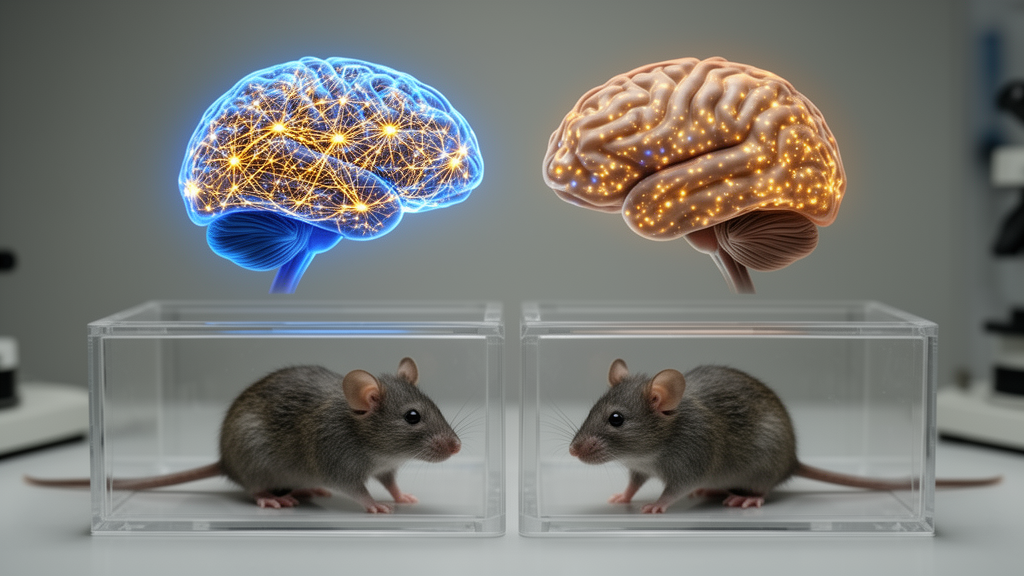
A comparative analysis of more than 1,000 mouse brain transcriptomes found that mutations associated with autism spectrum disorder can produce two broadly opposing patterns of brain gene activity despite substantial genetic diversity. Researchers examined 17 engineered mouse lines and identified one group with generally reduced expression of genes involved in synaptic communication and increased activity in chromatin-regulation and RNA-processing programs. The second group displayed the reverse configuration.
The classification also varied with sex, developmental stage and brain region, showing that the groups represent context-dependent molecular states rather than fixed categories assigned to individual mutations. The experimental study suggests that different autism-risk genes may converge on a limited number of recurring brain states, a framework that could help investigators compare shared biology across genetically distinct models. The research was led by Professor Kim Eunjoon of the Center for Synaptic Brain Dysfunctions within the Institute for Basic Science.
The team used RNA-sequencing data from the prefrontal cortex of mice carrying mutations in genes involved in synaptic communication, regulation of gene expression and cell signaling. Both male and female animals were included, together with groups exposed during early postnatal development to fluoxetine or lithium. By placing many genetic models into one analysis, the researchers sought to determine whether distinct autism-risk mutations generated shared molecular changes that might remain difficult to recognize when individual mutations or small collections of models are studied.
Co-corresponding author Bae Mihyun said the results suggest that many different mutations converge into a limited number of molecular brain states, providing a framework for understanding autism through shared biology rather than individual genes alone. Several complementary analyses supported the two-group classification. The researchers compared patterns of gene expression, RNA splicing and networks of genes that tend to be active together.
In the first molecular group, genes linked to communication between nerve cells generally had lower expression, whereas genes associated with chromatin regulation and RNA processing had higher expression. The second group displayed the opposite configuration. Because the distinction appeared across multiple forms of molecular analysis, the team interpreted the groups as recurring patterns of molecular change rather than an artifact produced by one analytical method.
The finding does not mean that every autism-associated gene produces the same effect, nor does it imply a simple one-gene, one-state correspondence. Instead, the results indicate that diverse mutations can alter broad cellular programs in contrasting ways, making it possible to compare several models through their downstream molecular signatures. Mutation alone did not fully determine which pattern an animal displayed.
In seven of the 17 mouse lines, males and females carrying the same mutation were assigned to different molecular groups. The pattern also changed during development: when four representative lines were examined at a later developmental stage, some retained their earlier group assignments while others switched. The distinction between the two states was much less pronounced in the hippocampus than in the prefrontal cortex.
These observations indicate that the molecular effects associated with an autism-risk mutation can depend on sex, developmental stage and anatomical location. The classification is therefore not a permanent property of a mutation or gene. It describes patterns observed under particular experimental conditions, and a model classified in one context may not retain the same assignment when those conditions change.
The team next investigated the cellular basis of the opposing profiles by analyzing gene expression in approximately one million individual cell nuclei from 205 mice. Both molecular groups showed distinct patterns of activity across several types of brain cells. The first group also exhibited broader changes in the relative proportions of certain neuronal and glial populations, while the second group showed a more moderate degree of cellular remodeling.
The results suggest that the two transcriptomic patterns involve coordinated changes across multiple cell populations rather than being attributable to a single neuronal class. The experimental drugs did not reverse the observed differences in cell-population proportions. Responses to fluoxetine, commonly known by the brand name Prozac, and lithium also differed between the molecular groups.
Both drugs have previously been investigated in selected mouse models for effects on autism-related behaviors, but neither is an established treatment for the core features of autism. In the first group, exposure shifted certain sets of genes more consistently toward expression patterns observed in control mice. The second group showed more variable responses, and the effects differed according to the gene set and cell type examined.
Rather than reversing the broader differences in neuronal and glial population proportions, the drugs acted mainly on particular gene-expression programs, including those in selected neuronal populations. These results suggest that molecular grouping could help investigators compare drug responses across genetically diverse mouse models and identify possible reasons for differences in experimental effects. They do not demonstrate that the drugs improved behavior or established their clinical effectiveness for autism.
To examine whether the classification extended beyond the original experimental set, the researchers studied three additional mouse lines and analyzed previously collected prefrontal-cortex transcriptomic data from 40 autistic individuals and 17 neurotypical controls. The additional mouse lines could be provisionally assigned to the two molecular groups, providing further support for the framework within the animal models. The human dataset also contained two subgroups with opposing patterns of synaptic gene activity.
That parallel suggested that contrasting molecular states may recur across species, but the correspondence was incomplete. Immune-related pathway changes were more prominent in the human samples, while some other molecular differences were less pronounced than in mice. The available human data also could not be used to connect subgroup membership to specific autism-risk mutations.
The findings remain preliminary and do not establish two clinical types of autism. The study did not show that the molecular groups can predict an individual’s symptoms, support needs or response to medication. Its primary experiments were conducted in genetically engineered mice, while the human comparison relied on previously collected transcriptomic data rather than an experimental intervention.
The researchers emphasized that their framework is intended to organize shared molecular mechanisms, not to replace the study of particular genes or genetic causes. Differences between species, brain regions, developmental stages and sex also limit direct transfer of the two-state pattern. The human analysis can therefore be viewed as evidence that comparable opposing subgroups can be detected in the available cortex data, not as a validated human classification system or demonstration of a treatment-selection tool.
Even with those limitations, the study offers a structured way for researchers to compare autism-related biology across distinct genetic models. Instead of treating each risk mutation as an isolated case, investigators can ask whether it produces a recognizable synaptic, chromatin, RNA-processing or cell-population signature. The framework may also help explain why fluoxetine and lithium produce different molecular effects in different models, while preserving the distinction between altered gene expression and restored behavior.
Future work would need to combine transcriptomic profiles with behavioral measurements, brain-circuit studies and additional experimental treatments to determine whether the two molecular states have functional significance or can contribute to therapy development and evaluation. Until that evidence is available, the strongest conclusion is that the study identifies two opposing, context-dependent transcriptomic patterns across autism-risk mouse models, with preliminary but imperfect parallels in human cortex samples.
Subject of Research: Transcriptomic classification of brain states in autism-risk mouse models
Article Title: Autism-risk mutations reveal two opposing patterns of brain gene activity
Article References: Autism-risk mutations reveal two opposing patterns of brain gene activity. Original publication (Bibliographic details unavailable.)
Image Credits: AI Generated
DOI: Not provided
Keywords: autism spectrum disorder, autism-risk mutations, mouse models, brain transcriptomics, RNA sequencing, synaptic genes, single-cell analysis, fluoxetine, lithium, human cortex, prefrontal cortex, Autism-risk
Cite Scienmag News
Juliet Wilcox. (October 26, 2026). Autism-risk mouse models reveal two opposing brain states. Scienmag. https://scienmag.com/autism-risk-mouse-models-reveal-two-opposing-brain-states/
Juliet Wilcox. "Autism-risk mouse models reveal two opposing brain states." Scienmag, 26 October 2026, https://scienmag.com/autism-risk-mouse-models-reveal-two-opposing-brain-states/. Accessed 26 October 2026.
Juliet Wilcox. "Autism-risk mouse models reveal two opposing brain states." Scienmag. October 26, 2026. https://scienmag.com/autism-risk-mouse-models-reveal-two-opposing-brain-states/


