

Monday, October 26, 2026
Science
No Result
View All Result
  • Login
  • HOME
  • SCIENCE NEWS
  • CONTACT US
  • HOME
  • SCIENCE NEWS
  • CONTACT US
No Result
View All Result
Scienmag
No Result
View All Result
Home Science News Psychology & Psychiatry

Cross-sectional EEG study identifies two adolescent depression subgroups

October 26, 2026
in Psychology & Psychiatry
Glenn Wilkins
By Glenn Wilkins Scienmag Editorial Profile - Clinical Psychology
Reading Time: 2 mins read
0
Cross-sectional EEG study identifies two adolescent depression subgroups

Cross-sectional EEG study identifies two adolescent depression subgroups

65
SHARES
587
VIEWS
Share on FacebookShare on Twitter
ADVERTISEMENT

Adolescents with major depressive disorder showed weaker connectivity between the default mode and limbic brain networks than healthy peers in a cross-sectional case-control study that combined resting-state EEG with childhood-trauma histories and depressive symptoms. The researchers also used multivariate analyses to identify two patient subgroups with distinct symptom and brain-network profiles, providing a preliminary description of heterogeneity within adolescent depression.

The study, published in BMC Psychology, included 67 medication-free adolescents with major depressive disorder and 35 matched healthy controls. The investigators estimated source-space functional connectivity from resting-state EEG, then applied sparse canonical correlation analysis to examine combinations of brain-network connections alongside clinical and childhood-trauma measures. This method identifies correlated sets of connectivity features and psychological characteristics. Because the study was cross-sectional, its results describe associations in the sampled adolescents but do not establish that trauma or any particular connectivity pattern caused depression.

Only one sparse canonical correlation analysis mode met the prespecified robustness criteria. It linked physical abuse, emotional neglect, and anxiety or somatization with distributed connectivity features involving the frontoparietal, limbic, visual, and salience networks. These findings concern coordinated patterns across measures rather than a single neural signature that independently diagnoses depression. The article’s abstract does not report the sizes or clinical characteristics of the resulting subgroups in enough detail to determine whether they represent clinically useful subtypes or how common they might be beyond this sample.

Connectivity within the visual network moderated the association between childhood trauma and depression severity. In statistical terms, the strength of that association varied with within-visual-network connectivity. The result does not show that altered visual-network connectivity increases the risk of depression following trauma, nor does it show that changing connectivity could change symptoms. The investigators then applied K-means clustering to canonical variates derived from the sparse canonical correlation analysis, separating the adolescents with major depressive disorder into two groups with different combinations of symptoms and network characteristics.

These findings remain preliminary because the sample was small and the design could not track changes over time. Including only medication-free adolescents with major depressive disorder also limits generalization to adolescents receiving treatment and to other clinical or demographic populations. Independent replication in larger samples will be required to assess whether the connectivity pattern, moderation result, and two-cluster solution persist. Even so, the study shows how EEG-derived network measures can be analyzed jointly with trauma exposure and symptom dimensions to characterize adolescent major depressive disorder, without delivering a diagnostic test or a treatment.

Subject of Research: EEG brain-network connectivity, childhood trauma, and symptom heterogeneity in adolescent major depressive disorder

Article Title: Data-driven subgroups of adolescent depression: integrating EEG-derived brain networks, childhood trauma, and depressive symptoms

Article References: Liu, X., Zeng, Y., Lan, X., Zhang, M., Li, W., Luo, Z., Liu, G., Xue, Y., Ning, Y., & Zhou, Y. (2026). Data-driven subgroups of adolescent depression: integrating EEG-derived brain networks, childhood trauma, and depressive symptoms. BMC Psychology. https://doi.org/10.1186/s40359-026-05753-2

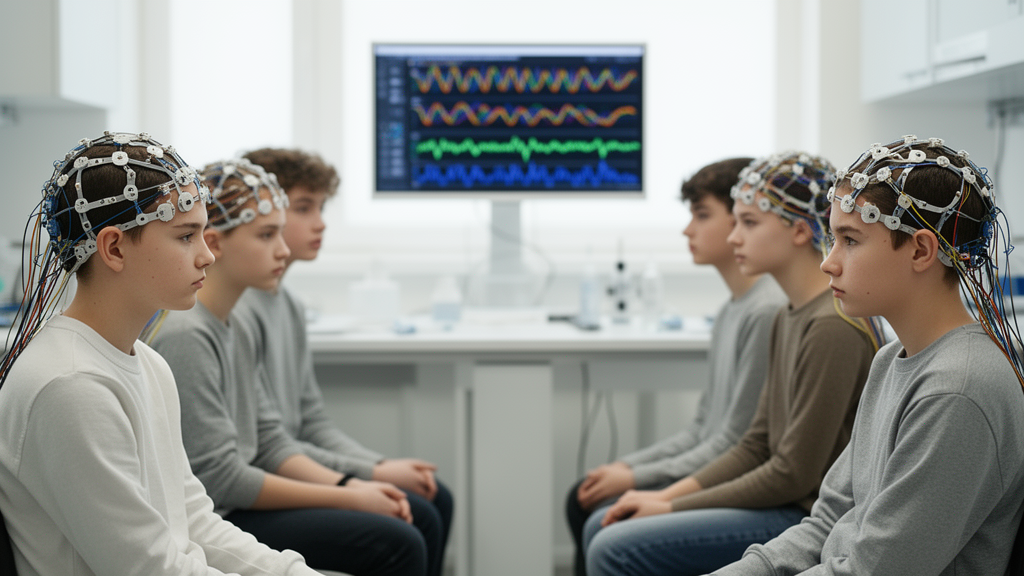
Image Credits: AI Generated

DOI: 10.1186/s40359-026-05753-2

Keywords: adolescent depression, electroencephalography, brain networks, childhood trauma, functional connectivity, depressive symptoms, data-driven subgroups, cross-sectional study, default mode network, limbic network, Data-driven, subgroups

Cite Scienmag News

Glenn Wilkins. (October 26, 2026). Cross-sectional EEG study identifies two adolescent depression subgroups. Scienmag. https://scienmag.com/cross-sectional-eeg-study-identifies-two-adolescent-depression-subgroups/

Glenn Wilkins. "Cross-sectional EEG study identifies two adolescent depression subgroups." Scienmag, 26 October 2026, https://scienmag.com/cross-sectional-eeg-study-identifies-two-adolescent-depression-subgroups/. Accessed 26 October 2026.

Glenn Wilkins. "Cross-sectional EEG study identifies two adolescent depression subgroups." Scienmag. October 26, 2026. https://scienmag.com/cross-sectional-eeg-study-identifies-two-adolescent-depression-subgroups/


Tags: adolescent depressionAdolescent depression subgroupsadolescent mental health neuroimagingbrain network alterations in depressionbrain networkschildhood traumaChildhood trauma and depressioncross-sectional studyData-drivendata-driven subgroupsDefault Mode Networkdefault mode network in depressiondepression symptom profiles and brain patternsdepressive symptomsEEG brain connectivityelectroencephalographyfunctional connectivitylimbic networklimbic system dysfunctionmultivariate brain-behavior analysisneural heterogeneity in adolescent depressionresting-state EEG analysissparse canonical correlation in neuroimagingsubgroups
Share26Tweet16
Previous Post

Survey maps AI exposure and concerns among Chinese endocrinologists and trainees

Next Post

Autism-risk mouse models reveal two opposing brain states

Related Posts

PTSD study identifies suicide-risk correlates in 80-person sample
Psychology & Psychiatry

PTSD study identifies suicide-risk correlates in 80-person sample

October 26, 2026
Systematic review categorizes volunteer motivation across 26 studies
Psychology & Psychiatry

Systematic review categorizes volunteer motivation across 26 studies

October 26, 2026
Prosocial Behavior Linked to Modestly Higher Maternal Happiness in Japanese Cohort
Psychology & Psychiatry

Prosocial Behavior Linked to Modestly Higher Maternal Happiness in Japanese Cohort

October 26, 2026
Chronic-pain status associated with stronger neutral-cue appraisals in 136 women
Psychology & Psychiatry

Chronic-pain status associated with stronger neutral-cue appraisals in 136 women

October 26, 2026
Lung transplant caregivers face multifaceted burdens and support needs
Psychology & Psychiatry

Lung transplant caregivers face multifaceted burdens and support needs

October 26, 2026
Meta-analysis finds counterintuitive mental-health links in rural youth
Psychology & Psychiatry

Meta-analysis finds counterintuitive mental-health links in rural youth

October 26, 2026
Next Post
Autism-risk mouse models reveal two opposing brain states

Autism-risk mouse models reveal two opposing brain states

  • Mothers who receive childcare support from maternal grandparents show more optimized

    Mothers who receive childcare support from maternal grandparents show more parental warmth, finds NTU Singapore study

    27656 shares
    Share 11059 Tweet 6912
  • University of Seville Breaks 120-Year-Old Mystery, Revises a Key Einstein Concept

    1061 shares
    Share 424 Tweet 265
  • Bee body mass, pathogens and local climate influence heat tolerance

    682 shares
    Share 273 Tweet 171
  • Researchers record first-ever images and data of a shark experiencing a boat strike

    546 shares
    Share 218 Tweet 137
  • Groundbreaking Clinical Trial Reveals Lubiprostone Enhances Kidney Function

    531 shares
    Share 212 Tweet 133
Science

Embark on a thrilling journey of discovery with Scienmag.com—your ultimate source for cutting-edge breakthroughs. Immerse yourself in a world where curiosity knows no limits and tomorrow’s possibilities become today’s reality!

RECENT NEWS

  • Autism-risk mouse models reveal two opposing brain states
  • Cross-sectional EEG study identifies two adolescent depression subgroups
  • Survey maps AI exposure and concerns among Chinese endocrinologists and trainees
  • First human Phase 1 data for AI-designed ISM6331 to be presented

Categories

  • Agriculture
  • Anthropology
  • Archaeology
  • Athmospheric
  • Biology
  • Biotechnology
  • Blog
  • Bussines
  • Cancer
  • Chemistry
  • Climate
  • Earth Science
  • Editorial Policy
  • Marine
  • Mathematics
  • Medicine
  • Pediatry
  • Policy
  • Psychology & Psychiatry
  • Science Education
  • Science News
  • Social Science
  • Space
  • Technology and Engineering

Subscribe to Blog via Email

Enter your email address to subscribe to this blog and receive notifications of new posts by email.

Join 5,151 other subscribers

© 2025 Scienmag - Science Magazine

Welcome Back!

Login to your account below

Forgotten Password?

Retrieve your password

Please enter your username or email address to reset your password.

Log In
No Result
View All Result
  • HOME
  • SCIENCE NEWS
  • CONTACT US

© 2025 Scienmag - Science Magazine

Discover more from Science

Subscribe now to keep reading and get access to the full archive.

Continue reading