


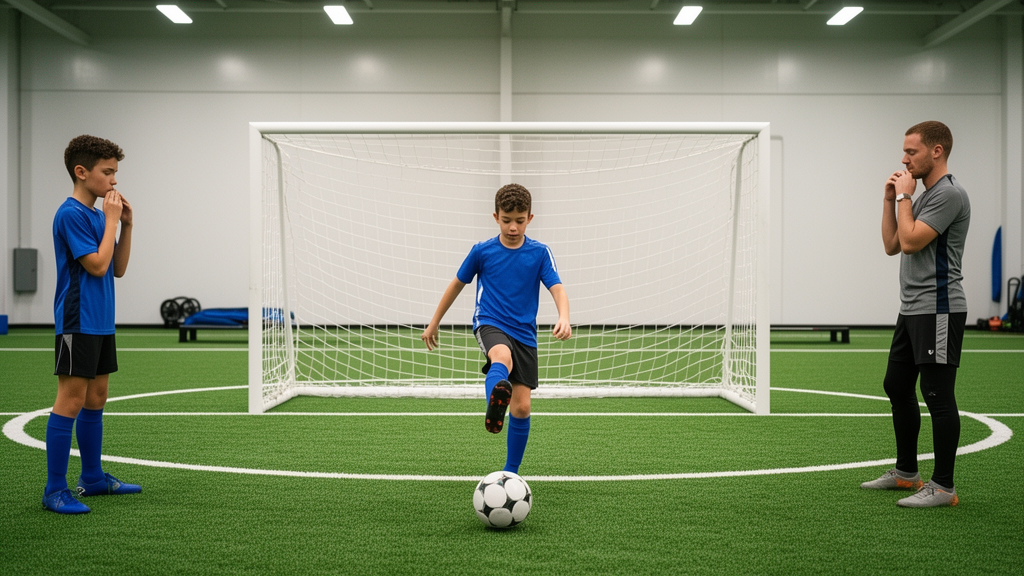
The research, published in BMC Psychology , was designed to compare the two psychological interventions rather than to test their effects in experienced or elite players. Participants completed three training sessions per week for four weeks, and their passing and goal-kicking skills were assessed before and after the intervention. Both intervention groups showed statistically significant within-group improvements in the two skills, whereas the control group showed no significant changes.
The trial randomly assigned the 60 players to PETTLEP imagery, mindfulness-based intervention, or control groups. The researchers analyzed pre- and post-intervention results from standardized soccer performance tests using analysis of covariance, or ANCOVA. For goal-kicking, the analysis found a significant difference among groups, with F(2, 55) = 31.54, p < 0.001 and a partial eta-squared of 0.53.
Passing performance also differed significantly among the groups, with F(2, 55) = 20.49, p < 0.001 and a partial eta-squared of 0.42. The statistical analysis therefore identified group differences in both outcomes, with the larger partial eta-squared occurring for goal-kicking. Bonferroni-adjusted comparisons clarified the pattern of those differences.
In the goal-kicking test, the PETTLEP group performed significantly better than the mindfulness group, p = 0.001, and also significantly better than the control group, p < 0.001. The same comparison favored PETTLEP imagery for passing: its performance exceeded that of the mindfulness group at p < 0.001 and that of the control group at p < 0.001. Mindfulness participants performed significantly better than controls for goal-kicking, p = 0.001, but the corresponding passing comparison did not reach the conventional statistical threshold, p = 0.077.
Together with the within-group results, these comparisons show that both interventions were followed by significant performance improvements, while the clearest separation between them appeared in favor of PETTLEP imagery. The control group’s lack of significant within-group change contrasts with the improvements recorded in both intervention groups. These results apply to a narrowly defined short-term training context: male novice soccer players between 10 and 14 years old who took part in one four-week program with three sessions each week.
It also does not show that the interventions affected actual match performance, injury risk, psychological well-being, participation, or long-term player development. The absence of girls, older players, younger children, and athletes with greater skill experience limits direct generalization. The findings therefore cannot determine whether PETTLEP imagery would outperform mindfulness in other populations, under longer programs, or among more experienced soccer players.
The authors characterized PETTLEP imagery as a potentially useful complementary approach for developing sport-specific skills in novice youth soccer players. That interpretation is consistent with the measured results, which place the intervention ahead of mindfulness and control in this sample, but the trial alone does not establish PETTLEP imagery as a universally superior method or establish that either intervention can substitute for technical soccer instruction. The authors proposed further research on long-term effects, applicability across age groups and skill levels, and possible combined use of PETTLEP imagery and mindfulness.
Until those questions are tested, the evidence supports a specific four-week result: among 60 novice male soccer players aged 10–14, PETTLEP imagery showed the strongest comparative performance results across standardized passing and goal-kicking tests.
Subject of Research: A randomized trial comparing PETTLEP imagery and mindfulness for passing and goal-kicking performance in novice male soccer players aged 10–14.
Article Title: Comparing the effects of PETTLEP imagery and mindfulness interventions on passing and goal-kicking performance in male novice soccer players (Ages 10–14): A randomized controlled study
Article References: Yousefi, M., & Khanmohammadi, R. (2026). Comparing the effects of PETTLEP imagery and mindfulness interventions on passing and goal-kicking performance in male novice soccer players (Ages 10–14): A randomized controlled study. BMC Psychology. https://doi.org/10.1186/s40359-026-05564-5
Image Credits: AI Generated
DOI: 10.1186/s40359-026-05564-5
Keywords: PETTLEP imagery, mindfulness, youth soccer, novice players, passing performance, goal-kicking, randomized trial, sports psychology, motor skills, Comparing, effects, PETTLEP
Cite Scienmag News
Glenn Wilkins. (October 26, 2026). Research report: Comparing the effects of PETTLEP imagery and mindfulness interventions on passing and goal-kicking performance in male novice soccer players (Ages 10–14): A randomized controlled study. Scienmag. https://scienmag.com/research-report-comparing-the-effects-of-pettlep-imagery-and-mindfulness-interventions-on-passing-and-goal-kicking-performance-in-male-novice-soccer-players-ages-10-14-a-randomized-control/
Glenn Wilkins. "Research report: Comparing the effects of PETTLEP imagery and mindfulness interventions on passing and goal-kicking performance in male novice soccer players (Ages 10–14): A randomized controlled study." Scienmag, 26 October 2026, https://scienmag.com/research-report-comparing-the-effects-of-pettlep-imagery-and-mindfulness-interventions-on-passing-and-goal-kicking-performance-in-male-novice-soccer-players-ages-10-14-a-randomized-control/. Accessed 26 October 2026.
Glenn Wilkins. "Research report: Comparing the effects of PETTLEP imagery and mindfulness interventions on passing and goal-kicking performance in male novice soccer players (Ages 10–14): A randomized controlled study." Scienmag. October 26, 2026. https://scienmag.com/research-report-comparing-the-effects-of-pettlep-imagery-and-mindfulness-interventions-on-passing-and-goal-kicking-performance-in-male-novice-soccer-players-ages-10-14-a-randomized-control/


