

Monday, October 26, 2026
Science
No Result
View All Result
  • Login
  • HOME
  • SCIENCE NEWS
  • CONTACT US
  • HOME
  • SCIENCE NEWS
  • CONTACT US
No Result
View All Result
Scienmag
No Result
View All Result
Home Science News Earth Science

Panchagavya compound improves salinity tolerance in rice seedlings

October 26, 2026
in Earth Science
Alan Morgan
By Alan Morgan Scienmag Editorial Profile - Precision Agriculture
Reading Time: 2 mins read
0
Panchagavya compound improves salinity tolerance in rice seedlings

Panchagavya compound improves salinity tolerance in rice seedlings

65
SHARES
587
VIEWS
Share on FacebookShare on Twitter
ADVERTISEMENT

A laboratory study combining chemical analysis, computational modelling and plant experiments found that 1-methyl palmitate isolated from the Panchagavya biostimulant enhanced salinity-stress tolerance in rice seedlings. Researchers reported changes in autophagy and programmed cell death pathways, together with increased expression of antioxidant-related genes, autophagy-related genes and transcription factors. The findings identify a defined molecular candidate through which at least part of the traditional formulation’s stress-response activity may be mediated.

Panchagavya, or PG, is a traditional bioorganic formulation used as a biostimulant in agricultural and veterinary applications. It is associated with plant growth and development, soil fertility, nutrient uptake and responses to environmental cues, but the identities of the bioactive compounds responsible for these reported effects have remained insufficiently resolved. The study therefore focused on standardized isolation and identification of PG constituents, providing a chemically defined set of candidates for further investigation.

The researchers used column chromatography to isolate four pure compounds from PG. They characterized the substances through electrospray ionization mass spectrometry and nuclear magnetic resonance analysis. In silico modelling and molecular docking were then used to examine interactions between the four compounds and eight rice autophagy proteins. The models indicated strong binding affinities for all four compounds, while 1-methyl palmitate produced the most promising interaction and was selected for biological evaluation in rice.

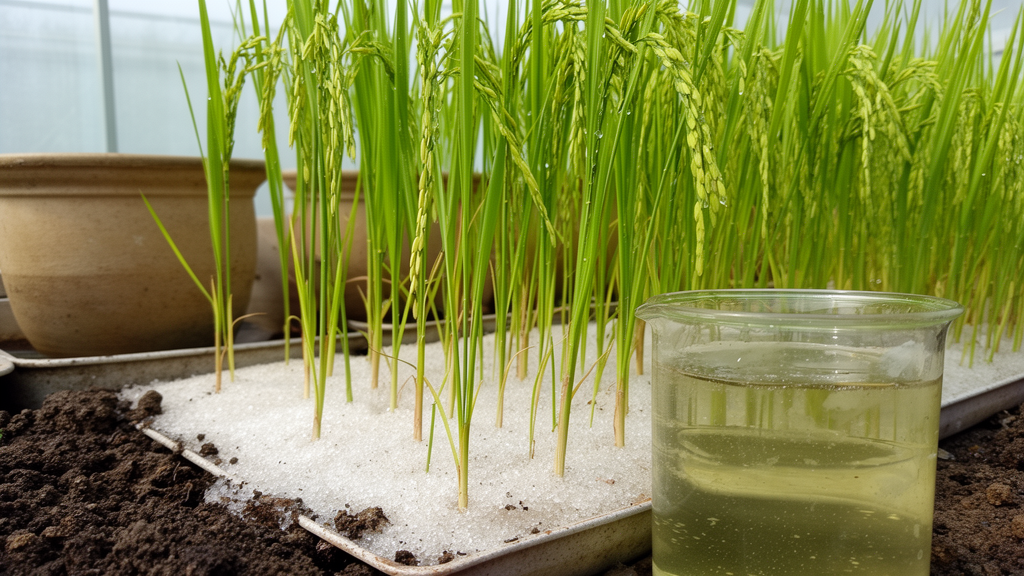
Rice seedlings exposed to saline conditions were assessed through biochemical, cellular and molecular analyses. According to the researchers, 1-methyl palmitate enhanced tolerance to salinity by positively regulating autophagy and programmed cell death, cellular processes that contribute to maintaining cellular balance under stress. The treatment was accompanied by significant upregulation of antioxidant genes, autophagy-related genes and transcription factors. These measured molecular responses were consistent with the reported improvement in the seedlings’ ability to cope with salt stress.

The results provide a mechanistic lead for studying how a constituent of Panchagavya may support plant stress tolerance. The authors connect the chemical profiling and seedling experiments to the formulation’s broader biostimulant role and to possible implications for fertilizer efficiency and sustainable food production. At the same time, the reported evidence concerns a selected compound tested in a controlled rice-seedling system, while the computational results describe predicted interactions with eight proteins. The study therefore establishes a testable candidate and a set of associated molecular responses rather than a complete account of how the full formulation acts in rice.

Subject of Research: Chemical isolation and evaluation of a Panchagavya compound associated with improved salinity tolerance in rice seedlings

Article Title: Chemical profiling and identification of bioactive compounds from biostimulant enhancing salinity tolerance in rice

Article References: Khan, M. S., & Hemalatha, S. (2026). Chemical profiling and identification of bioactive compounds from biostimulant enhancing salinity tolerance in rice. Discover Sustainability, 7(1), Article 1581. https://doi.org/10.1007/s43621-025-01802-9

Image Credits: AI Generated

DOI: 10.1007/s43621-025-01802-9

Keywords: rice seedlings, salinity stress, Panchagavya, 1-methyl palmitate, autophagy, programmed cell death, antioxidant genes, molecular docking, plant biostimulants, Chemical, profiling, identification

Cite Scienmag News

Alan Morgan. (October 26, 2026). Panchagavya compound improves salinity tolerance in rice seedlings. Scienmag. https://scienmag.com/panchagavya-compound-improves-salinity-tolerance-in-rice-seedlings/

Alan Morgan. "Panchagavya compound improves salinity tolerance in rice seedlings." Scienmag, 26 October 2026, https://scienmag.com/panchagavya-compound-improves-salinity-tolerance-in-rice-seedlings/. Accessed 26 October 2026.

Alan Morgan. "Panchagavya compound improves salinity tolerance in rice seedlings." Scienmag. October 26, 2026. https://scienmag.com/panchagavya-compound-improves-salinity-tolerance-in-rice-seedlings/


Tags: 1-methyl palmitateantioxidant geneantioxidant genesautophagychemicalchemical analysis of bioactive compounds in Panchagavyacomputational modelling of plant stress-related protein interactionsidentificationidentification of 1-methyl palmitate as stress-mitigating compoundisolation and characterization of bioactive compounds from Panchagavyamolecular dockingmolecular mechanisms of salinity stress response in ricePanchagavyaPanchagavya biostimulant in rice salinity tolerancePlant biostimulantsprofilingprogrammed cell deathrice seedlingsrole of autophagy and programmed cell death in plant stress adaptationsalinity stresstraditional bioorganic formulations for crop stress resilience
Share26Tweet16
Previous Post

51-country ecological study links ART coverage with lower AIDS mortality, 2010–2024

Next Post

Influenza subtypes show distinct meteorological drivers in Shanxi

Related Posts

Ethiopia field trial identifies highest chickpea yield at 30 × 5 cm spacing
Earth Science

Ethiopia field trial identifies highest chickpea yield at 30 × 5 cm spacing

October 26, 2026
Functional roles of Actinomycetota in agroecosystem resilience under climate and environmental stress
Earth Science

Functional roles of Actinomycetota in agroecosystem resilience under climate and environmental stress

October 26, 2026
Construction logistics research remains fragmented, systematic review finds
Earth Science

Construction logistics research remains fragmented, systematic review finds

October 26, 2026
Discover Sustainability marks five years of interdisciplinary growth
Earth Science

Discover Sustainability marks five years of interdisciplinary growth

October 26, 2026
Affordable seedlings and market access linked to agroforestry scaling in Ethiopia
Earth Science

Affordable seedlings and market access linked to agroforestry scaling in Ethiopia

October 26, 2026
Survey links financial and environmental perceptions to household biogas adoption
Earth Science

Survey links financial and environmental perceptions to household biogas adoption

October 26, 2026
Next Post
Influenza subtypes show distinct meteorological drivers in Shanxi

Influenza subtypes show distinct meteorological drivers in Shanxi

  • Mothers who receive childcare support from maternal grandparents show more optimized

    Mothers who receive childcare support from maternal grandparents show more parental warmth, finds NTU Singapore study

    27656 shares
    Share 11059 Tweet 6912
  • University of Seville Breaks 120-Year-Old Mystery, Revises a Key Einstein Concept

    1061 shares
    Share 424 Tweet 265
  • Bee body mass, pathogens and local climate influence heat tolerance

    682 shares
    Share 273 Tweet 171
  • Researchers record first-ever images and data of a shark experiencing a boat strike

    546 shares
    Share 218 Tweet 137
  • Groundbreaking Clinical Trial Reveals Lubiprostone Enhances Kidney Function

    531 shares
    Share 212 Tweet 133
Science

Embark on a thrilling journey of discovery with Scienmag.com—your ultimate source for cutting-edge breakthroughs. Immerse yourself in a world where curiosity knows no limits and tomorrow’s possibilities become today’s reality!

RECENT NEWS

  • Influenza subtypes show distinct meteorological drivers in Shanxi
  • Panchagavya compound improves salinity tolerance in rice seedlings
  • 51-country ecological study links ART coverage with lower AIDS mortality, 2010–2024
  • Global review projects shorebird losses from sea-level rise

Categories

  • Agriculture
  • Anthropology
  • Archaeology
  • Athmospheric
  • Biology
  • Biotechnology
  • Blog
  • Bussines
  • Cancer
  • Chemistry
  • Climate
  • Earth Science
  • Editorial Policy
  • Marine
  • Mathematics
  • Medicine
  • Pediatry
  • Policy
  • Psychology & Psychiatry
  • Science Education
  • Science News
  • Social Science
  • Space
  • Technology and Engineering

Subscribe to Blog via Email

Enter your email address to subscribe to this blog and receive notifications of new posts by email.

Join 5,151 other subscribers

© 2025 Scienmag - Science Magazine

Welcome Back!

Login to your account below

Forgotten Password?

Retrieve your password

Please enter your username or email address to reset your password.

Log In
No Result
View All Result
  • HOME
  • SCIENCE NEWS
  • CONTACT US

© 2025 Scienmag - Science Magazine

Discover more from Science

Subscribe now to keep reading and get access to the full archive.

Continue reading